How platforms like TikTok and Twitter are like life itself

Social platforms reflect people’s behaviors but unlike life, you can uninstall and stop visiting them.

TikTok and Twitter are often described as mirrors of life; chaotic, messy, sometimes brilliant, sometimes horrifying. But here’s the thing: life didn’t come with an “uninstall” button. These platforms do, sort of (you can remove the apps or stop visiting them altogether). And that makes it a lot harder to accept their messiness as something we just have to live with.

The harm they cause is undeniable. The misinformation, the rabbit holes, the amplification of violence and hate, it’s all right there, front and center. And because these aren’t immutable forces of nature but products of human design, it feels logical to think: Why not just turn them off? If a bridge kept collapsing under people’s feet, we’d stop letting people walk on it. If a factory was spewing toxins into the air, we wouldn’t celebrate the occasional mural painted on its walls, we’d shut the thing down.

But TikTok and Twitter aren’t just digital bridges or toxic factories, they’re also marketplaces, stages, classrooms, protest grounds, and cultural archives. They’ve been instrumental in amplifying marginalized voices, organizing grassroots movements, and spreading ideas that would’ve otherwise been silenced. Shutting them down wouldn’t just erase the harm, it would also erase the joy, the connection, the organizing power, and the little moments of humanity they enable.

That’s the tension we’re stuck with: the pull between “this is causing so much damage” and “this is doing so much good.” And it’s not a tension we can resolve cleanly, because both are true. These platforms are not neutral, they’re shaped by design choices, incentives, and algorithms that reward outrage, escalate conflict, and keep users scrolling no matter the emotional cost. But they’re also spaces where real, meaningful things happen, sometimes in spite of those same algorithms.

It’s easier to point fingers at the platforms themselves than to reckon with the fact that their messiness isn’t an anomaly, it’s a reflection. They thrive on the same things we do: conflict, validation, novelty, and the occasional hit of collective catharsis. The darkness they expose isn’t artificially generated, it’s drawn out from people who were always capable of it. TikTok and Twitter didn’t invent bad faith arguments, moral panic cycles, or performative empathy, they just turned them into highly optimized content formats.

That’s why it’s so tempting to reach for the “off” switch. Because these platforms don’t just show us other people’s mess, they show us our own. They force us to confront the uncomfortable reality that the world doesn’t just have ugliness, it produces it. And no matter how advanced our moderation tools get, or how many advisory panels are assembled, there’s no elegant way to algorithm our way out of human nature.

But accepting that doesn’t mean we stop holding these platforms accountable. They’re still products of human design, and every design choice, from the algorithm’s preferences to the placement of a “like” button, shapes behavior and incentives. The companies behind them can and should do better. But even if they do, the fundamental tension remains: these spaces are built on human behavior, and human behavior will always be messy.

Maybe the real discomfort isn’t just about what TikTok and Twitter are. It’s about what they reveal about us. The chaos, the harm, the brilliance, the joy, it’s all a reflection. And if we can’t figure out how to look at that reflection without flinching, no amount of platform reform is going to save us from ourselves.

P.S: Let me just add that I’m talking about the old Twitter, not the cesspool of unhinged miseducated misinformed mass of misguided white supremacists that it has increasingly become, a.k.a discount 4Chan. On top of that, outside of the English speaking sphere of the platform, the old Twitter still exists unbothered or unaffected by what’s happening outside of their spheres partly due to cultural differences, partly due to lack of relevance, partly due to language, and perhaps a handful of other reasons.

Adam Mosseri further clarifies position about news on Threads

Instagram and Threads Chief Adam Mosseri posted on Threads to clarify what people perceive to be suppression of news on the platform.

I don’t believe the IG team and especially leadership are sneaky or malicious in any way but it’s difficult to see this statement and take it at face value.

Just to clarify, and this is on me for not being specific enough in my language historically, we’re not trying to avoid being a place for any news. News about sports, music, fashion, culture is something we’re actively pursuing. Political news is the topic where are looking to be more careful. Politics is already very much on threads, and that’s okay, we’re just not looking to amplify it.

He said that the kind of news (and presumably other types of discussions) they want on the platform is around sports, music, fashion, and culture. They prefer those to be driving the conversation instead of hard news or politics which are not actually banned but they want to be “more careful” about those topics, presumably, and it’s my guess, because of how sensitive and delicate they can be, not to mention Meta’s issue and history with the news media in general.

Everything in life is about politics. Sports is a battleground for political ideologies (Colin Kaepernick, anyone?), the fashion scene is a statement of political allegiances (Cate Blanchett, we see you), and music is a hotbed of political discourse (where do I even start?). As for culture, oh boy, if it’s not a political minefield then what is?

These are hot button arenas rife with debates over subjects such as race, social justice, equality, opportunity, and exploitation—topics that Meta appears to prefer to avoid. It seems Meta’s ideal platform is one of superficial harmony and feel-good aesthetics, shunning the gritty realities of societal discourse in favor of saccharine content and elaborate platitudes.

The more fundamental issue

Choosing what topics to focus on isn’t even their main problem. The Threads platform’s algorithmic approach to content curation is fundamentally flawed, prioritizing stale content and undermining the user experience.

The default ‘For You’ feed is plagued by a glaring disconnect between user expectations and delivery, as it frequently surfaces posts that are either already two days old—a virtual eon in the text-based social media space—or irrelevant and unwanted. This not only diminishes the freshness of the feed but also calls into question the platform’s understanding of ‘relevancy,’ which is intrinsically tied to the timeliness of content.

Additionally, the apparently elusive ‘Following’ feed, which offers a chronological timeline, is marred by its clunky activation and its baffling tendency to revert to the ‘For You’ feed at random. This erratic behavior disrupts the user’s control over their own social media experience, forcing them back into a loop of outdated content.

Threads says it wants to be a conversation platform but its default feed still struggles to surface timely and relevant posts. It is certainly a challenge to algorithmically deliver content that matches everyone’s unique sets of interests, and it has to be algorithmically driven if they want to ensure people don’t miss posts that they may be interested.

Clearly it’s not impossible to run a purely chronologically driven feed because Twitter did it before and Mastodon, along with its ActivityPub gang, still do, but unless you’re chronically online, the likelihood of seeing posts that are published while you’re away is small.

Without an algorithm that can be tuned to identify your interests and serve you posts that match them you’ll have to rely on other people surfacing them to you either by replying to those posts or have someone repost them and for some people that works just fine but when you run a platform with the intention of keeping as much of people’s time and attention, an algorithm is necessary.

In essence, Threads still has some ways to go to address the critical issue of recency, leaving users drowning in a sea of irrelevance. The platform’s inability to provide a consistently up-to-date and relevant feed not only frustrates users but also undermines the very purpose of social media—to connect people with what matters to them, here and now.

A text based social platform is inherently different to one that’s based on images or videos. Usage on TikTok and Instagram are driven more by entertainment value while text platforms are about what’s happening. If Meta wants Threads to be a place for conversations, let people follow their interests, not just accounts, and tune the algorithm to lean heavier on recency.

X suffers from declining usage but you won’t hear that from Indonesians

NBC News has the stats from a few traffic monitoring companies showing the drop in usage and downloads of the former Twitter app.

In February, X had 27 million daily active users of its mobile app in the U.S., down 18% from a year earlier, according to Sensor Tower, a market intelligence firm based in San Francisco. The U.S. user base has been flat or down every month since November 2022, the first full month of Musk’s owning the app, and in total it’s down 23% since then, Sensor Tower said. 

The numbers were nearly as bad worldwide, as daily active users on the mobile app fell to 174 million in February, down 15% from a year earlier, the firm said. The worldwide user base has been flat or down every month during Musk’s tenure began except one, when it grew slightly in October and then resumed falling, according to Sensor Tower. 

Other social media apps experienced modest increases in their worldwide user bases during the same period, according to the research, with Snapchat growing 8.8%, Instagram 5.3%, Facebook 1.5% and TikTok 0.5%. Those apps all experienced declines over that period in the U.S., but none was as steep as the decline on X. 

X had “the most material decline in active users compared to its peers,” Abe Yousef, a senior insights analyst at Sensor Tower, wrote in a research report. 

The company also struggles to retain advertisers with 75% of the top 100 ceasing their spend on X. The kinds of ads you see on the site are now primarily cryptocurrency, AI apps, individuals promoting their own accounts, and other oddities.

While there’s no numbers shared for individual countries or markets, traffic and attention for the Indonesian market seems to remain high or at least visibly active, despite the exodus reported worldwide.

What’s happening in the US and most of the English speaking community doesn’t seem to affect the Indonesian speaking users who continue to post and have conversations on the platform.

Politics, entertainment, and daily life activities dominate the discourse in the market especially with the general election happening in February and the results only just announced on Wednesday. The local scene on X seems to remain healthy more than a year after the acquisition and just under a year after the platform was legally reestablished under X Corporation.

As the English speaking crowd slowly make their way to alternative platforms such as BlueSky, Threads, Mastodon, and other platforms on the social web, the bulk of the Indonesian crowd are mostly sticking to Instagram and TikTok in addition to X itself and major brands such as Bank Mandiri, BCA, Mitsubishi, Grab, Warner Music, and Indosat, are still buying spots on X.

There’s little to no push factor that will drive them away from the platform and no amount of pull will convince them to make a move. Unless there’s an existential threat to their presence on X or to X itself, it’s extremely unlikely for Indonesians on the platform to switch to another. The majority, especially the younger demographics, are already on TikTok and Instagram anyway because they prefer video platforms, which leaves text based alternatives a niche.

Media Companies are Suckers for Punishments 

I don’t understand why the media keep insisting on posting to this platform when they themselves admit that traffic from social media links have been dropping, and especially on X, they don’t bring significant audience.

The disdain that Musk has over media companies, especially ones that don’t kowtow to his whims, as well as his calls to publish directly on his platform or be deprioritized, should warrant enough reasons for them to cease using the platform as a traffic funnel.

They are not welcomed nor do they gain anything from staying around. As if having article titles removed from posts was not enough of a sign that Musk isn’t keen on driving traffic to news sites.

There’s no shortage of options for content distribution these days so pulling back from one  isn’t going to make a lot of difference.

TV can be Educational but Social Media Likely Harms Mental Health

Many people equate screen time or gadget use with addiction to smoking because they’re perceived as bringing far more harmful effects on health than any benefit but I’m a strong believer of context and what people (including kids) consume or use on their screens matter so much more than just the use itself because these devices can help if used the right way.

Separately, kids and adults also need to learn about control and ways to respond to certain triggers to reduce harmful effects.

Zuckerberg Says Threads has Almost 100 Million Monthly Users

The reports of Threads’s death have been greatly exaggerated. Just under 100 million monthly users in three months since launch is one hell of a feat. 

Is the claim dubious? Anyone can certainly question that since they have yet to show additional information such as the highly coveted “unregretted minutes” a certain other billionaire CEO seems to prefer, but Business Insider was reporting just a week ago that Threads has 33 million daily active users so 100 million active users in a month does sound plausible.

But what about all those people who told us that Threads is a graveyard, that nothing is happening because their posts get no engagement? Well, are they the ones that logged in back in July or August once or twice and then return a few months later without posting anything in between? They have no idea what’s happening. How much interaction have they done in Threads, did they just post and expect responses or have they interacted with people? Have they been asking their friends and followers to check out the place and stick around for a while?

Threads have added so many features and functions between launch period and now that it’s become a full fledged social network that feels like it’s been around for years. 

Sure, search is still limited to certain languages and markets, there’s no trending list, no lists, and no proper analytics, but there are separate feeds for Following and For You, can easily swap between accounts, log in on the web, post voice notes, follow every account mentioned in a single post all at once (makes Follow Fridays easier), quote posts, see basic stats per post, see quote posts and likes, follow and get notified of updates to any post for 24 hours, you can edit your posts and replies within five minutes of posting, and so on.

It’s still missing an API, however, which prevents many organizations, institutions, public figures, and businesses from using it with their social media admin tools. Perhaps that’s a big reason people think they can’t use it yet, but at nearly 100 million monthly users, it’s not a place for people to jump back in after months of absence and 

ask if there’s anyone there, because it’s a thriving place.

That thing about the news? The one where Instagram chief Adam Mosseri said they’re not prioritizing or giving a leg up to news because they prefer people talk about other things? Yeah, that’s not a thing. News is absolutely what people share and talk about on Threads. Multiple major media organizations have found that Threads deliver far more traffic and engagement than expected.

Mosseri also reiterated today that they are working on landing in the EU as well as establishing early connections to ActivityPub and therefore federating or connecting to platforms like WordPress, Mastodon, and micro.blog in the next few months, not to mention the all important trends list that people have been shouting about. 

There’s also evidence of more work already being done within the app but not yet ready for release, so while Threads may not be the place for real time updates yet, it is definitely sprinting forward.

Meta follows Twitter in charging for the coveted blue internet checkmark

Weeks after someone saw code inside the Instagram app referring to paid verification, Meta today formally announced their latest copycat feature, the paid blue checkmark.

Like pretty much every major product that Meta offers, the blue checkmark originally came from somewhere else, in this case, Twitter. Now that Twitter is charging for it, Meta can’t resist doing the same but they added their own twist.

Just like Twitter’s version, you’ll get the all important blue badge, increased visibility and reach, and exclusive features, but you’ll also get personal customer support, something that Twitter can’t offer because Elon fired everyone already.

Meta’s checkmarks are more expensive than Twitter’s. Even more expensive than paying for Netflix, Disney+, or HBO GO. One month of Meta Verification costs the same as Disney+ Hotstar for one entire year. Think about that.

Twitter charges US$11 per month from mobile apps and $8 from the web, while Meta charges $15 from mobile apps and $11 from the web.

Meta’s paid checkmarks are available only in Australia and New Zealand for now, though, so they make you crave for it with the oh so good FOMO and envy brewing up inside of you.

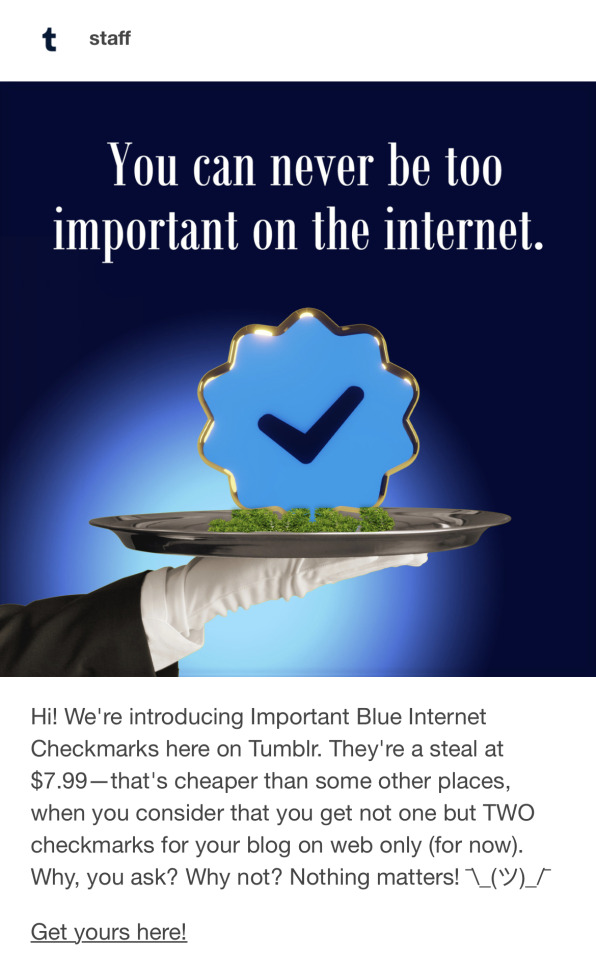
But my favorite one, though, is Tumblr. For a one time payment of $8 you get not one but two badges all at once and if that’s not enough, you can buy and display up to 12 pairs of badges! They now come in all rainbow colors too, not just blue, so it’s so much fancier and cooler because you can pick and choose which colors you want. You pay once and you keep it forever. Or until you delete your account. Love those guys.

Who Wants to Pay for a Checkmark?

Hey, look who’s taking after one of the most unhinged individuals to ever run a company and dipping their toes into making identity verification a commercial product?

The entire point of account verification is all about confirming that the profile account represents who it claims to be. The part about having to be a notable person or organization was a side effect of the notion that only public figures needed to have their account verified to avoid impersonation.

The fact is anyone or any organization could be impersonated for any reason as notability needs not be on a national, let alone global, level.

If Meta is truly aiming to drive revenue out of account verification then it’s not about notability anymore. They should just make it like Tumblr and charge it for kicks because nobody knows if you’re a dog, who cares as long as you pay? The initial roll out of the revamped Twitter Blue went exactly as everyone outside of the company would expecte.

If account verification is about identity they can do it by enabling rel=“me” by way of a website that the person or entity controls.

The rel=“me” identity verification attribute is used to establish a link between a website and a person’s or organization’s profile on another site. This will assert that the entity owns or runs both the website and the profile on the other site.

Basically it lets other websites or services know that you are who you say you are without having to submit further proof of identity such as your government ID and saves them from the arduous process of manually verifying every profile created on their service and saves you from the repetitive process at each online service.

However, because there’s no central authority that actually verifies this attribution it can create a single point of failure if the reference website gets hijacked, leading to security issues such as identity fraud.

Between the lack of central authority and chaos through impersonation accounts, essentially it comes down to which problem they are more willing to deal with. And if say it costs $5 a month to have a check mark next to your name, that’s potentially hundreds millions maybe billions of dollars of additional annual revenue. Who’s gonna say no to that?

Before you know it every corporate social network will charge for a check mark and you’ll be spending more per month than your streaming subscriptions combined.

Twitter ends all free public API, switches to paid access

“Putting a cap on free API usage could also stop firms working around detecting the spread of misinformation on Twitter.”

That right there is the money shot. Misinformation is much more freely distributed today on the platform than at any time last year without the full trust and safety team and council working to suppress them. Then again the definition of what constitutes misinformation seems to have changed within the company.

The other point is why would any self respecting developer jump right back in after being suddenly shut out without prior or even any official communication on the sudden change of policy?

Anybody who still trusts the company to do anything right must be kidding themselves.

If anything, third party developers might be even more inclined now, if not highly encouraged, to develop for other platforms that offer free or open source API *cough*Mastodon*cough*.

Mastodon isn’t the only open platform in play that takes advantage of the ActivityPub protocol. There are plenty others such as Friendica, Pleroma, CalcKey, etc., that connect through this protocol, which means the playground for software developers and designers is wide open. Even WordPress, Tumblr, and Flickr have ActivityPub on the roadmap for this year.

There’s far more interest now on the federated networks or the open social web than ever before and networks that stay closed are going to miss out.

Social Media Diversity Gets Reinvigorated

I think I’m pretty happy that one of the major things that came out of 2022 was the implosion of Twitter which opened up a whole range of other destinations for the social web that may have always been there but saw little attention.

The social space is exciting again with people flocking to places like Mastodon, Post, and Tumblr and the federated space is getting far more attention than ever. 

In a lot of ways it seemed to have brought back some of the web development energy of the 2000s as people began to rethink what’s possible.

Much of the development back then was fueled by VC money which ultimately halted many innovations in pursuit of growth and dominance so it remains to be seen how this new energy is going to be funded. I have doubts that crowdfunding will be able to generate the necessary resources without being supported by other forms. 

What that would be I guess is something that we’ll eventually find out in the coming years if the stance against capitulating to VC demands becomes more widely adopted.