Twitter is going really great

As I keep saying, the company is not compatible at all with how Elon Musk thinks how a company should be run. In fact, it’s likely the complete opposite is true, which is why there’s far fewer than 50% of the company’s staff remains. 

Originally Twitter wanted to shave 25% of their headcount even without Elon, because they were painfully aware the company was bloated. Elon boasted about wanting to cut 75% of the staff, but when he came in, he ended up Thanosing the company instead.

What he probably wasn’t counting on (or maybe he did to an extent) were the culture clash and staff solidarity so now Twitter ends up with fewer than 3000 employees and that number is likely going to go down even further by the day. Apparently 75% of the remaining staff opt out of the “extremely hardcore” conditions.

From the looks of it, Twitter could break next week with nobody available to fix things. People are already seeing glitches and things not working on the site.

He boasted about cutting 80% of the micro services that he deemed inessential to running Twitter which ended up disabling two factor authentication via SMS and now it looks like his 75% layoff plan is working, albeit perhaps slightly differently than he intended.

Musk is fucking around and finding out.

I was going to post the article about the latest round of resignations but this Techmeme page is more relevant with all the live tweets included 

The Count Stopped Counting

Sesame Street’s Count von Count stopped tweeting in October at 3,763. He may have seen the writing on the wall.

Here’s a great website to follow closely what’s going on with Twitter if you really want to know

😂😂😂😂

This is a perfect article that encapsulates pretty much everything that’s happening with Twitter in the last couple of weeks.

The mercurial CEO is under fire from his own staff to the point that he can’t take a joke and can’t deal with employee uprising. He’s also very allergic to criticism and challenges to his statements which makes him very thin skinned. All the talk about being a free speech absolutist and comedy being legal on Twitter had unraveled mere days after he took over the company.

However, Musk has always harbored a vision for a service he calls X which is supposed to be the everything app, so all that he’s done to the Twitter corporation seems to be the steps into creating that company.

He always insisted that PayPal was meant to be X but it turned out differently and gave him the opportunity to create Tesla and SpaceX, along with everything around them like The Boring Company and Starlink. So now with Twitter he thinks he’s bought himself several years into creating this X.

When you see it from this perspective, it’s no wonder it looks like he’s destroying the company because he is treating it as a shortcut to building something else. It’s likely that Twitter may end up as a PayPal competitor or something else with a payment service at its core and the social network as just one of its products.

He’s a billionaire who probably is best at dealing with machines, not people, since clearly he has no regard for people. Meanwhile, Twitter is a company about people, so that’s not going to work. He’s going to have to turn it into a company about products, like his other companies, to be compatible with his vision and management style.

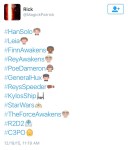
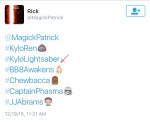
Twitter emoji for Star Wars: The Force Awakens

Twitpic is shutting down

Twitpic founder Noah Everett prefers to shut down his six year old service rather than retract its trademark application to the USPTO as demanded by Twitter. The service will shut down on September 25 and users will be given an opportunity to export all of their hosted images prior to the date.

Twitter had opposed the trademark application which was filed in 2009 and threatened to refuse access to Twitter’s API but a company spokesperson said that Twitpic was actually allowed to continue to operate using the name, just not as a trademarked name because Twitter considers that a violation of its own.

There doesn’t seem to be a business case that can be made out of a Twitter-specific photo hosting service especially after Twitter rolled out its own, so the legal threat about the name seems like a perfect excuse Everett needs to shut down without needing to disclose the real reason if there was one.

Some years ago a competing service called tweetphoto was acquired and renamed as Lockerz. The acquiring company failed to find a viable business model in the Twitter photo hosting service and is now gone, having been acquired by a Chinese company a few years ago and no longer deals with Twitter.

When Twitpic was not asked to be one of the partners for Twitter’s own photo hosting service a few years ago Everett went and built a competing microblogging service called Heello which mimicked Twitter but it soon faded into irrelevance.

If Everett is so hung up with wanting to trademark the name more than anything, it smells fishy. It’s a bit of a shame because Twitpic’s approach was different to Twitter’s own although in terms of purpose and function they’re identical. It was an alternative that a lot of people found preferable to Twitter’s own.

Twitter Backflips on Block Policy

Twitter today made changes to how the block function works in a way that seems counterintuitive and perhaps even the exact opposite of what it had been previously. The change essentially acts as an earplug rather than a barrier which separates people from accounts they don’t wish to interact with. A few hours later though, the company backed down.

The new policy, which came into effect immediately and without public notification, allowed blocked accounts to see, follow, and interact with the accounts that block them, except that the blocked account won’t be able to see or know that. It effectively performs a mute function rather than a proper block. Why Twitter didn’t just rename it to “mute” is unclear because the action obviously performs what a mute function is expected to do.

By changing the block function to the new behavior, it meant that stalkers or people with malicious intent can far more easily monitor their target, keep track of them, store their tweets, distribute, or use them as they wish.

//platform.twitter.com/widgets.js

Preventing Retaliation Twitter told TechCrunch that the new behavior was designed to prevent retaliatory actions. When a person is blocked, they would know it when they try to visit their target’s profile because Twitter would tell them that they are unauthorized to do so. Apparently there have been instances in which this led to elevated and and extreme responses although the company did not provide more specific examples. Twitter also reiterated the point that tweets are public and therefore can be seen by everyone.

On one hand, Twitter has a point. Blocked people have always been able to see tweets from people who block them by going directly to the target account without logging in, which can easily be done from any web browser. They can also create other accounts, with varying inconspicuous names, to follow them again.

However, tracking tweets without logging in severely limits a person’s activities to merely viewing and perhaps taking screenshots of the tweets. They won’t be able to interact with their targets on Twitter in any way at all.

When people use different accounts to follow their targets, sooner or later their activities will be noticed and they will subsequently be blocked again.

Derek Powazek perhaps said it best in explaining how the new block works.

//platform.twitter.com/widgets.js

This leads people to form an opinion that Twitter is siding with the stalkers and abusers by letting them do what they wish and making them invisible to the target or victim.

//platform.twitter.com/widgets.js

Twitter’s position seems to be that ignorance is bliss. What they don’t know won’t hurt them.

//platform.twitter.com/widgets.js

//platform.twitter.com/widgets.js

Reverting the block In less than five hours though, Twitter reversed its decision and reverted nearly all the changes to the blocking function it had implemented.

Twitter’s VP of product Michael Sippey posted on Twitter’s main blog emphasizing that the changes were made to prevent post-block reactions which can be far more severe than pre-block abuse but the company decided to turn back on its decision because the backlash #restoretheblock had been so overwhelming, there was even a change.org petition.

In all fairness, neither solutions are ideal. One has the potential to spark severe reactions, even offline, another lets abusers roam free around their targets. The Twitter crowd certainly prefers the prior block behavior because it allowed a more immediate control over who can interact with them at the risk of retaliation, expecting that such a risk may be relatively low.

We’ve seen time and time again that culturally relevant content achieves engagement at much greater scale than that which is forced. So, all the brands suggesting hashtags and slapping platform logos on the end of their commercials are better off tuning into CNN or ESPN for inspiration to create something people will actually care about.

Mike Mikho for AdAge

Just in time advertising during Super Bowl XLVII blackout

This year’s Super Bowl, held in New Orleans, had probably the best half time show in years featuring Beyonce and Destiny’s Child, but it will also be memorable for another thing, which is the fact that there was a power blackout right after half time which delayed the third quarter for several minutes. A number of quick thinking social media agents used Twitter to pounce on the opportunity for their brands and these were brilliant.

//platform.twitter.com/widgets.js

//platform.twitter.com/widgets.js

//platform.twitter.com/widgets.js

Walgreens supermarket had a couple of tips for the Mercedes Benz Superdome in New Orleans

//platform.twitter.com/widgets.js

//platform.twitter.com/widgets.js