Zuckerberg Says Threads has Almost 100 Million Monthly Users

The reports of Threads’s death have been greatly exaggerated. Just under 100 million monthly users in three months since launch is one hell of a feat. 

Is the claim dubious? Anyone can certainly question that since they have yet to show additional information such as the highly coveted “unregretted minutes” a certain other billionaire CEO seems to prefer, but Business Insider was reporting just a week ago that Threads has 33 million daily active users so 100 million active users in a month does sound plausible.

But what about all those people who told us that Threads is a graveyard, that nothing is happening because their posts get no engagement? Well, are they the ones that logged in back in July or August once or twice and then return a few months later without posting anything in between? They have no idea what’s happening. How much interaction have they done in Threads, did they just post and expect responses or have they interacted with people? Have they been asking their friends and followers to check out the place and stick around for a while?

Threads have added so many features and functions between launch period and now that it’s become a full fledged social network that feels like it’s been around for years. 

Sure, search is still limited to certain languages and markets, there’s no trending list, no lists, and no proper analytics, but there are separate feeds for Following and For You, can easily swap between accounts, log in on the web, post voice notes, follow every account mentioned in a single post all at once (makes Follow Fridays easier), quote posts, see basic stats per post, see quote posts and likes, follow and get notified of updates to any post for 24 hours, you can edit your posts and replies within five minutes of posting, and so on.

It’s still missing an API, however, which prevents many organizations, institutions, public figures, and businesses from using it with their social media admin tools. Perhaps that’s a big reason people think they can’t use it yet, but at nearly 100 million monthly users, it’s not a place for people to jump back in after months of absence and 

ask if there’s anyone there, because it’s a thriving place.

That thing about the news? The one where Instagram chief Adam Mosseri said they’re not prioritizing or giving a leg up to news because they prefer people talk about other things? Yeah, that’s not a thing. News is absolutely what people share and talk about on Threads. Multiple major media organizations have found that Threads deliver far more traffic and engagement than expected.

Mosseri also reiterated today that they are working on landing in the EU as well as establishing early connections to ActivityPub and therefore federating or connecting to platforms like WordPress, Mastodon, and micro.blog in the next few months, not to mention the all important trends list that people have been shouting about. 

There’s also evidence of more work already being done within the app but not yet ready for release, so while Threads may not be the place for real time updates yet, it is definitely sprinting forward.

Meta follows Twitter in charging for the coveted blue internet checkmark

Weeks after someone saw code inside the Instagram app referring to paid verification, Meta today formally announced their latest copycat feature, the paid blue checkmark.

Like pretty much every major product that Meta offers, the blue checkmark originally came from somewhere else, in this case, Twitter. Now that Twitter is charging for it, Meta can’t resist doing the same but they added their own twist.

Just like Twitter’s version, you’ll get the all important blue badge, increased visibility and reach, and exclusive features, but you’ll also get personal customer support, something that Twitter can’t offer because Elon fired everyone already.

Meta’s checkmarks are more expensive than Twitter’s. Even more expensive than paying for Netflix, Disney+, or HBO GO. One month of Meta Verification costs the same as Disney+ Hotstar for one entire year. Think about that.

Twitter charges US$11 per month from mobile apps and $8 from the web, while Meta charges $15 from mobile apps and $11 from the web.

Meta’s paid checkmarks are available only in Australia and New Zealand for now, though, so they make you crave for it with the oh so good FOMO and envy brewing up inside of you.

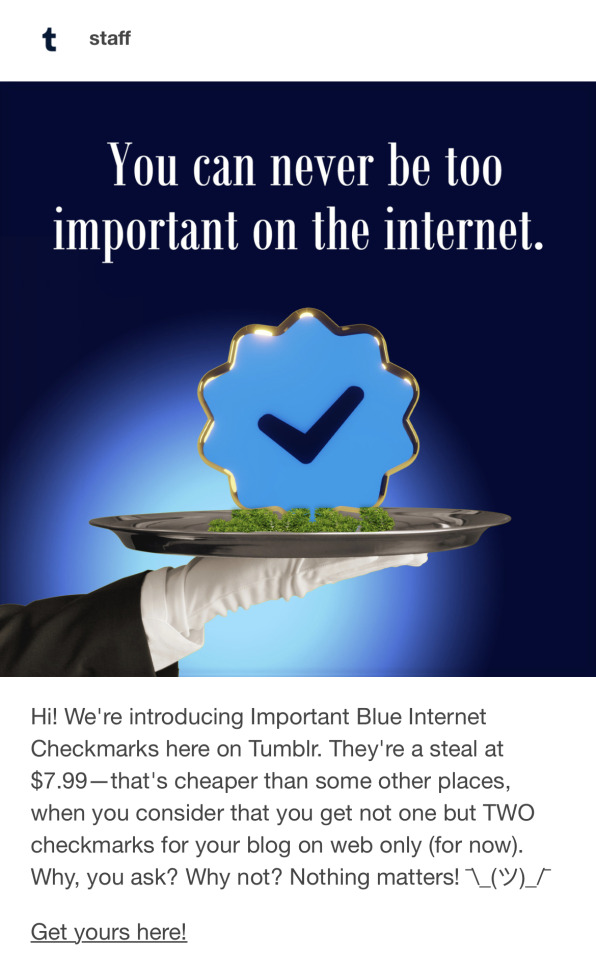
But my favorite one, though, is Tumblr. For a one time payment of $8 you get not one but two badges all at once and if that’s not enough, you can buy and display up to 12 pairs of badges! They now come in all rainbow colors too, not just blue, so it’s so much fancier and cooler because you can pick and choose which colors you want. You pay once and you keep it forever. Or until you delete your account. Love those guys.

Who Wants to Pay for a Checkmark?

Hey, look who’s taking after one of the most unhinged individuals to ever run a company and dipping their toes into making identity verification a commercial product?

The entire point of account verification is all about confirming that the profile account represents who it claims to be. The part about having to be a notable person or organization was a side effect of the notion that only public figures needed to have their account verified to avoid impersonation.

The fact is anyone or any organization could be impersonated for any reason as notability needs not be on a national, let alone global, level.

If Meta is truly aiming to drive revenue out of account verification then it’s not about notability anymore. They should just make it like Tumblr and charge it for kicks because nobody knows if you’re a dog, who cares as long as you pay? The initial roll out of the revamped Twitter Blue went exactly as everyone outside of the company would expecte.

If account verification is about identity they can do it by enabling rel=“me” by way of a website that the person or entity controls.

The rel=“me” identity verification attribute is used to establish a link between a website and a person’s or organization’s profile on another site. This will assert that the entity owns or runs both the website and the profile on the other site.

Basically it lets other websites or services know that you are who you say you are without having to submit further proof of identity such as your government ID and saves them from the arduous process of manually verifying every profile created on their service and saves you from the repetitive process at each online service.

However, because there’s no central authority that actually verifies this attribution it can create a single point of failure if the reference website gets hijacked, leading to security issues such as identity fraud.

Between the lack of central authority and chaos through impersonation accounts, essentially it comes down to which problem they are more willing to deal with. And if say it costs $5 a month to have a check mark next to your name, that’s potentially hundreds millions maybe billions of dollars of additional annual revenue. Who’s gonna say no to that?

Before you know it every corporate social network will charge for a check mark and you’ll be spending more per month than your streaming subscriptions combined.