Indonesia’s Deadly Elections

71 Indonesian election officials died on duty from exhaustion following last Wednesday’s elections while more than 4,500 fell ill. Health Minister Budi Sadikin said other than exhaustion the second highest cause of death was heart failure.

Apparently nearly 400,000 people out of 6.8 million officials across the country were approved to work on the election despite having health concerns. Officials have been working 10-15 hour days to verify ballot papers, tabulate the results, submit and verify the submitted results to the central database, which has problems of its own.

So far, with 71% of the ballots officially counted, data from more than 1,200 polling stations were found to be erroneous out of more than 820,000 stations, which triggers a revote in a number of locations.

In 2019 nearly 900 election officials died on the job from exhaustion while more than 5,000 fell ill.

Third Time Lucky for Prabowo Subianto

Pretty comprehensive read on the apparent victory of Defence Minister Prabowo Subianto in Indonesia’s presidential election last Wednesday. Sample ballots by all official surveys have him at nearly 60% of the votes in a three horse race, negating a run off in June. Official results must be announced by 20th of March. Inauguration will take place in October (yes, an eight month wait where anything could happen).

This was his third straight run at the Presidency after previous attempts ended at the party convention. In 2009 he unsuccessfully ran as Megawati Soekarnoputri’s running mate, losing to the Yudhoyono-Budiono ticket.

The best take I’ve seen on this victory was on a post I can’t find anymore. It said Jokowi is so impressive that he managed to carry a player with 0% win rate to mythic level. I’ll link to it if I find it.

Strongly believed to have given his blessing end endorsement to Prabowo in this election instead of his own party’s candidate, Jokowi of course defeated him decisively in the last two elections to the point that Prabowo threw a tantrum refusing to accept his loss. Post election riots in May 2019 by his supporters led to the death of six people in Jakarta.

Of Exit Polls and Mail-in Ballots

Apparently a lot of Indonesians have never heard of voting by mail, thinking people can only vote on the day of the election instead of sending their ballot papers by mail.

There’s no mail-in ballots in the country but extensively used overseas where polling stations are limited to consular offices and embassies.

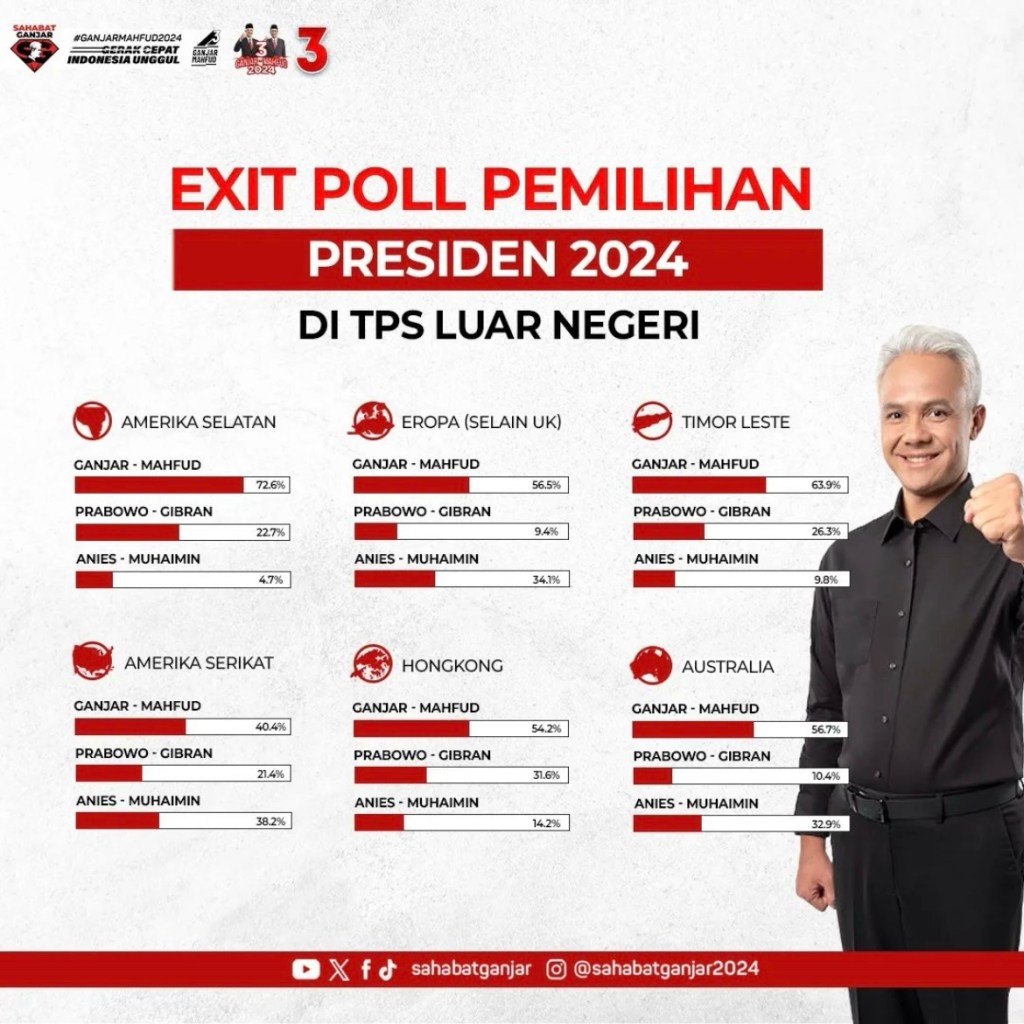
Worldwide exit polls for this month’s Indonesian presidential election have been released in defiance of the election rules which prohibit them from being announced until polling booths are closed in Western Indonesia on Wednesday.

Surprisingly all of the results gave a win to Ganjar and Mahfud MD, the least popular pairing across all domestic surveys, and by large margins.

In some cases the exit polls were conducted ahead of the actual voting day which differ from country to country, presumably based on those who cast mail-in ballots.

However, by no means it’s an indicator for the final results. Prabowo-Gibran are expected to sweep the election on Wednesday and they’ve been polling increasingly better by the week, exceeding 50% in some cases, which would negate the need for a second round in June.

By the way, overseas votes are counted as part of the South and Central Jakarta constituency, so they don’t matter as much in the national level.

Overseas exit poll results for the
2024 Indonesian presidential election

South America:
Ganjar-Mahfud 72.6%
Prabowo-Gibran 22.7%
Anies-Muhaimin 4.7%

Europe
Ganjar-Mahfud 56.5% 
Prabowo-Gibran 9.4% 
Anies-Muhaimin 34.1%

United States
Ganjar-Mahfud 40.4% 
Prabowo-Gibran 21.4% 
Anies-Muhaimin 38.2%

Timor Leste
Ganjar-Mahfud 63.9%
Prabowo-Gibran 26.3%
Anies-Muhaimin 9.8%

Hong Kong
Ganjar-Mahfud 54.2%
Prabowo-Gibran 31.6%
Anies-Muhaimin 14.2%

Australia
Ganjar-Mahfud 56.7%
Prabowo-Gibran 10.4% 
Anies-Muhaimin 32.9%

What I think about social media and the upcoming Indonesian elections

The Australian Associated Press emailed me asking my views on the role of social media in this year’s Indonesian elections and the role of digital natives as first times voters.

My long answer below

I don’t think social media can make or break a candidate by itself. Presence on social networks certainly help raise their profiles but it also opens them up to attacks.

While use of social media in Indonesia seems massive, the majority of things I see about this upcoming election and even Indonesian elections in the past, is about making fun of elections and candidates.

The primary driver of political campaigns remains television. The influence of TV is still significantly much larger than the likes of Twitter or Facebook but TV and other “traditional” media also take their news from social media, therefore social media presence and activities can help spearhead the image or intention that the candidates want to project. Television can amplify what is being said or what is happening on social media.

Look at the publicity on Aburizal Bakrie’s trip to the Maldives for example. That trip from four or so years ago first made the rounds on YouTube and Twitter a few days ago and within hours it was picked up by television as well as online news media and became a national talking point by the end of the day.

That being said, conversations on social media are also being driven by what is happening on TV so you have that full circle of coverage and talking points from both media amplifying each other until the masses are tired of the subject and move on to the next topic.

Another example is Farhat Abbas. The one time presidential hopeful and legislative candidate was on Twitter until recently, perhaps to deliver his campaign promises, to create a more popular image of himself, and to address people who talked about him. Ultimately it was a failed experiment because everyone saw right through him. His actions that had been reported across all media were amplified and ridiculed on Twitter so much that he eventually shut down his @farhatabbaslaw account, although as it turns out he reactivated it several days later.

The success of Jokowi and Ahok may have been driven by social media but to my eyes, the real driver was the relentless coverage on TV and newspapers about their campaigns and activities. Perhaps the final kicker was the flashmob at Bundaran HI shortly prior to the gubernatorial election day in 2012.

What’s good about this election is that the rise of software developers taking advantage of Pemilu API, which is the publicly available access to the KPU data about all of the legislative candidates and their parties. Spurred on by Perludem, these mobile applications and websites may not be massively popular but they provide far more useful and easier to access information so that the voters are better informed about their options.

The digital natives, in other words, people who are far more comfortable with the internet, mobile devices, and appications, most of which happen to be first time voters, apparently are increasingly looking for election information from the internet. They will scrounge news and info not just from social media but also from news websites and other sources including applications. It’s up to them to decide how to filter and process all that information.

Google is known to have provided a central repository of election news and information for other countries in the past and it’s just a matter of time before they launch an Indonesian version of it. It’s a bit of a shame that they haven’t so far with the election being so close now, just a matter of days. – Read on Path.