
My therapist just told me my problem is that I need to write more fanfiction.
This sounds fake but the logic behind it is actually really interesting? She said obsession with a new fandom triggers quick dopamine release when we consume all this related content–it’s easy and addictive.
What we’re NOT getting is that ‘slow dopamine’ that’s more sustainable and engaging. That’s the kind we get from DOING things that take effort but are ultimately rewarding.
So like, she suggested that writing fic and making fanart are ways to balance the quick dopamine of watching a show/reading fic with the slow dopamine of working at something that takes effort.
Moral of the story is you should engage in the process of creation around your favorite things. You’ll feel better for it.
Oh.
OH.
Let’s all go do fandom.
FOR SCIENCE!
🙂
Artifact News Reader is Being Shut Down
I’ve enjoyed using Artifact and it’s upsetting that it’s being shut down because it really seemed like it was on its way to be a really good news reader. It’s often the first or second app I open to kickstart the day. I like that Artifact lets you load an AI-generated article summary if you don’t have time to read the full story.
Artifact at some point added social elements but people just didn’t see it that way because it’s a news reader first and foremost. It also let you publish your own takes of the news linking to them, making it a blog platform. This part I enjoyed a lot. I didn’t post too many times but enough to keep me writing my thoughts on things that bugged me.
They said Artifact will remain up until til the end of February. I’ll be spending some time to republish those posts here and backdating them accordingly.
Ultimately for a blogger it all comes back to running your own space if you want to keep your published thoughts available to read on the web. Maybe one day I’ll eventually decide to have my own self hosted blog and social web instance like it’s always meant to be and move everything to that because platforms like there, including Medium and Tumblr, may one day shut down if they can’t justify keeping them around whether through lack of revenue or something else.
For my daily news reading there’s always Flipboard which I also still use regularly but I’m going to miss Artifact.


Media Companies are Suckers for Punishments
I don’t understand why the media keep insisting on posting to this platform when they themselves admit that traffic from social media links have been dropping, and especially on X, they don’t bring significant audience.
The disdain that Musk has over media companies, especially ones that don’t kowtow to his whims, as well as his calls to publish directly on his platform or be deprioritized, should warrant enough reasons for them to cease using the platform as a traffic funnel.
They are not welcomed nor do they gain anything from staying around. As if having article titles removed from posts was not enough of a sign that Musk isn’t keen on driving traffic to news sites.
There’s no shortage of options for content distribution these days so pulling back from one isn’t going to make a lot of difference.
iPhone Design Chief Joins Jony Ive’s LoveFrom
Losing 20 designers to Jony Ive must be a significant blow to Apple but it’s certainly a testament to Ive’s leadership as a design executive. And now the tech giant loses another senior design executive.
What Ive and his team built at Apple are unquestionably iconic, from the groundbreaking original iMac and its weird puck mouse to the oddly designed Magic Mouse and Lightning Apple Pencil, but with Ive’s and his former team members’ departures, Apple has to rebuilt the design team with new leadership and direction.
With almost none of Ive’s former charges left in the company, Apple’s award winning Ive era is over and if they want to return to that level, it’s going to take a lot of work.
It’s unfortunate that Apple is no longer a design focused company the way it used to be in the 90s to the 2010s having reorganized the team under Operations instead of its own vertical under the CEO but they’ve decided to take this path following Ive’s departure.
This is already a new era at Apple where product design is more iterative and functional than inspirational and if they aim to reclaim their crown as one of the most iconic industrial design companies, it will require a new batch of outstanding designers and design leadership.
Las Vegas Residents Not Happy with F1 Race
Exactly the same sentiments have always been expressed for the Melbourne F1 GP ever since the city took over the Australian race from Adelaide decades ago.
For years you’d find protesters at the Melbourne Grand Prix because the circus brought fewer economic benefits than losses with evidence that the city lost money each time the race was held.
Protesters also pointed out that the race week disturbs the neighborhood as the sounds of those 2.4-3.0L V8s-V12s reached far beyond the race neighborhood. Albert Park is a housing area after all, so people’s routes and access would be affected for the week. Today’s V6s are nowhere near as loud.
The Singapore GP on the other hand, despite being held around housing neighborhoods as well, have seen little publicized protests. The racing circus there seems to be welcomed with open arms and many residents and visitors come to not just see the race but enjoy the accompanying concerts as well.
You could probably argue that government-controlled media may have a hand in not highlighting protests or maybe the Singapore Tourism Board have just been really good at framing the race to the residents. And the engines are also not as loud as they used to be.
TV can be Educational but Social Media Likely Harms Mental Health
Many people equate screen time or gadget use with addiction to smoking because they’re perceived as bringing far more harmful effects on health than any benefit but I’m a strong believer of context and what people (including kids) consume or use on their screens matter so much more than just the use itself because these devices can help if used the right way.
Separately, kids and adults also need to learn about control and ways to respond to certain triggers to reduce harmful effects.
Zuckerberg Says Threads has Almost 100 Million Monthly Users
The reports of Threads’s death have been greatly exaggerated. Just under 100 million monthly users in three months since launch is one hell of a feat.
Is the claim dubious? Anyone can certainly question that since they have yet to show additional information such as the highly coveted “unregretted minutes” a certain other billionaire CEO seems to prefer, but Business Insider was reporting just a week ago that Threads has 33 million daily active users so 100 million active users in a month does sound plausible.
But what about all those people who told us that Threads is a graveyard, that nothing is happening because their posts get no engagement? Well, are they the ones that logged in back in July or August once or twice and then return a few months later without posting anything in between? They have no idea what’s happening. How much interaction have they done in Threads, did they just post and expect responses or have they interacted with people? Have they been asking their friends and followers to check out the place and stick around for a while?
Threads have added so many features and functions between launch period and now that it’s become a full fledged social network that feels like it’s been around for years.
Sure, search is still limited to certain languages and markets, there’s no trending list, no lists, and no proper analytics, but there are separate feeds for Following and For You, can easily swap between accounts, log in on the web, post voice notes, follow every account mentioned in a single post all at once (makes Follow Fridays easier), quote posts, see basic stats per post, see quote posts and likes, follow and get notified of updates to any post for 24 hours, you can edit your posts and replies within five minutes of posting, and so on.
It’s still missing an API, however, which prevents many organizations, institutions, public figures, and businesses from using it with their social media admin tools. Perhaps that’s a big reason people think they can’t use it yet, but at nearly 100 million monthly users, it’s not a place for people to jump back in after months of absence and
ask if there’s anyone there, because it’s a thriving place.
That thing about the news? The one where Instagram chief Adam Mosseri said they’re not prioritizing or giving a leg up to news because they prefer people talk about other things? Yeah, that’s not a thing. News is absolutely what people share and talk about on Threads. Multiple major media organizations have found that Threads deliver far more traffic and engagement than expected.
Mosseri also reiterated today that they are working on landing in the EU as well as establishing early connections to ActivityPub and therefore federating or connecting to platforms like WordPress, Mastodon, and micro.blog in the next few months, not to mention the all important trends list that people have been shouting about.
There’s also evidence of more work already being done within the app but not yet ready for release, so while Threads may not be the place for real time updates yet, it is definitely sprinting forward.
iPad line up proposal
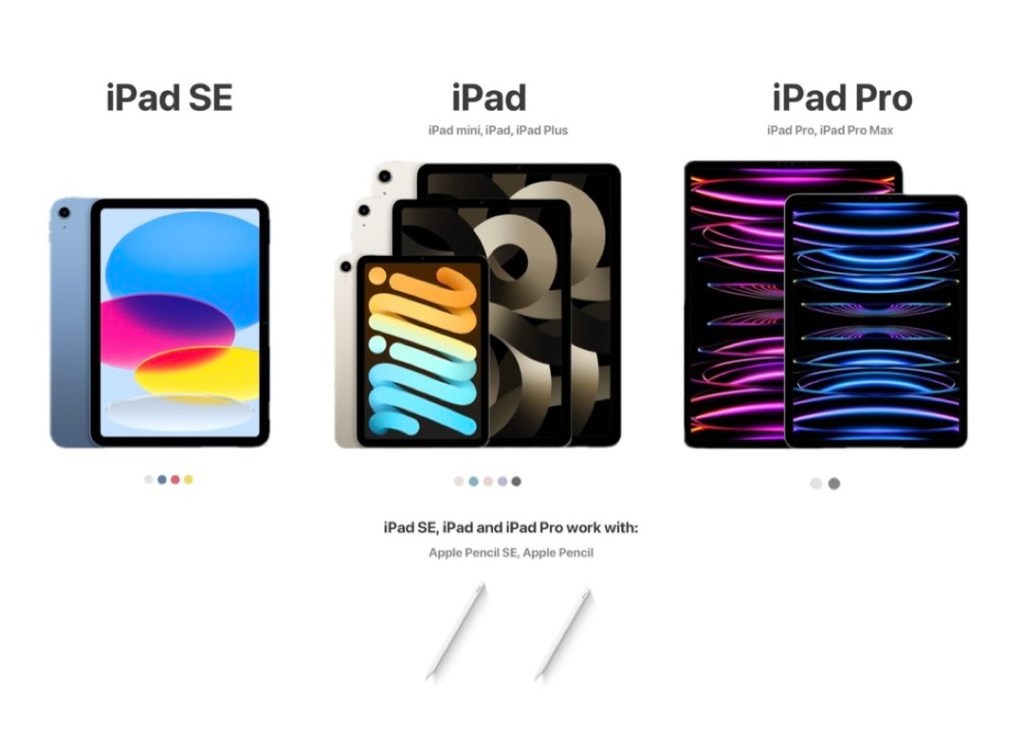
Let’s face it, the iPad line up is a little bloated if not confusing at the moment.
You have the 9th Gen iPad which carries all of the baggage of that generation’s iPad, the 10th generation iPad which overlaps so much with the iPad Air, the iPad Air itself which has lost all meanings thanks to the 10th Gen iPad, the iPad mini which can serve whole other categories of functions due to its diminutive size, and finally the iPad Pro that comes in two sizes.
Sebastiaan de With’s proposal here tries to align the product closer to the less confusing iPhone line up. While it doesn’t change the number of models, it gets rid of the 9th Gen and the original Pencil, introduces a low end iPad and adds a Plus model to the regular range.
I can agree with that and my details would be as follows:
When Apple introduces the 11th Gen regular iPad, the 9th Gen would be gone along with the original Pencil and any other lighting iPad accessory. That clears that table.
Let the low end iPad be the previous generation model with one or two color options, no cellular, and just one storage size because it’s meant to be the most accessible iPad that also serves the education market.
The standard iPad would include the mini and the Plus, all carrying the previous generation chipsets, obviously lower tech specs compared to the Pro, no high speed charging or connector just the widely acceptable one, and a single camera.
As for TouchID vs FaceID on the regular iPads, I lean towards TouchID unless they can lower the cost on that component.
The Pro will obviously be the flagship model with all the bells and whistles.
What about the Air? Right now the Air nomenclature is just that, a nomenclature. Functionally it serves as a confusing spot on the line up because the 10th gen iPad is too close to it but it carries a previous generation Pro chipset and features. They can keep the name for the regular iPad like how they kept the MacBook Air and Pro and got rid of the vanilla MacBook. That way they can have the iPad mini, iPad Air, iPad Plus all under the “regular iPad” class.
The Pencil will have two options, regular or Pro but there will be a hard separation. Only the Pro iPads can use either Pencil models while the non Pro iPad have to stick to the regular Pencil. That takes away the customer confusion. You want Pro features, get the Pro iPad.
Although maybe the Pro Pencil can work with the regular iPads but it just won’t have the Pro features enabled. It’ll be like a high speed charging or data cable delivering at low speed because the host or target device doesn’t support high speed.
I’m not addressing the nearly Apple Watch level overwhelming range of SKUs here because there’s going to be multiple colors, storage sizes, and cellular vs WiFi models to worry about.
The important element is is addressing the fundamental differences between the different iPad categories. Streamlining the product range this way will present a much more coherent set of options to the consumers.
People will have an easier time deciding which model to get especially those figuring out if they should get the 10th gen iPad, the Air, or the smaller Pro model, and retail staff won’t be tearing their hair out helping customers figure it out.
 AuliaSays