X suffers from declining usage but you won’t hear that from Indonesians

NBC News has the stats from a few traffic monitoring companies showing the drop in usage and downloads of the former Twitter app.

In February, X had 27 million daily active users of its mobile app in the U.S., down 18% from a year earlier, according to Sensor Tower, a market intelligence firm based in San Francisco. The U.S. user base has been flat or down every month since November 2022, the first full month of Musk’s owning the app, and in total it’s down 23% since then, Sensor Tower said. 

The numbers were nearly as bad worldwide, as daily active users on the mobile app fell to 174 million in February, down 15% from a year earlier, the firm said. The worldwide user base has been flat or down every month during Musk’s tenure began except one, when it grew slightly in October and then resumed falling, according to Sensor Tower. 

Other social media apps experienced modest increases in their worldwide user bases during the same period, according to the research, with Snapchat growing 8.8%, Instagram 5.3%, Facebook 1.5% and TikTok 0.5%. Those apps all experienced declines over that period in the U.S., but none was as steep as the decline on X. 

X had “the most material decline in active users compared to its peers,” Abe Yousef, a senior insights analyst at Sensor Tower, wrote in a research report. 

The company also struggles to retain advertisers with 75% of the top 100 ceasing their spend on X. The kinds of ads you see on the site are now primarily cryptocurrency, AI apps, individuals promoting their own accounts, and other oddities.

While there’s no numbers shared for individual countries or markets, traffic and attention for the Indonesian market seems to remain high or at least visibly active, despite the exodus reported worldwide.

What’s happening in the US and most of the English speaking community doesn’t seem to affect the Indonesian speaking users who continue to post and have conversations on the platform.

Politics, entertainment, and daily life activities dominate the discourse in the market especially with the general election happening in February and the results only just announced on Wednesday. The local scene on X seems to remain healthy more than a year after the acquisition and just under a year after the platform was legally reestablished under X Corporation.

As the English speaking crowd slowly make their way to alternative platforms such as BlueSky, Threads, Mastodon, and other platforms on the social web, the bulk of the Indonesian crowd are mostly sticking to Instagram and TikTok in addition to X itself and major brands such as Bank Mandiri, BCA, Mitsubishi, Grab, Warner Music, and Indosat, are still buying spots on X.

There’s little to no push factor that will drive them away from the platform and no amount of pull will convince them to make a move. Unless there’s an existential threat to their presence on X or to X itself, it’s extremely unlikely for Indonesians on the platform to switch to another. The majority, especially the younger demographics, are already on TikTok and Instagram anyway because they prefer video platforms, which leaves text based alternatives a niche.

Everything is a billboard these days

Car sharing and rental company Free2Move rolled out a new advertising unit in Germany recently where they placed ad screens on the rear side windows of their cars.

On-car advertising is by no means new. For decades cabs around the world have had advertising boards or brackets installed on their trunk or the roof as a way to increase revenue. Brands have also deployed cars or other vehicles to promote their products during campaign periods, and racing cars have always sold advertising or brand placements as part of sponsorship packages.

These days even private car owners can also partner with certain advertising companies to place stickers or wraps on most parts of their cars to earn money as they drive around the city, so there’s nothing surprising or novel about placing ads on cars.

However, Free2Move, which is a Stellantis subsidiary, decided that it’s a good idea to place advertising screens on the rear windows instead of stickers or wraps. According to Reddit users, these displays don’t activate unless the car is parked or stationary, most likely to avoid breaking local laws on car safety.

It’s not difficult to imagine the thought process that went into creating this ad unit. A screen takes away the need to take the car to the shop to place or replace stickers or wraps as necessary. Depending on how the technology works, they may be able to program the ads and deploy them at will or as part of a schedule, or they can update them over the air. Any typos or errors on the ad which may escape QA stage may be fixed much more easily that printed ads.

However, screen-based ads are much more distracting, and therefore less safe. When they’re only deployed when the car is stationary, it’s much less effective than having a wrapped car drive around town because far fewer people would see the ad on the the car when they’re parked versus when they’re on the move. The ad product may be novel or innovative but the effectiveness is certainly up in the air.

Speaking of up in the air, just the other day I posted about Indonesian airlines putting up ads on the overhead compartment panels on their planes. This is not new, they’ve been doing this for so long, maybe a decade or more, and they’re not the only airlines that do this.

These ads are certainly eyesores but they do take advantage of a captive market. What are you gonna do on an airplane, not look around? I’d argue that these ads are much more effective than the window screens on Free2Move, at least when it comes to creating awareness and imprinting the brand and product on people’s minds.

Some people don’t like ads because they can be intrusive and pervasive, not to mention distracting, which they certainly are when they’re on LED panels. However, it’s nigh impossible to avoid or ignore them and in many cases ads can be informative. People love ads that entertain, that are inspirational, and they equally hate intrusive and incessant ones.

These car window ads, in my opinion, because they supposedly don’t run when the car is moving, more likely serves little purpose, even as a tech demo, because ads are all about return on investment and for advertisers, I can’t imagine the return being worth the cost or effort compared to more conventional placements.

Challenging Jakob Nielsen’s claim on accessibility

Renowned user experience guru Jakob Nielsen published a post offering generative AI as an alternative to accessibility measures which he claimed to have failed to make computers usable for disabled users. He’s been criticized for the way he offered his thoughts which can easily be taken as dismissing accessibility altogether.

Nielsen claims that he sees all computer users equally, not making distinctions based on their ability to use them so user and interface experience designers:

Where I have always differed from the accessibility movement is that I consider users with disabilities to be simply users. This means that usability and task performance are the goals. It’s not a goal to adhere to particular design standards promulgated by a special interest group that has failed to achieve its mission.

He then offers two reasons why he thinks accessibility has failed. The first is that “accessibility is too expensive for most companies” so instead of making an effort to meet the needs of disabled users, companies either forego accessibility altogether or follow a checklist of items without verifying the results with actual disabled people. That last point actually contravenes the evaluation steps on accessibility work in the W3C’s Web Accessibility Initiative (WAI). Involving actual disabled users is one of the final steps towards compliance with WAI.

The second reason is, “accessibility is doomed to create a substandard user experience” and then continues to dismiss the present approach to auditory interface because it poorly translates a two dimensional visual user interface designed for sighted people.

At the end of his argument he offers generative AI as the core of interface generator which will present a visual interface for sighted users and auditory interface not based on the visual version, for blind users.

He may well be correct in how AI in the future may play a substantial role in presenting computing interfaces based on the user’s conditions but that day has yet to arrive and it may take some time.

The current accessibility solutions for disabled users based on W3C standards are indeed interpretive of the visual interface instead of being fully designed for non sighted users, which makes them less ideal, but for such a renowned leader in experience design to dismiss the efforts entirely may lead to companies taking his advice on face value and use that as an excuse to not make the effort and investment towards accessibility and assistive technologies at all. That’s harmful.

Per Axbom, the Swedish designer and thought leader on human centered design, has a much more comprehensive breakdown of his objections over Nielsen’s proposal. Worth reading in its entirety. The crux of his argument is Nielsen is advocating for radically customized individual interfaces, not just general interface approaches for certain groups of people with different abilities. He said distinct experiences for individuals “is an extreme take with very little foundation in feasibility or desirability”.

Update 7 March:

I just came across several more reactions and responses to Nielsen’s ignorant claims about digital accessibility and they are livid.

Designer and accessibility advocate Eric W. Bailey called Nielsen “an asshole” in a very short post, but he also included links to a handful of other people’s thoughts about the matter that you might be interested to read.

A much more diplomatic response came from Léonie Watson, a board member at the W3C, telling Nielsen to rethink his views on accessibility, based on her own disability and how she’s managed to experience and contribute to the development of the web as a blind person.

In fact, just a couple of weeks prior to Nielsen’s post, she wrote a post about how the leading AI tools would present misinformation or incomplete info, skip rules and guidelines, and even fail when tasked with delivering “all the code that I need to create a set of accessible tabs for a website”.

So just like with any information delivered by AI, we still need to verify their validity, whether they’re factual, whether they work, whether they’re applicable, etc. Maybe one day that won’t be as urgent, but for now, especially in delivering universal digital experience, AI still needs human supervision and oversight to minimize mistakes. Which is ironic because we rely on digital tools to minimize our own.

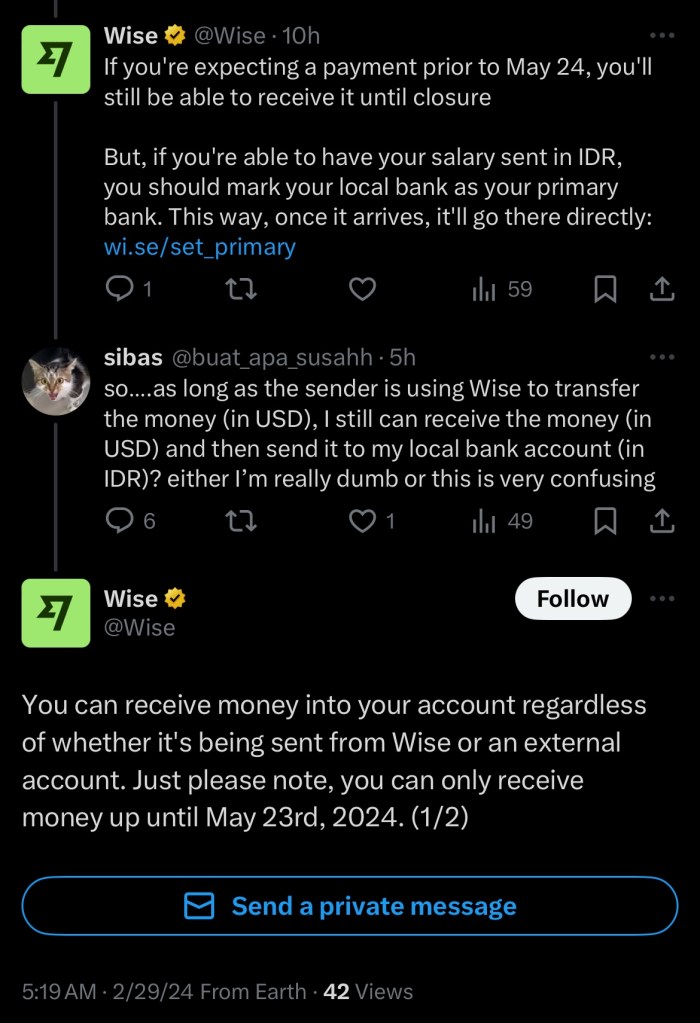
Wise forced to restrict use in Indonesia to fund transfers only

The money transfer service Wise sent out an email to customers with registered Indonesian addresses on their accounts telling them that they must empty their accounts before 23 May 2024.

From then on, Wise customers in Indonesia will not be able to store, receive, or send money from their Wise accounts. They will be limited to using Wise only as a wire transfer service and nothing else due to local regulations governing financial transactions.

The company is advising customers with Indonesian addresses to inform their benefactors or clients that they can use Wise to arrange transfers to their bank accounts instead.

While fund transfer is the core of the service and Wise is a licensed remittance facilitator, it offers a wider range of services including an account that people can use to store balance and internationally send and receive money, international remittance, and issuing debit cards for international transactions.

In a lot of ways Wise is similar to PayPal as they allow customers to receive, send, and store funds on their accounts but in Indonesia Wise doesn’t appear to have a license to operate as a bank or digital wallet provider which means they’re not permitted to allow customers to store funds in a Wise account.

It would be … wise for the company to acquire the wallet license if they wish to offer their full services in Indonesia. Until they manage to secure that license, their services will remain limited to remittances, just like Western Union.

Live Action Avatar: The Last Airbender

Watched three episodes of Netflix’s live action Avatar series. As someone who only knows the original series from internet memes and still has yet to watch even a single episode of the animated series, I don’t see what’s wrong with it. It’s a perfectly fine fantasy series which seems to draw story inspiration from Star Wars.

I get that there may be differences but what do you expect when it’s an 8 episode series as opposed to 20 in the first season? On top of that, no adaptation is going to be a perfect 1:1.

I don’t know if character and story arc changes were necessarily abandoned to keep the story moving or if the team couldn’t get it to work but the original series is still there to watch and I plan to catch it finally once I’m done with the live action.

Google Testing Removal of News Tab

With Australia, Canada, and Indonesia passing laws or regulations requiring platforms to pay for news links and the US having introduced the Journalism Competition and Preservation Act last year, removing the News tab looks like Google’s response to avoid having to pay link tax to media companies.

The News tab is only missing for a limited group of users for the moment. It is a test after all and I still see it when I use Google search.

Indonesia’s Deadly Elections

71 Indonesian election officials died on duty from exhaustion following last Wednesday’s elections while more than 4,500 fell ill. Health Minister Budi Sadikin said other than exhaustion the second highest cause of death was heart failure.

Apparently nearly 400,000 people out of 6.8 million officials across the country were approved to work on the election despite having health concerns. Officials have been working 10-15 hour days to verify ballot papers, tabulate the results, submit and verify the submitted results to the central database, which has problems of its own.

So far, with 71% of the ballots officially counted, data from more than 1,200 polling stations were found to be erroneous out of more than 820,000 stations, which triggers a revote in a number of locations.

In 2019 nearly 900 election officials died on the job from exhaustion while more than 5,000 fell ill.

Third Time Lucky for Prabowo Subianto

Pretty comprehensive read on the apparent victory of Defence Minister Prabowo Subianto in Indonesia’s presidential election last Wednesday. Sample ballots by all official surveys have him at nearly 60% of the votes in a three horse race, negating a run off in June. Official results must be announced by 20th of March. Inauguration will take place in October (yes, an eight month wait where anything could happen).

This was his third straight run at the Presidency after previous attempts ended at the party convention. In 2009 he unsuccessfully ran as Megawati Soekarnoputri’s running mate, losing to the Yudhoyono-Budiono ticket.

The best take I’ve seen on this victory was on a post I can’t find anymore. It said Jokowi is so impressive that he managed to carry a player with 0% win rate to mythic level. I’ll link to it if I find it.

Strongly believed to have given his blessing end endorsement to Prabowo in this election instead of his own party’s candidate, Jokowi of course defeated him decisively in the last two elections to the point that Prabowo threw a tantrum refusing to accept his loss. Post election riots in May 2019 by his supporters led to the death of six people in Jakarta.

Of Exit Polls and Mail-in Ballots

Apparently a lot of Indonesians have never heard of voting by mail, thinking people can only vote on the day of the election instead of sending their ballot papers by mail.

There’s no mail-in ballots in the country but extensively used overseas where polling stations are limited to consular offices and embassies.

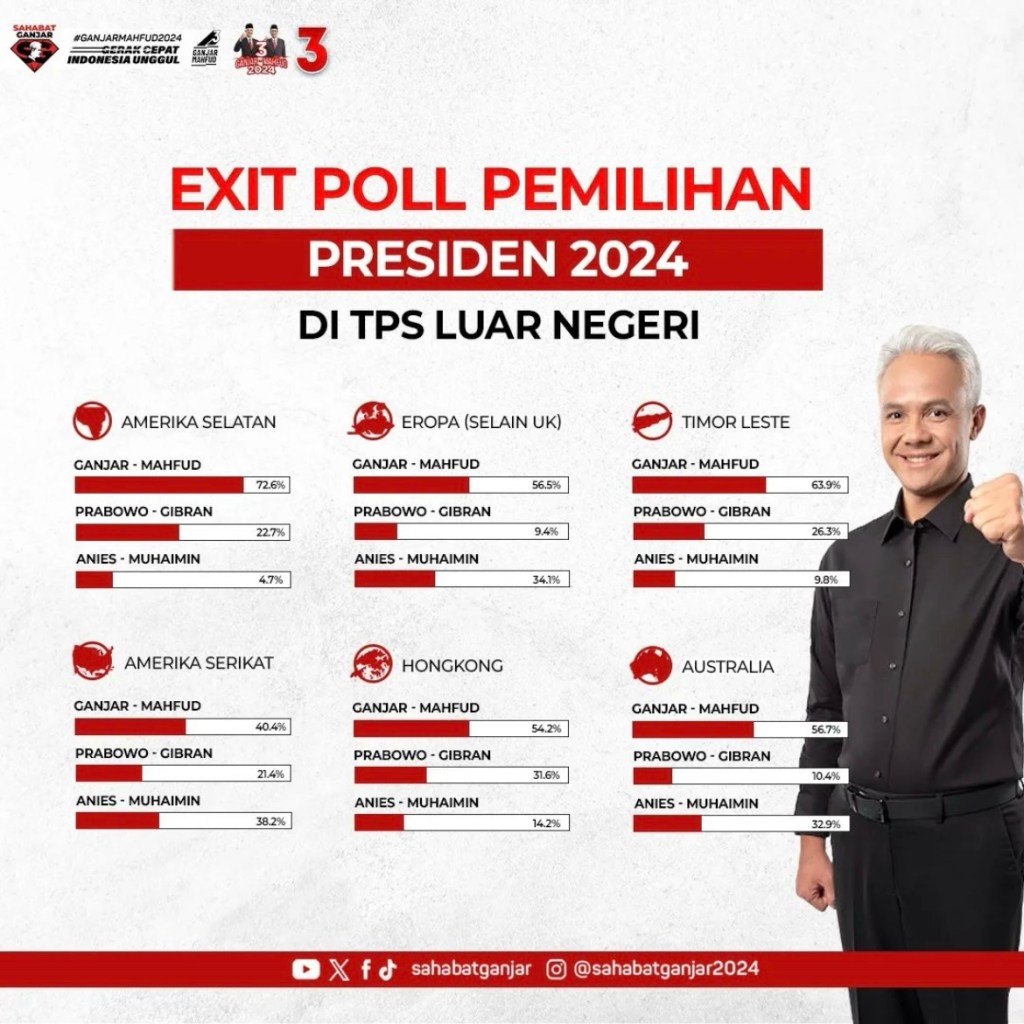
Worldwide exit polls for this month’s Indonesian presidential election have been released in defiance of the election rules which prohibit them from being announced until polling booths are closed in Western Indonesia on Wednesday.

Surprisingly all of the results gave a win to Ganjar and Mahfud MD, the least popular pairing across all domestic surveys, and by large margins.

In some cases the exit polls were conducted ahead of the actual voting day which differ from country to country, presumably based on those who cast mail-in ballots.

However, by no means it’s an indicator for the final results. Prabowo-Gibran are expected to sweep the election on Wednesday and they’ve been polling increasingly better by the week, exceeding 50% in some cases, which would negate the need for a second round in June.

By the way, overseas votes are counted as part of the South and Central Jakarta constituency, so they don’t matter as much in the national level.

Overseas exit poll results for the
2024 Indonesian presidential election

South America:
Ganjar-Mahfud 72.6%
Prabowo-Gibran 22.7%
Anies-Muhaimin 4.7%

Europe
Ganjar-Mahfud 56.5% 
Prabowo-Gibran 9.4% 
Anies-Muhaimin 34.1%

United States
Ganjar-Mahfud 40.4% 
Prabowo-Gibran 21.4% 
Anies-Muhaimin 38.2%

Timor Leste
Ganjar-Mahfud 63.9%
Prabowo-Gibran 26.3%
Anies-Muhaimin 9.8%

Hong Kong
Ganjar-Mahfud 54.2%
Prabowo-Gibran 31.6%
Anies-Muhaimin 14.2%

Australia
Ganjar-Mahfud 56.7%
Prabowo-Gibran 10.4% 
Anies-Muhaimin 32.9%

smokiedokie:

I opened my copy of The Tale of the Body Thief & immediately had to close it again because of this silly little annotation