The threats facing press freedom in Indonesia are only increasing

The decline in press freedom under President Joko Widodo’s administration and the growing concerns about President Prabowo Subianto’s approach to the media are alarming.

As Sofie Syarief’s article in Fulcrum highlights, Jokowi’s government set a troubling precedent, particularly with Ministerial Regulation 5 (MR5) and other policies that gave the state more control over what could be published online. These regulations, under the guise of content moderation, opened the door to censorship, weakening Indonesia’s democracy. The move to fine digital platforms for failing to remove “prohibited” content further undermines the press’s ability to hold power accountable. She recalled her own experience being censored:

MR5 has numerously been used to force social media sites to take down content deemed as “breaking” the law. While journalistic products are protected by the Press Law, social media posts from individuals are not. In early October 2023, for instance, X/Twitter informed the author in an email that it received a request from Kominfo to take down one of the author’s tweets. The tweet cited an article from Indonesia’s largest daily, Kompas, criticising Widodo’s alleged misuse of intelligence to spy on political parties. After the author appealed to X and protested to the ministry, the then deputy minister claimed that their report against the tweet was due to “human error”.

Prabowo’s track record does little to inspire hope for improvement. His past threats against the media, particularly during his 2019 Labor Day speech, show a worrying disregard for press freedom. If the proposed revisions to the Broadcasting Law and Police Law that she mentioned in the article are passed, the situation could worsen, empowering authorities to silence dissent under the guise of maintaining security. The potential for abuse is clear, especially with a compliant Parliament likely to rubber-stamp these changes.

Indonesia’s press and civil society must rally together to defend their freedoms. As she points out, a free press is crucial in a functioning democracy, and with the current trajectory, Indonesia risks losing that. The need for solidarity and a strategic response has never been more urgent.

Digital media repression is an emerging global trend and an imminent threat to Indonesia’s declining democracy. Indonesian media have been criticised for their overall failure to adequately function as a political watchdog, especially given the campaign to restore Widodo’s dented public image. At present, Indonesia’s civil society is far from consolidated and cannot meaningfully challenge the government. If democracy is to stand a chance under the new administration, Indonesia’s press and civil society need to stand together to strategise their fight against autocratic legalism and to hold power accountable.

Exploited, Extorted, and Erased: Indonesia’s Struggle Against Dutch Historical Revision

I’ve never considered myself a nationalist, but there’s one thing that has been tugging at me for decades: the Dutch colonial legacy in Indonesia. It’s a complex history that continues to resonate and remains unresolved to this day.

Let’s talk about the elephant in the room – the price of Indonesian independence. In the 1950s, Indonesia had to pay billions of guilders to the Netherlands just to secure full sovereignty, about 4.5 billion. It’s a staggering sum that apparently had a far greater impact on the Dutch economy than the much-lauded Marshall Plan. Yet, when the Dutch discuss their post-war recovery, it’s all about that American aid. The audacity to erase the role of Indonesia in the post World War II reconstruction and redevelopment of the Netherlands.

As if you’re not aware, here’s a bitter pill to swallow: part of that independence payment went towards covering the cost of weapons the Dutch used against Indonesians during the struggle for freedom. A member of the Indonesian delegation at the Round Table Conference in 1949 escaped death in Jogjakarta by a Dutch bomb that went through a window he was standing by. It’s a cruel twist that still leaves a bad taste in my mouth.

From the article linked above:

The Dutch delegation firmly started negotiations with the requirement that the entire Dutch Indian debt of 6.5 billion guilders should be transferred to Indonesia, including the cost of all recent military actions that had estimated to have killed a hundred thousand Indonesians. The original draft law states that the ‘measures taken to restore order and peace (…) were (were) in the interest of Indonesia’.


It must have been a strange sensation for the Indonesian delegation members. Mohammed Hatta was still imprisoned during the so-called ‘Second Police Action’ in 1948 and Dr. Leimena, one of the Republican delegation members, had seen a Dutch bomb arrive through the window during the same action in Yogyakarta and managed to jump into a space under the stairs just in time. Now they were presented with the bill of that Dutch bomb.

And let’s not forget the ongoing dispute over our Independence Day. The Dutch government stubbornly refuses to legally recognize August 17, 1945, insisting instead on December 1949 after the conclusion of the Round Table Conference at The Hague. It’s as if our declaration and struggle meant nothing until they decided to acknowledge it, a power that the colonists insists on maintaining because they can’t bear to witness their former slaves achieving full independence.

But here’s the crux of the matter: the Netherlands’ current prosperity is built on a foundation of colonial exploitation. For over three centuries, they extracted wealth from the Indonesian archipelago, shaping their nation’s trajectory at our expense. This historical debt remains largely unacknowledged and unaddressed.

Last year’s “acknowledgment” of the Independence Day by the Dutch government? It’s a step that carries no legal weight and falls short of true reconciliation. The Dutch government even stated that it has no legal relevance and it does not change the date for the United Nations. It’s high time for the Netherlands to face a reckoning with history.

Too many people aren’t aware of this situation between the Netherlands and Indonesia. I’m not satisfied until there is a full recognition, a genuine acknowledgment of the past and its lasting impacts and a full reparation paid by the Netherlands to Indonesia even if it means collapsing their economy because that’s what the Dutch deserve. They don’t deserve a single thing that they enjoy today because everything they have was built upon the exploitation of an entire archipelago wider than the width of the continental United States. Until that happens, this chapter of our shared history remains painfully unresolved.

Why is it important that the Netherlands, the United Nations, and any other country and organization recognize this date? The official recognition of 17 August 1945 is an important milestone as part of the decolonization process to acknowledge the loss of power and authority of the Netherlands over the former colony. 

This refusal is the same as if the UK refuse to acknowledge July 4, 1776 as the American Independence Day because the revolutionary war was still happening until 1783, and will only recognize September 3, 1783 because that’s the date of the Treaty of Paris. Indonesia was still at war with the Netherlands until 1949 but we declared our independence in 1945. Tell me how that’s a different case.

It’s important that former colonists fully detach themselves of all their power and authority to disabuse the notion that they still have some level of control over the status of the independent nation.

So while I may not wave flags or lead protests, this is an issue that strikes a very deep chord. It’s not just about the past; it’s about respect, justice, and setting the historical record straight. And that is something worth speaking up for.

Further reading

Forced atonement? Dutch apologies and compensation for colonial era rights violations – Indonesia at Melbourne

Dutch government apologises to Indonesia for war abuses, but knowledge of atrocities is nothing new

How the Netherlands systematically used extreme violence in Indonesia and concealed this afterwards – Leiden University

Archipelago of Death: The Brutality of Japanese and Dutch Counterinsurgency Operations in Indonesia

Uproar about De Oost: ‘Westerling is a war criminal, that is my truth’

The New Hope was a vehicle to build a new Empire all along

One can’t help but marvel at the efficiency with which fairness, empathy, and democratic ideals are being obliterated through the masterful manipulation of legislations and regulations by those in power to cement their grip and undermine public interest and scrutiny.

Who needs checks and balances when you can simply rewrite the rules to your advantage? Censorship, surveillance, and suppression of dissent are just the icing on this authoritarian cake, effectively silencing any opposition. It’s almost impressive how swiftly and thoroughly they’ve dismantled the democratic framework, leaving little hope for a resurgence of true democratic governance.

Indonesia’s Deadly Elections

71 Indonesian election officials died on duty from exhaustion following last Wednesday’s elections while more than 4,500 fell ill. Health Minister Budi Sadikin said other than exhaustion the second highest cause of death was heart failure.

Apparently nearly 400,000 people out of 6.8 million officials across the country were approved to work on the election despite having health concerns. Officials have been working 10-15 hour days to verify ballot papers, tabulate the results, submit and verify the submitted results to the central database, which has problems of its own.

So far, with 71% of the ballots officially counted, data from more than 1,200 polling stations were found to be erroneous out of more than 820,000 stations, which triggers a revote in a number of locations.

In 2019 nearly 900 election officials died on the job from exhaustion while more than 5,000 fell ill.

Third Time Lucky for Prabowo Subianto

Pretty comprehensive read on the apparent victory of Defence Minister Prabowo Subianto in Indonesia’s presidential election last Wednesday. Sample ballots by all official surveys have him at nearly 60% of the votes in a three horse race, negating a run off in June. Official results must be announced by 20th of March. Inauguration will take place in October (yes, an eight month wait where anything could happen).

This was his third straight run at the Presidency after previous attempts ended at the party convention. In 2009 he unsuccessfully ran as Megawati Soekarnoputri’s running mate, losing to the Yudhoyono-Budiono ticket.

The best take I’ve seen on this victory was on a post I can’t find anymore. It said Jokowi is so impressive that he managed to carry a player with 0% win rate to mythic level. I’ll link to it if I find it.

Strongly believed to have given his blessing end endorsement to Prabowo in this election instead of his own party’s candidate, Jokowi of course defeated him decisively in the last two elections to the point that Prabowo threw a tantrum refusing to accept his loss. Post election riots in May 2019 by his supporters led to the death of six people in Jakarta.

Of Exit Polls and Mail-in Ballots

Apparently a lot of Indonesians have never heard of voting by mail, thinking people can only vote on the day of the election instead of sending their ballot papers by mail.

There’s no mail-in ballots in the country but extensively used overseas where polling stations are limited to consular offices and embassies.

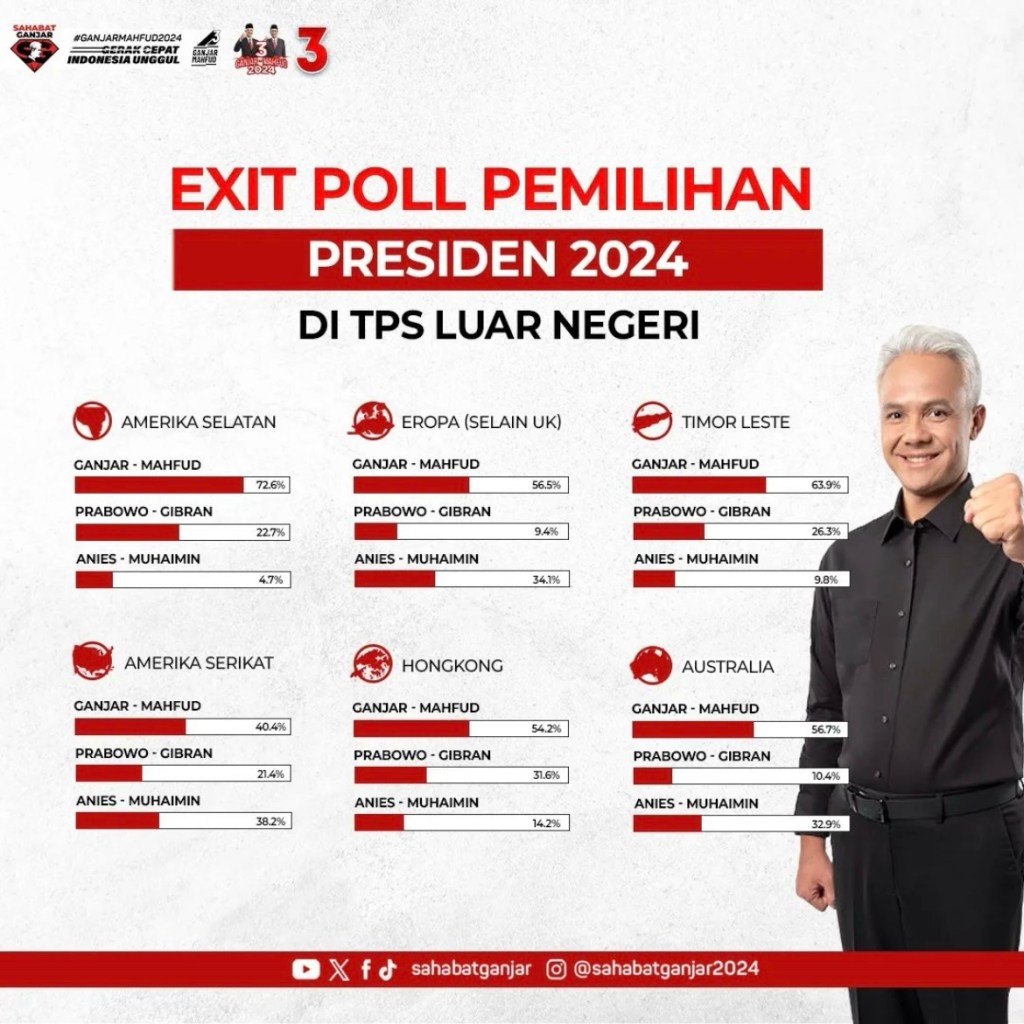
Worldwide exit polls for this month’s Indonesian presidential election have been released in defiance of the election rules which prohibit them from being announced until polling booths are closed in Western Indonesia on Wednesday.

Surprisingly all of the results gave a win to Ganjar and Mahfud MD, the least popular pairing across all domestic surveys, and by large margins.

In some cases the exit polls were conducted ahead of the actual voting day which differ from country to country, presumably based on those who cast mail-in ballots.

However, by no means it’s an indicator for the final results. Prabowo-Gibran are expected to sweep the election on Wednesday and they’ve been polling increasingly better by the week, exceeding 50% in some cases, which would negate the need for a second round in June.

By the way, overseas votes are counted as part of the South and Central Jakarta constituency, so they don’t matter as much in the national level.

Overseas exit poll results for the
2024 Indonesian presidential election

South America:
Ganjar-Mahfud 72.6%
Prabowo-Gibran 22.7%
Anies-Muhaimin 4.7%

Europe
Ganjar-Mahfud 56.5% 
Prabowo-Gibran 9.4% 
Anies-Muhaimin 34.1%

United States
Ganjar-Mahfud 40.4% 
Prabowo-Gibran 21.4% 
Anies-Muhaimin 38.2%

Timor Leste
Ganjar-Mahfud 63.9%
Prabowo-Gibran 26.3%
Anies-Muhaimin 9.8%

Hong Kong
Ganjar-Mahfud 54.2%
Prabowo-Gibran 31.6%
Anies-Muhaimin 14.2%

Australia
Ganjar-Mahfud 56.7%
Prabowo-Gibran 10.4% 
Anies-Muhaimin 32.9%