How platforms like TikTok and Twitter are like life itself

Social platforms reflect people’s behaviors but unlike life, you can uninstall and stop visiting them.

TikTok and Twitter are often described as mirrors of life; chaotic, messy, sometimes brilliant, sometimes horrifying. But here’s the thing: life didn’t come with an “uninstall” button. These platforms do, sort of (you can remove the apps or stop visiting them altogether). And that makes it a lot harder to accept their messiness as something we just have to live with.

The harm they cause is undeniable. The misinformation, the rabbit holes, the amplification of violence and hate, it’s all right there, front and center. And because these aren’t immutable forces of nature but products of human design, it feels logical to think: Why not just turn them off? If a bridge kept collapsing under people’s feet, we’d stop letting people walk on it. If a factory was spewing toxins into the air, we wouldn’t celebrate the occasional mural painted on its walls, we’d shut the thing down.

But TikTok and Twitter aren’t just digital bridges or toxic factories, they’re also marketplaces, stages, classrooms, protest grounds, and cultural archives. They’ve been instrumental in amplifying marginalized voices, organizing grassroots movements, and spreading ideas that would’ve otherwise been silenced. Shutting them down wouldn’t just erase the harm, it would also erase the joy, the connection, the organizing power, and the little moments of humanity they enable.

That’s the tension we’re stuck with: the pull between “this is causing so much damage” and “this is doing so much good.” And it’s not a tension we can resolve cleanly, because both are true. These platforms are not neutral, they’re shaped by design choices, incentives, and algorithms that reward outrage, escalate conflict, and keep users scrolling no matter the emotional cost. But they’re also spaces where real, meaningful things happen, sometimes in spite of those same algorithms.

It’s easier to point fingers at the platforms themselves than to reckon with the fact that their messiness isn’t an anomaly, it’s a reflection. They thrive on the same things we do: conflict, validation, novelty, and the occasional hit of collective catharsis. The darkness they expose isn’t artificially generated, it’s drawn out from people who were always capable of it. TikTok and Twitter didn’t invent bad faith arguments, moral panic cycles, or performative empathy, they just turned them into highly optimized content formats.

That’s why it’s so tempting to reach for the “off” switch. Because these platforms don’t just show us other people’s mess, they show us our own. They force us to confront the uncomfortable reality that the world doesn’t just have ugliness, it produces it. And no matter how advanced our moderation tools get, or how many advisory panels are assembled, there’s no elegant way to algorithm our way out of human nature.

But accepting that doesn’t mean we stop holding these platforms accountable. They’re still products of human design, and every design choice, from the algorithm’s preferences to the placement of a “like” button, shapes behavior and incentives. The companies behind them can and should do better. But even if they do, the fundamental tension remains: these spaces are built on human behavior, and human behavior will always be messy.

Maybe the real discomfort isn’t just about what TikTok and Twitter are. It’s about what they reveal about us. The chaos, the harm, the brilliance, the joy, it’s all a reflection. And if we can’t figure out how to look at that reflection without flinching, no amount of platform reform is going to save us from ourselves.

P.S: Let me just add that I’m talking about the old Twitter, not the cesspool of unhinged miseducated misinformed mass of misguided white supremacists that it has increasingly become, a.k.a discount 4Chan. On top of that, outside of the English speaking sphere of the platform, the old Twitter still exists unbothered or unaffected by what’s happening outside of their spheres partly due to cultural differences, partly due to lack of relevance, partly due to language, and perhaps a handful of other reasons.

Linda Yaccarino doesn’t have X on her Home Screen

X CEO Linda Yaccarino showing her iPhone screen to the audience at Code Conference

CEO of X doesn’t have X on her Home Screen but casually (maybe inadvertently) shows off Facebook and Instagram while on stage at Code Conference. Maybe she uses the browser, maybe it’s on the second page, maybe she’s a desktop or Tweetdeck user, doesn’t matter, successfully fumbled the optics all on her own, nevermind the interview itself.

This is why companies have PR people who deal with media or appearance briefings. Going to be a study case or example in PR circles.

Kara Swisher then posted her Home Screen in response and hilariously this set off a trend on Threads where people started showing off their home screens and discussed why they have certain apps there.

Meta follows Twitter in charging for the coveted blue internet checkmark

Weeks after someone saw code inside the Instagram app referring to paid verification, Meta today formally announced their latest copycat feature, the paid blue checkmark.

Like pretty much every major product that Meta offers, the blue checkmark originally came from somewhere else, in this case, Twitter. Now that Twitter is charging for it, Meta can’t resist doing the same but they added their own twist.

Just like Twitter’s version, you’ll get the all important blue badge, increased visibility and reach, and exclusive features, but you’ll also get personal customer support, something that Twitter can’t offer because Elon fired everyone already.

Meta’s checkmarks are more expensive than Twitter’s. Even more expensive than paying for Netflix, Disney+, or HBO GO. One month of Meta Verification costs the same as Disney+ Hotstar for one entire year. Think about that.

Twitter charges US$11 per month from mobile apps and $8 from the web, while Meta charges $15 from mobile apps and $11 from the web.

Meta’s paid checkmarks are available only in Australia and New Zealand for now, though, so they make you crave for it with the oh so good FOMO and envy brewing up inside of you.

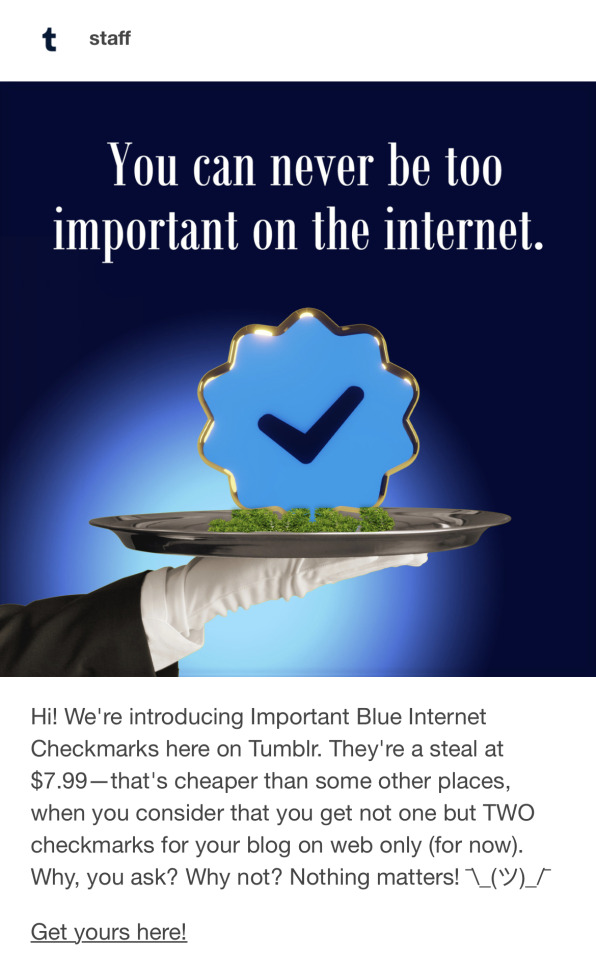
But my favorite one, though, is Tumblr. For a one time payment of $8 you get not one but two badges all at once and if that’s not enough, you can buy and display up to 12 pairs of badges! They now come in all rainbow colors too, not just blue, so it’s so much fancier and cooler because you can pick and choose which colors you want. You pay once and you keep it forever. Or until you delete your account. Love those guys.

Who Wants to Pay for a Checkmark?

Hey, look who’s taking after one of the most unhinged individuals to ever run a company and dipping their toes into making identity verification a commercial product?

The entire point of account verification is all about confirming that the profile account represents who it claims to be. The part about having to be a notable person or organization was a side effect of the notion that only public figures needed to have their account verified to avoid impersonation.

The fact is anyone or any organization could be impersonated for any reason as notability needs not be on a national, let alone global, level.

If Meta is truly aiming to drive revenue out of account verification then it’s not about notability anymore. They should just make it like Tumblr and charge it for kicks because nobody knows if you’re a dog, who cares as long as you pay? The initial roll out of the revamped Twitter Blue went exactly as everyone outside of the company would expecte.

If account verification is about identity they can do it by enabling rel=“me” by way of a website that the person or entity controls.

The rel=“me” identity verification attribute is used to establish a link between a website and a person’s or organization’s profile on another site. This will assert that the entity owns or runs both the website and the profile on the other site.

Basically it lets other websites or services know that you are who you say you are without having to submit further proof of identity such as your government ID and saves them from the arduous process of manually verifying every profile created on their service and saves you from the repetitive process at each online service.

However, because there’s no central authority that actually verifies this attribution it can create a single point of failure if the reference website gets hijacked, leading to security issues such as identity fraud.

Between the lack of central authority and chaos through impersonation accounts, essentially it comes down to which problem they are more willing to deal with. And if say it costs $5 a month to have a check mark next to your name, that’s potentially hundreds millions maybe billions of dollars of additional annual revenue. Who’s gonna say no to that?

Before you know it every corporate social network will charge for a check mark and you’ll be spending more per month than your streaming subscriptions combined.

The death of third party Twitter apps

On Friday, 13 January 2023, Twitter turned off access to most third party Twitter clients. People who used apps like Tweetbot, Twitterrific, and Echofon were suddenly shut out of their apps, faced with a screen that told them there’s an authentication issue. 

It’s not the first time third party apps were given the shaft by the company but this time there were no warnings, no official statements acknowledging the matter, no explanations. It’s as if millions of voices were suddenly silenced.

While there had been internal discussions about the ban, it wasn’t until almost a week later that there was an official word and even then there was no public communication that third party apps are no longer allowed. Engadget found out by diving into Twitter’s developer terms which were only just updated yesterday.

Twitterrific developer Craig Hockenberry was rightly incensed about the move, and his Iconfactory colleague Sean Heber wrote about having to shut down the app after 16 years. It’s absolutely clear that Twitter is no longer the same company as it was a year ago or even six months ago.

Unlike companies such as Instagram, Snapchat, YouTube, or TikTok, Twitter had always been reliant on third party apps and solutions even near the beginning, which was why the 2012 API restrictions were met with massive backlash to which Twitter then relented. This time, though, no such luck.

Social Media Diversity Gets Reinvigorated

I think I’m pretty happy that one of the major things that came out of 2022 was the implosion of Twitter which opened up a whole range of other destinations for the social web that may have always been there but saw little attention.

The social space is exciting again with people flocking to places like Mastodon, Post, and Tumblr and the federated space is getting far more attention than ever. 

In a lot of ways it seemed to have brought back some of the web development energy of the 2000s as people began to rethink what’s possible.

Much of the development back then was fueled by VC money which ultimately halted many innovations in pursuit of growth and dominance so it remains to be seen how this new energy is going to be funded. I have doubts that crowdfunding will be able to generate the necessary resources without being supported by other forms. 

What that would be I guess is something that we’ll eventually find out in the coming years if the stance against capitulating to VC demands becomes more widely adopted.

Someone wake Instagram’s Twitter admin up. They haven’t posted in days.

The suspensions of journalists from Twitter should have been a wake up call for media organizations 

There were just too many things going on about Twitter over the past week and all of them absurd. I’m happy that John Gruber took the time to summarize it all and even added the parts about Tesla and Jack Dorsey that I might not have touched on. 

I was in the Spaces discussion hosted by Buzzfeed reporter Katie Notopoulos but left just before Elon joined. At that point I was too upset at Jason Calacanis insisting on hypotheticals and the journalists refusing to answer one question so the discussion could move forward. Had I stayed I might have caught Elon rage quitting mid question.

This should have been a moment in which media companies realized and took a stand for their social presence instead of hoping or demanding that the suspension of their reporters’ accounts be lifted. The CNN statement is stronger but only by a smidgen.

This is an opportunity for media outlets to take control of their own social presence and join the fediverse. I touched on the issue last month in my post about the need for identity authentication but by hosting their own social presence, not only will companies be hosting their own and their own staff’s posts, they are not beholden to the rules, limitations, issues, or restrictions of other people’s platforms. 

The online social presence of media companies or any organization in general doesn’t even have to take the form of established platforms. They can create and design their own and still be connected to the federated network thanks to ActivityPub, the protocol that allows such things to happen.

Imagine Washington Post’s website address looking like washingtonpost dot wordpress dot com or their work emails looking like jbezos at gmail. Of course they have their own website and email with official corporate addresses.

For organizations with a half decent tech team, setting up and managing a fediverse presence is trivial. It’s time for them to take control of their own social presence.

Expanding Twitter’s Character Limit. Again.

The point of Twitter was its brevity. The need to conform to SMS standards was why it was limited to 140 characters with 20 set aside for the username. Five years ago they raised it to 280 long after it no longer needed to match SMS and now they apparently want to raise it again to 4,000

Some time after Twitter allowed people post up to 280 characters they said the majority of tweets don’t reach the limit but they never said how popular threads were and how long was the average thread. Twitter has always been more suited for story tellers so it makes sense to let people write longer posts.

Twitter’s reach and discoverability was a major selling point to bloggers and journalists to share their thought streams and link to their work. It’s why they were among the early adopters of Twitter alongside the startup crowd.

Letting people post long tweets is basically coopting the blogging experience, essentially telling people that they can just post everything there, not bothering with links. Most people don’t blog anymore so that’s moot but people do share stories and they make long Twitter threads, which means threads are going to go away. 

Twitter’s plan to release Notes (Twitter Write) was in early stages before the takeover and it was a full blogging experience with embedded images, captions, and titles but they were going to be separate from the regular tweets, a lot like Instagram’s Guide, which was likely inspired by Twitter Moments. Curious how they’re going to roll it out now after the people who worked on it are no longer around. 

It would be relatively easy to just expand the character limit but it’s also lazy. Turning Twitter into a full blown story telling or blogging platform would make more sense and it may serve to head off the migration to other platforms like Tumblr or Mastodon (face it, Google’s Blogger just isn’t a thing anymore) but that’s only looking at it from a product perspective. 

The return and increase of right wing political radicals on Twitter is a major turn off for many people and many have jumped over to other platforms. However there are crowds that are not affected directly by these groups, can’t afford to switch platforms for whatever reason, or simply chose to stay. They may still stick around, oblivious or dismissive to what’s happening, and most likely be taking advantage of the new features instead of jumping to another platform. 

Change is challenging and it’s not just about features or environment. Leaving your playground or asking people to move to a new one is not easy. The push factors need to be stronger than the pull factors and if people don’t feel the need to move, they won’t, no matter how much you try to convince them. Letting people write even longer tweets could be a reason for people to stay.

Several months ago Twitter acknowledged that someone had exploited more than five million user data that were stolen in the breach last year. Turns out multiple individuals had managed to get their hands on them.

The security researcher who tweeted this fact this week had his account suspended almost immediately.

9to5 Mac ended the story with a banger of a closing line:

We would reach out to Twitter for comment, but Musk fired the entire media relations team, so …