Samsung could be a threat to Google

Today’s Monday Note by Jean Louis Gassée sparked an interesting thought and possibility that Samsung is gaining a serious upper hand in the Android world and could use it as leverage against Google. Now why would Samsung do that?

At this point, Samsung probably wouldn’t do anything to jeopardize the relationship with Google, after all, it’s selling tons of Android phones across the world and has become the number one smartphone maker on the planet because of it. Samsung owes a lot of that to Google.

On the other hand, it’s exactly this position that may allow Samsung to put pressure on Google. Samsung is large enough to dwarf its closest competitors and enough of an influence to pull off two of the three Nexus phones, the pinnacle and showcase of Android.

HTC and Motorola are the next largest Android manufacturers yet their sales are nowhere near Samsung’s and in fact have been cannibalized by its Korean competitor. The two companies are suffering.

Erik Sherman at CBS MoneyWatch puts Samsung’s share of Android phones at 55%. Given that it’s an estimation, it’s likely to be off by a bit but still an impressive ballpark figure. Since Samsung no longer officially announces its sales figures for mobile devices, it’s difficult to ascertain just how much of a lead precisely it has over its competitors both inside and outside of the Android ecosystem.

Android is still Samsung’s bread and butter as far as smartphones go, but it also has bada, its own mobile operating system and also Windows Phone to fall back on in case things go sour and you may never know what could happen in this industry. Look at Palm, Apple, RIM, Nokia. In the last five years, the mobile industry has changed so much.

Seeing what Amazon managed to do with Android along with a number of Chinese manufacturers, it’s not out of the question that Samsung could consider forking and maintaining its own version of Android away from Google, thereby creating its own ecosystem.

Why would it want to do that? Control. Google is beginning to assert a level of control that it previously did not require. Ice Cream Sandwich, the fourth iteration of Android, will require partners to include the default Holo theme as an option or risk losing Android Market access.

This may not sound like a big deal at first but it could ruffle some feathers at Samsung, HTC, and other Android companies. The very reason they came up with their own display themes is to differentiate themselves from the competitors and now Google wants conformity (albeit as an option) across the board and it is willing to punish partners for not abiding. After this, what else would Google do to assert control? That’s the question likely going around at the headquarters of those companies.

Google may not want to follow up further than this though, seeing that Microsoft hasn’t been successful going with this very strategy of requiring near-uniform features on its Windows Phone handhelds but it also has market challenges elsewhere. In fact, Microsoft is looking like it will rely mostly on Nokia to push its mobile platform ahead of its other partners.

However, if Samsung were to go by this route, it could face consumer backlash if it fails to execute it properly. An Android variant by Samsung would initially have to be compatible with Android Market apps, just like the Amazon’s Kindle Fire but it may decide to move its entire platform towards its own marketplace. It already has Samsung Apps as a repository for Samsung-exclusive apps and ChatOn could be step one towards establishing its own ecosystem.

At the moment, the smartphone market is run by four major operating systems; Symbian, Android, iOS, and BlackBerry. Windows Phone is still in its infancy and unlikely to make a significant enough move by itself in the next 12 months to break into the top 3. In three years though, who knows.

There’s no way Samsung would pull this off in the next 12 months but I’d be surprised if they’re not working on something that could significantly reduce their reliance on external parties.

Google looks like it needs to pull off its acquisition with Motorola Mobility more than most people think and somehow get people to buy Android phones from Motorola instead of others.

Google may be buying Motorola Mobility for its patent portfolio and is vowing to operate the company independently but down the road, it may be the most important play it makes for its Android platform if it can execute it well.
With “Open” Arms

parislemon:

Chris Ziegler of The Verge was finally able to clarify (via a source, presumably within Google) what Google means exactly when they give Android activation numbers. Essentially, it’s when you activate Google services on the device.

In other words, Kindle Fire, Nook, etc, don’t count as Android devices by this metric. Seems a bit odd, no? Android is an open ecosystem, but Google only counts you if use their services. 

Sure, you can argue that Google has no way of knowing the numbers for those other Android devices, but they could at least acknowledge them. It’s weird that they don’t given the millions of units this would add overall ecosystem bottom line. 

On the other hand, Google probably doesn’t like what players like Amazon are doing by forking Android. You usually don’t give your enemy a pat on the back. 

With “Open” Arms

parislemon:

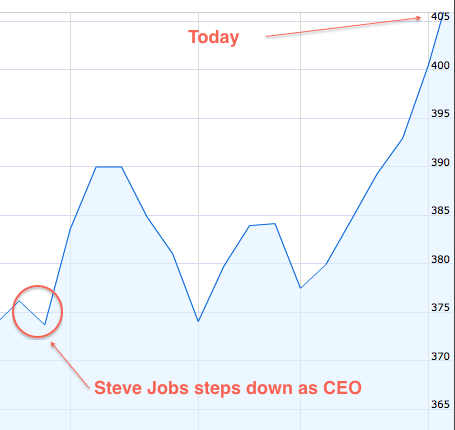
It has been almost a month since Steve Jobs officially stepped down as CEO of Apple. Today the stock is literally off-the-charts at a new all-time high. 

Apple’s market cap is now nearly $25 billion larger than Exxon’s, the second most-valuable public company in the world. Apple’s market cap will soon surpass $400 billion.

The iPhone 5 hasn’t even been announced yet.

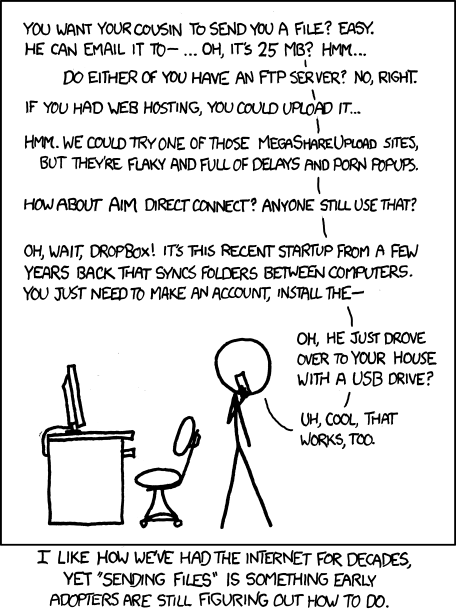
File transfer is complicated

Apple would love us to believe it’s all “Eureka.” But Apple produces 10 pixel-perfect prototypes for each feature. They compete — and are winnowed down to three, then one, resulting in a highly evolved winner. Because Apple knows the more you compete inside, the less you’ll have to compete outside.

Comparing your Mac’s raw performance with other Macs

The benchmark is a PowerMac G5 1.6GHz at 1000 points, measured using GeekBench. You can switch between 32-bit and 64-bit performances.

My late 2007 2.2GHz MacBook scored 3281 for 64bit performance, just 50 points ahead of the same speed MacBook Pro released earlier in the same year, which means it’s just over three times more powerful than the baseline PowerMac G5. The base model 2011 MacBook Air with Core i5 though, scored 4988, nearly five times more powerful.

Comparing your Mac’s raw performance with other Macs

Lenovo executive claims Samsung sold only 20,000 Galaxy Tabs

Samsung said at the end of 2010 that it had shipped 1m of its 7-inch Galaxy devices, which were seen as the first real Android competitors to Apple’s iPad. However, according to Barrow, Samsung only sold 20,000 of the tablets. Samsung had not returned a request for comment on Barrow’s claim by the time of publication.

A claim by Samsung’s Lee Young-hee earlier this year that the sales of the first Galaxy Tab Android tablet was “smooth” was apparently misheard as slow. If what Andrew Barrow of Lenovo said is true or close to the truth, slow and smooth apparently mean the same thing to Samsung. Also, how many people you know would describe sales performance as smooth?

Lenovo executive claims Samsung sold only 20,000 Galaxy Tabs

It was more than frustrating,” the former White House aide said. “Here we were, this young hip administration, and we were using stodgy BlackBerrys and old Microsoft programs. A lot of us were starting to get iPhones and iPads and we couldn’t really use them.

The White House is running a pilot program to get Apple’s mobile products approved for official use – Politico

Apple claims Android has roots at Apple

Before you go all crazy and accuse me of fanboyism or Apple being ridiculous (or both), go read the piece from Florian Mueller. In one of Apple’s filing against HTC, it says that when Andy Rubin worked at Apple in the 90s, his superiors were the ones who came up with a patent that Rubin later used to create Android, which means he may have been a contributor to the patent that Apple owns. If the ITC judge holds up Apple’s argument, this clearly will not bode well for Android.

Rubin worked at Apple long before the iPhone – even long before the iPod. If Apple had just claimed without particularity that Android started at Apple, most people would dismiss such an allegation as complete nonsense. But Apple now asserts – in a filing with the ITC, which means Apple has a legal obligation to make truthful representations of fact – that Rubin’s superiors at Apple were the inventors of that realtime API patent and he worked for them at the very time they made that invention. He worked as a low-level engineer while the inventors were senior people. It’s possible that he then contributed to the implementation of the claimed invention.

Apple claims Android has roots at Apple

What’s going on with Michael Arrington?

At the beginning it looked like Arrington simply wanted to go back to investing since that’s how he got into this blogging business in the first place and even more so recently when he put money into a number of startups.

The way AOL is going about the news from today however, is a lot less clear. AOL had committed Arrington for three years as part of the TechCrunch acquisition which means he’s still got about two years to go but if AOL wanted him out of TC, they could be shifting him aside to another arm outside of the Huffington media group.

Here’s a summary by Dan Primack at Fortune:

It told the NYT that Arrington would still have a (reduced) role with the site, and continue reporting directly to Arianna Huffington. Then AOL said he would report to AOL Ventures. Today it says that he is no longer employed by the company, but can continue contributing to TechCrunch as an unpaid blogger. In other words, AOL is acting like AOL typically acts: Scattershot.

It’s been less than 24 hours so the flurry of news is still coming in and even news out of AOL itself isn’t clear. Nobody seems to have a straight story to tell.

Meanwhile, not a peep from TechCrunch but a monster rant from Kara Swisher.

[update] Paul Carr has his say on the matter. Yes, AOL screwed up in announcing the CrunchFund.

What’s going on with Michael Arrington?