

Back in April I picked up the Oppo Find 5. A solidly built 5-inch Android phone with a 13 megapixel camera, large battery capacity, and high resolution screen. At first glance, it looks something like a model out of the Sony Xperia line with its clean, sleek look with bold lines and all glass face plate. This substantially large phone is out to impress with a big risk in carrying an unknown brand.
For a new player to launch this kind of offensive on the crowded smartphone market is more than brave, perhaps even foolish, but the Find 5 doesn’t seem to break a sweat on the challenge.
You can read some of my early impressions of the Find 5 and see more photos of the phone on my Flickr set.
Oppo is perhaps better known to some as a consumer electronics company or as a maker of Blu-Ray players but for most people, it’s an entirely unknown brand with no reputation to speak of. Then they went and launch a high end Android smartphone with a funny name and “premium” pricing. Naturally, red flags went up on people’s minds.
Just about everyone I met since I got the phone wanted to know about the phone. They all gushed about the screen, the responsiveness, the sturdy build and premium-looking design, but when they found out about the brand and the price, pretty much all of them looked at me in disdain. Almost everyone said, “Why should I pay that much for a Chinese phone? So expensive”.
The Jelly Bean-powered Oppo Find 5 sells for Rp 5.5 million in Indonesia, roughly USD 550. When people hear about a Chinese branded phone, they generally think of low cost knock offs, phones that cost between $150-250 with low end or mid-range specs. The reaction they gave when they hear $500 for a Chinese phone is perhaps similar to finding out that you have a contagious skin disease.
Never mind that the Find 5 is in the same class as the Xperia Z and ZL which is just above the Nexus 4 and better than the Galaxy S3. Never mind that the Find 5 is still cheaper than any of the other phones mentioned, save the Nexus 4, which goes for Rp 5 million on standard retail price.
But let’s step past the name, origin, and the price for a moment and take a look at what this phone offers. The Oppo Find 5 is sold as a powerful, high end Android smartphone with a more affordable pricing.
Packaging
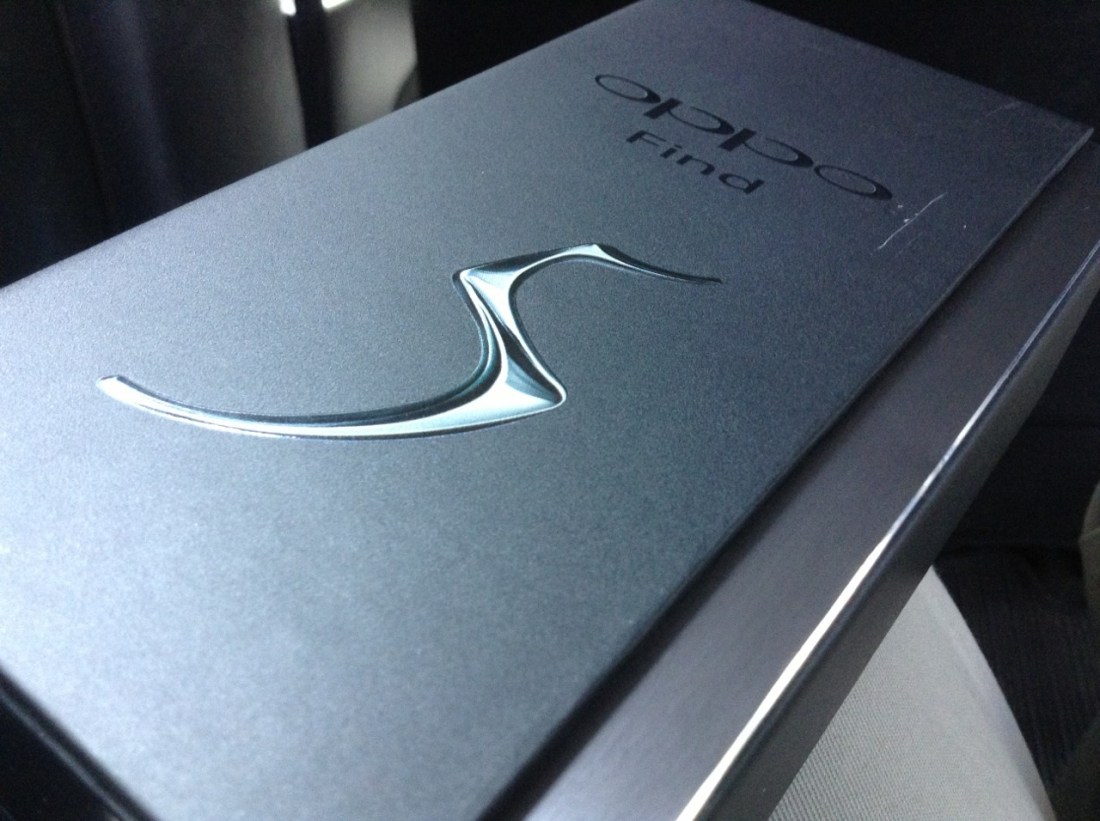
In releasing the phone, Oppo wants to deliver a premium phone experience to a greater range of consumers. This intention can’t be more evident than from the packaging that the Find 5 comes in.
Aside from Apple, Nokia had been the only other mobile device manufacturer that takes great care in how its products are packaged. Both companies carefully pack their devices and their accompanying accessories as well as printed documents inside a packaging that brings delight to those who receive and open them. With the Find 5, Oppo joins that exclusive club.
The clean, matte black box with glossy patterned ends and a magnetic seal across the side of the top really sets it apart from many other smartphone packaging and raised the bar significantly for most other manufacturers. Upon seeing this box, it’s fair to say that the content had to be equally impressive or the entire experience would greatly suffer.
Physical
The back of the box reveals some specification details of the phone. Technically named Oppo X909, it has a 5-inch full high definition screen packing 1920 x 1080 pixels, which gives it a screen density of 441 ppi, the second highest ever released on a mobile device, highest being the HTC One at 468ppi.
Before you even open the box, you’ll know the screen will give you very sharp and very detailed images. The viewing angle is very wide and you won’t see color desaturation or shift even at sharp angles. Color reproduction is very clear and vivid with great contrast, and video playbacks look great. It’s brilliant.
In terms of physical attributes, the Find 5 weighs 165 grams, with a dimension of 141.8 x 68.8 x 8.8 millimeters. Because of the 5-inch screen, the phone is taller than the 4.5-inch Lumia 920 which I dub the aircraft carrier because it is so large and heavy, but it is also thinner, lighter, and slightly narrower. Perhaps the moniker will have to change now.
The two tone look with a flat black screen and curved white plastic back gives the phone a very polished professional look. The surface is very clean save for the volume buttons on the right side of the phone, the power button on the opposite side, a 3.5mm audio jack on top and the micro USB port at the bottom. On its back, you’ll find the primary camera perched on top of its double flash LEDs with the speaker grille positioned at the other end. Oppo’s branding is curiously placed horizontally which can easily be misread as Oddo when held the other way around.
Make no mistake, the phone is large but the fact that it’s quite thin with a curved back makes it much easier to handle. The physical button positioning feels perfect but when you want to operate the phone using the soft buttons located right underneath the screen, you have to slide the phone up a little bit to adjust your grip unless you have large hands.
Unfortunately the soft buttons are a little too close to the spacebar when the keyboard is up so when hitting the space bar it’s easy to mistap and hit the home button instead.
Internal
The Find 5 is powered by a 1.5GHz quad core Snapdragon S4 Pro processor, coupled with Adreno 320 GPU and 2GB of RAM. The battery is a very capable non-removable 2500mAh slab which gives the phone two days of light use or one day of standard active use on a single charge. With my typical use however (always on Twitter and Path), 10 hours is the absolute most it will last on a single full charge.
The phone holds 16GB of storage space, with 12.5 GB available for use. According to Phone Storage in the Settings app, it has 2GB of internal phone storage and 10.5GB of phone memory or phone storage.
With the phone entirely enclosed, there’s no way to add more storage through an SD card. Strangely there is an option to erase SD card contents within the storage settings, although it may well have been left there as part of a standard Android feature. In any case, 12.5GB is all the space you’re given with the Find 5 unless you happen to pick up the 32GB model.
Connectivity
The Find 5 runs on multi-band WCDMA and GSM frequencies, covering 850, 900, and 1900 MHz for both networks, as well as 1800 MHz for GSM and 2100 MHz for WCDMA. It’s world phone that will work just about anywhere on the planet over a GSM or 3G/HSPA network.
Lack of LTE is not much of a disappointment at this stage but in the few markets with LTE coverage, it’s a slight handicap. With NFC, Bluetooth 4.0, Wi-Fi a/b/g/n, DLNA and FTP support, it’s got enough for speedy data transfers and to serve as an entertainment console. The two NFC stickers included in the package, can be used to trigger certain predetermined actions such as sending the display to a compatible TV, changing profile settings, launching certain apps, and so on.
Cameras
The Find 5 has two cameras, the rear one produces 13 megapixel shots and the front shoots 1.9 MP. Unfortunately they are not excellent cameras. It wouldn’t be fair to compare the rear camera to the 8.7 MP camera on the Lumia 920, but against the 8 MP camera on the iPhone 4S, the Find 5 falls a bit short. In taking low light photos, even the 5 MP camera on the iPad mini manage to take brighter photos.
Given ample outdoor lighting, the primary camera on the Find 5 performs mostly as expected with sharp and detailed pictures and vivid color reproduction. Take the camera indoors with only standard room lighting, watch the performance drops. Shots become grainy, details are lost, and you’ll get ordinary results with cropped photos. Bottom line, the rear camera on the Find 5 is decent, adequate, and good, but unfortunately, it’s not brilliant for taking photos.
Sample shots can be found on my Google+ posts here and here
Camera Software
There’s a basic set of camera features built in to the Camera app including four resolution options, flash, facial recognition, timer, panorama and HDR and its editing abilities are quite comprehensive with color corrections, filters, cropping, red eye correction, effects, and more.
The built in panorama feature is definitely handy but it doesn’t produce results as good as Nokia’s Panorama or iPhone’s built in panorama. Unlike the iPhone’s portrait pan for panorama, the shot is taken with a horizontal orientation but again, intricate details are often lost in a blur although overall performance is still acceptable.
The rear camera also takes high definition videos at 1080p. As a video camera, it’s not bad. Pictures look sharp, colors are good, audio is captured well, and it only has minimal blurring on high speed motion. The settings let you choose between high speed and low speed video at 480p or standard speed videos at 720p and 1080p. HDR video option is available only at 1080p recording.
Software
As with most Android devices, manufacturers are free to modify it as they like. They can add remove, or alter almost any part of the Android software package and deliver them with their own custom version. Oppo’s Android 4.1.1 is no less modified. Oppo has said that it is preparing an update to Jelly Bean 4.2 but even with 4.1.1, the phone performs well.
The stock launcher is a let down to be honest. It looks terribly ridiculous, icons are forced into square designs, each application icon is placed on top of this odd gray plate, the widgets have these bubbly shape that serve no purpose but to take up space, it’s just a mess, although the lock screen options are pretty nice. Fortunately it comes with a set of apps that allow you to change the looks of the launcher and if that’s not enough, you can always search for more on Google Play.
It’s important to note that there is an official Cyanogen Mod replacement for the Find 5 which is surprisingly pleasing for those who can’t stand the stock operating software. It’s encouraging to know that Oppo realizes that its current software isn’t really up to snuff and is allowing a well regarded third party custom Android ROM builder to provide it with an alternative. Oppo also has its own effort to deliver an improved experience called Project Firefly which currently is still in private beta.
The Photo app initially shows only two folders, the Camera and Screenshots folders and this would throw people off if they had downloaded images through the browser, over bluetooth, or had created them using apps. Fortunately there’s a way to make other folders visible if they exist, through the soft menu button below the screen.
Even though the phone runs Jelly Bean (4.1.1) it doesn’t support launching Google Now from the home button but with the right Launcher, it can be modified. A long press of the home button actually opens the list of recently active apps and you can clear them all with a single tap on the Sweep button or manually removing them one by one with a swipe up.
Perhaps a downside to its modified software is that the battery settings show nothing more than what you can see on the toolbar on top. It doesn’t actually have the standard battery usage breakdown and battery life monitoring tool. It’s unclear why Oppo has omitted this, maybe it’s not at all confident about its battery performance.
Bottom line
The Find 5 is a substantial phone. It’s large, wide, tall, and slightly hefty but it’s also very well designed. Overall, the hardware is amazing coming from a company with practically no experience in building a smartphone. Its first smartphone effort is so well done, it would be a shame if it didn’t catch on in the market.
It’s not iPhone 5 but it certainly beats the crap out of any phone that Samsung has ever made, and yes, that includes the Galaxy S4. The screen quality is among the top of the market which is important when it’s a device that will get used constantly throughout the day.
Unfortunately, the Find 5 will have to have points taken off of it for poor software implementation and generally average camera. It’s great that Oppo is working on improving the software and even allowing alternatives, but out of the box, it’s not a great experience.
When that’s finally taken care of, there’s still the issue of the camera. For it to be bested by iPad mini in low light and by the 4S in capturing details and sharpness is embarrassing. It brings down the phone’s otherwise great experience and there’s nothing anyone can do about it.
The good thing though, ordinary camera performance is only one of the very few low points of the device. The Find 5 is a standout smartphone from a new manufacturer that can already compete in the big leagues with the major players and their long list of experience.
It’s like Oppo managed to figure out what needs to go into a standout device and packs them in there, or most of them anyway. The packaging is outstanding, the device is well built, well designed, and looks great. The pricing is also competitive for its class.
People just needs to get used to the idea that Chinese brands don’t necessarily mean cut price pedestrian products.
 AuliaSays