Megawati: Indonesia’s political system doesn’t recognize oppositions and coalitions

Megawati Soekarnoputri is once again lecturing the nation from a podium padded with nostalgia and selective memory.

At PDIP’s 6th Congress in Bali, following her reelection as party leader until 2030, she confidently announced that “there’s no such thing as opposition or coalition in Indonesia’s presidential system,” arguing that such dichotomies belong only in parliamentary governments. She then doubled down, framing Indonesia’s democracy as one “based on the people’s sovereignty and the Constitution,” and insisting that PDIP would now act as an “ideological balancing force” rather than opposition.

It’s the kind of speech that sounds profound until you remember how politics in this country actually works.

Let’s start with the basics. Coalitions are not just a feature of Indonesia’s political system, they’re a structural necessity. You need them to qualify for the presidential race. You need them to pass legislation. You need them to govern. There is no constitutional path to power without them. The electoral threshold makes sure of that. So Megawati’s insistence on semantics changes nothing about how political parties operate in practice. If anything, it’s an attempt to overwrite the obvious with rhetorical fog.

Without a coalition, Megawati wouldn’t have had Prabowo Subianto as her running mate in 2008, the same Prabowo whose party just beat hers in the 2024 election, and who spent a solid decade as the loudest, most confrontational opposition to the Jokowi administration, which PDIP dominated. Never mind that in the final years of Jokowi’s term, Gerindra’s loyalty in that so-called coalition was visibly eroding.

That same “nonexistent” coalition also helped put Jokowi and Ahok into City Hall in Jakarta. And let’s not forget, oppositions, even if not enshrined in constitutional vocabulary, have existed and operated for decades in this country. Political parties outside power have always criticized, challenged, and scrutinized those in it. They hold press conferences. They file lawsuits. They propose alternatives. That’s called being the opposition, regardless of whether Megawati feels like saying the word out loud.

Oppositions and coalitions in Indonesia are as inevitable as Jakarta’s traffic jams, they only disappear during Lebaran holidays when no one’s around. So why deny them now?

Well, it’s hard not to notice the timing. Megawati’s sudden interest in redefining Indonesia’s entire political vocabulary coincides, coincidentally, of course with President Prabowo’s decision to grant amnesty to PDIP’s Secretary General who was convicted for bribing officials to parachute a party-hopping politician into parliament and sent to 3.5 years in prison. That politician has since gone missing. For five years. But sure, tell us more about constitutional purity.

This is the kind of gaslighting that only works when everyone else agrees to play along. Megawati wants to position PDIP as above the fray, “a critical balancer,” not opposition, not loyalist, just… conveniently in between. But you don’t get to erase the last 25 years of your own party’s behavior and pretend the entire system is suddenly different because you’re not in charge anymore.

Megawati still sees herself as the matriarch of Indonesian politics, cloaked in Sukarnoist symbolism and mythic authority. But at some point, that legacy turns into a liability, especially when it’s used to blur history, dodge accountability, and deny the very dynamics that made her party viable in the first place.

If PDIP wants to stay relevant in a post-Jokowi, post-victory Gerindra era, it needs more than ideological posturing. It needs to stop pretending that the system it thrived in doesn’t exist. Because it obviously does.

And it’s probably a sign that the party needs new leadership and direction. As it stands it will never not be known as the party of whatever she wants it to be.

When Reporters Become Collateral in an Unpopular Executive Decision

So here we are: The Washington Post announced it won’t endorse a candidate this US election, and the fallout is immediate. Readers are canceling subscriptions in droves, about 200,000 and counting according to NPR, and reporters are left scrambling on social media, pleading for them to stay. As a former journalist, I feel for the reporters caught in this mess. This isn’t just an editorial call they can shrug off. It’s a hit to their credibility, their income, and their professional mission.

To me what’s important isn’t whether a media makes a political endorsement because we live in a time when these decisions don’t matter like they used to. Media endorsements don’t carry the same weight as in previous decades. What matters to me is when they did it. I said on Threads the other day,

The issue isn’t that they will not endorse but that there’s a decades long tradition to endorse one candidate over another and not just for the presidential candidates, it’s often local candidates too. That the boards of two major US papers already drafted the endorsements only to be spiked by their billionaire owners is what matters because it’s too close to Election Day. They could have announced the stance weeks or months ago but they didn’t and now they’re causing a scene.

The timing is everything here. Only 11 days before the election, the paper killed a planned endorsement of Kamala Harris, the Democratic candidate, saying it’s a return to their “roots” of neutrality, as they did until about 50 years ago. But the newsroom is in uproar. Famed reporters like Bob Woodward and Carl Bernstein have called the move cowardly. Others, like former editor Marty Baron, went further, saying it’s a betrayal of democracy itself. Many readers opined in light of the decision that the Post’s slogan, “Democracy dies in darkness”, wasn’t a slogan but a mission statement as the newspaper has decided to tun the lights off to let democracy stumble in darkness.

Meanwhile, there’s Jeff Bezos, the billionaire owner, defending the decision as “principled.” He argues it’s about restoring trust in journalism. But here’s where things get complicated. The same day the Post cancels its endorsement, Bezos’s space company, Blue Origin, had a meeting with none other than Donald Trump. Even if it’s a coincidence, it’s an unfortunate look, especially considering that endorsements were a standard practice at the Post until… well, about five minutes ago. When Woodward and Bernstein broke the Watergate scandal at the Post in the ‘70s, then owner Katherine Graham stood tall defending their decision to run the story and expose the illegal actions of President Nixon which led to his resignation. Bezos on the other hand, has no such conviction, fearing retribution by Trump in case the 34x convicted felon ended up winning re-election, and jeopardizing his government contracts and other opportunities for his companies.

And it’s not just the Post. Earlier this month, the Los Angeles Times made a similar choice, dropping its own endorsement after its billionaire owner, Patrick Soon-Shiong intervened. His daughter, who supposedly has no influence at the company, defended it as a “family decision” tied to frustration over Harris’s stance on the genocide happening in Palestine. Curiously, a feature series titled, “Case Against Trump” was canceled by the newspaper at his behest. Yet again, we’ve got a big decision, tied to editorial independence, happening at the last minute with little transparency.

USA Today has joined the ranks of papers sitting this one out. However with outlets like The New York Times, Rolling Stone, and the Philadelphia Inquirer still endorsing candidates, it seems the media landscape is splitting down the middle on this issue.

Readers, for their part, feel they’ve been sidelined. Canceling subscriptions is one of the few ways they can register their frustration with decisions made behind closed doors. But the fallout isn’t falling on Bezos, it’s falling on reporters who had no part in the decision. Now, they’re essentially forced into being spokespersons for an editorial shift they didn’t ask for, defending a stance that most of them probably would have argued against.

So, what’s the way out? Instead of reporters bearing the brunt of management’s hasty decision, maybe they could actually join with the readers on this one. Push back internally. Make it clear that if big decisions like this one are going to reshape their relationships with readers, they need to be more than last-minute top-down calls. They could demand a seat at the table, a voice in decisions that impact their integrity and the trust of their audience. Some members of the editorial boards and newsrooms at both the Post and the LA Times have made their strong opinions known even to the point of resigning.

In the end, the future of journalism doesn’t just depend on what’s reported, it depends on how these decisions are made. If the Post, the LA Times, and other major outlets want to regain trust, they need to do more than make calls from the top. Credibility is built on transparency, respect for journalists, and a genuine acknowledgment of the readers who make their work possible.

Angry Indonesian Internet Users Create Virtual Roadblocks on Google Maps in Response to Mob Murder

Indonesian internet users have flooded Google Maps with virtual roadblocks on nearly every road and street in the Sukolilo district, Pati, Central Java.

This digital protest comes in the wake of a tragic incident where a mob of local residents set fire to a rental car owner and his vehicle, resulting in his death. The victim was reportedly attempting to retrieve the car from suspected car thieves when the mob attacked. Three other men who accompanied the deceased victim were also assaulted and are in a coma in a hospital.

Several rental car business owners have come forward, revealing that they have long blacklisted rentals to individuals carrying Pati-issued identification cards due to concerns about vehicle theft. They claim that the regency is widely known within the industry as a hub for stolen motor vehicles, with many vehicles in the area lacking license plates.

Sukolilo subdistrict head Andrik Sulaksono rejected the allegations, saying the area is not a fencing hub and that it was all said by angry netizens reacting to the news of the murder.

Until recently, law enforcement authorities have reportedly taken little action in response to suspicions and public reports of vehicle theft in the region. This apparent lack of action has prompted some angry Indonesians to resort to vigilante justice.

The incident has sparked outrage among Indonesian internet users, leading to the virtual roadblock campaign on Google Maps as a form of protest and a call for increased attention to the issue of vehicle theft and the need for improved law enforcement in the area.

Police have apprehended ten suspects with evidence belonging to the victims found at their homes, and seized 27 motorcycles and 6 cars with fake registration papers, from one property.

Composite image of one neighborhood in Sukolilo showing virtual roadblocks on Google Maps on nearly every road.

Google Testing Removal of News Tab

With Australia, Canada, and Indonesia passing laws or regulations requiring platforms to pay for news links and the US having introduced the Journalism Competition and Preservation Act last year, removing the News tab looks like Google’s response to avoid having to pay link tax to media companies.

The News tab is only missing for a limited group of users for the moment. It is a test after all and I still see it when I use Google search.

In the world of ad-supported media, traffic volume is everything. Too often that means sacrificing quality for quantity and prioritising stories that generate clicks. In the subscription world, quantity doesn’t move the needle. Quality does.

theatlantic:

The Facebook Effect on the News

Around this time last year, I considered writing a story claiming that Facebook and Twitter were the new “homepages” for news on the Internet. It was going to be about how, if the Web had ripped out the article pages of newspapers and magazines and scattered them to the wind, Facebook and Twitter had pinched them from the air and stacked them in easy, vertical columns that were becoming our new first-look sources for the day’s events.

A year ago, social networks are the new homepage seemed like an (almost) original observation. Today, it’s just a boring fact.

In the last twelve months, traffic from home pages has dropped significantly across many websites while social media’s share of clicks has more than doubled, according to a 2013 review of the BuzzFeed Partner Network, a conglomeration of popular sites including BuzzFeed, the New York Times, and Thought Catalog.

Facebook, in particular, has opened the spigot, with its outbound links to publishers growing from 62 million to 161 million in 2013. Two years ago, Facebook and Google were equal powers in sending clicks to the BuzzFeed network’s sites. Today Facebook sends 3.5X more traffic.

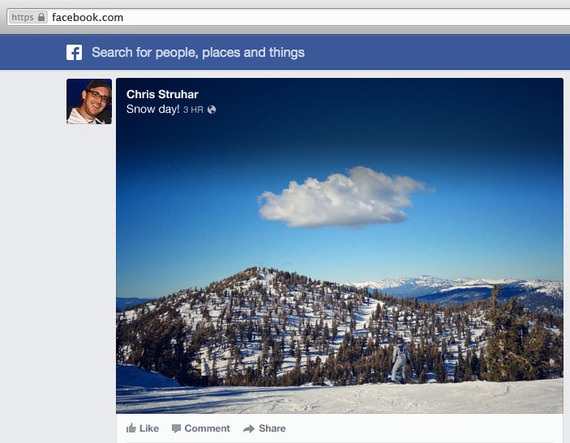
Read more. [Image: Facebook]

Concise summary of news that you need to know

Tired of trying to catch up with what’s going on in the world? Go to this website and find out what’s really important in the news today.

Concise summary of news that you need to know

I’m cutting down on news feed subscriptions

Rethinking my RSS feed subscriptions. I have 140 feeds listed (what is it with 140?), at least 10, perhaps 20 of them are defunct, as in abandoned, and I probably read only about half of the rest, max. Having 100 feeds is also detrimental to loading them on news reader apps. The sheer amount of content often brings down the app too often and when they do load, it takes a million years (not really, 5-10 minutes).

My issue now is, do I nuke them all and start from scratch or should I curate the list and eliminate the ones I definitely don’t read? I’m thinking nuke and pave is the way to go but I’m not sure if I’ll find those feeds again.

On the other hand, if they’re important enough I would come across them regardless. I mean that’s how information comes to you these days. If you care enough about it and your friends or contacts do too, you’ll end up seeing them anyway. If a piece of news is really important and you missed it the first time, it’ll pass you by several more times one way or another. 

And then there are sites that despite subscribing to them, I tend to open them on the main browser for whatever strange reason or habit I seem to have.

Speaking of which, it applies to Twitter as well doesn’t it? No need to follow thousands, just follow the right ones and you’ll get your news, jokes, and opinions that appeal to you either directly or by proxy.

What do you think?

Internet nominated for Nobel Peace Prize

The Internet has been nominated for the Nobel Peace Prize. Yes, folks, the medium that has brought us icanhascheezburgerFAILblogMySpace, and 4chan among other things is on the list of candidates to bring home the award that US President Barack Obama won last year.
Of course the internet has been the instrument of peace, there’s no doubt about it. Everyone’s too busy to wage war because they’re all updating their statuses on Facebook and Twitter, and are running around collecting points and badges on Foursquare.

Posted via email from A Geek Dad’s Log | Comment »

The Indonesian public is confused over TV news programs

Interesting stats in today’s Kompas daily (Sunday, Jan 24, 2010) about news on TV. Pollings in June 2008 and November 2009 paint a stark contrast in public perception of Indonesian television news programs. In terms of today’s programs here are the findings: 86.6%: TV news programs are more interesting

67%: TV news programs are more entertaining 71.3%: Focuses more on sensationalism over substance

64.9%: Ratings over quality 53.8%: Hosts tend to pit sources against one another (in a multiple guest sources situation) instead of digging through the issue.

52.6%: Hosts tend to back sources to a corner (in a single guest situation) instead of digging through the issue. 80.4%: Better sources or guests

80.9%: Higher quality. The last stat there is unclear as to what it refers to, presumably the quality of the news programs but it flies in the face of the other stats where it says viewers think the stations are pushing sensationalism over substance and that it’s less about quality than ratings.

It’s a funny country.

Sent from my iPhone

Posted via email from A Geek Dad’s Log | Comment »