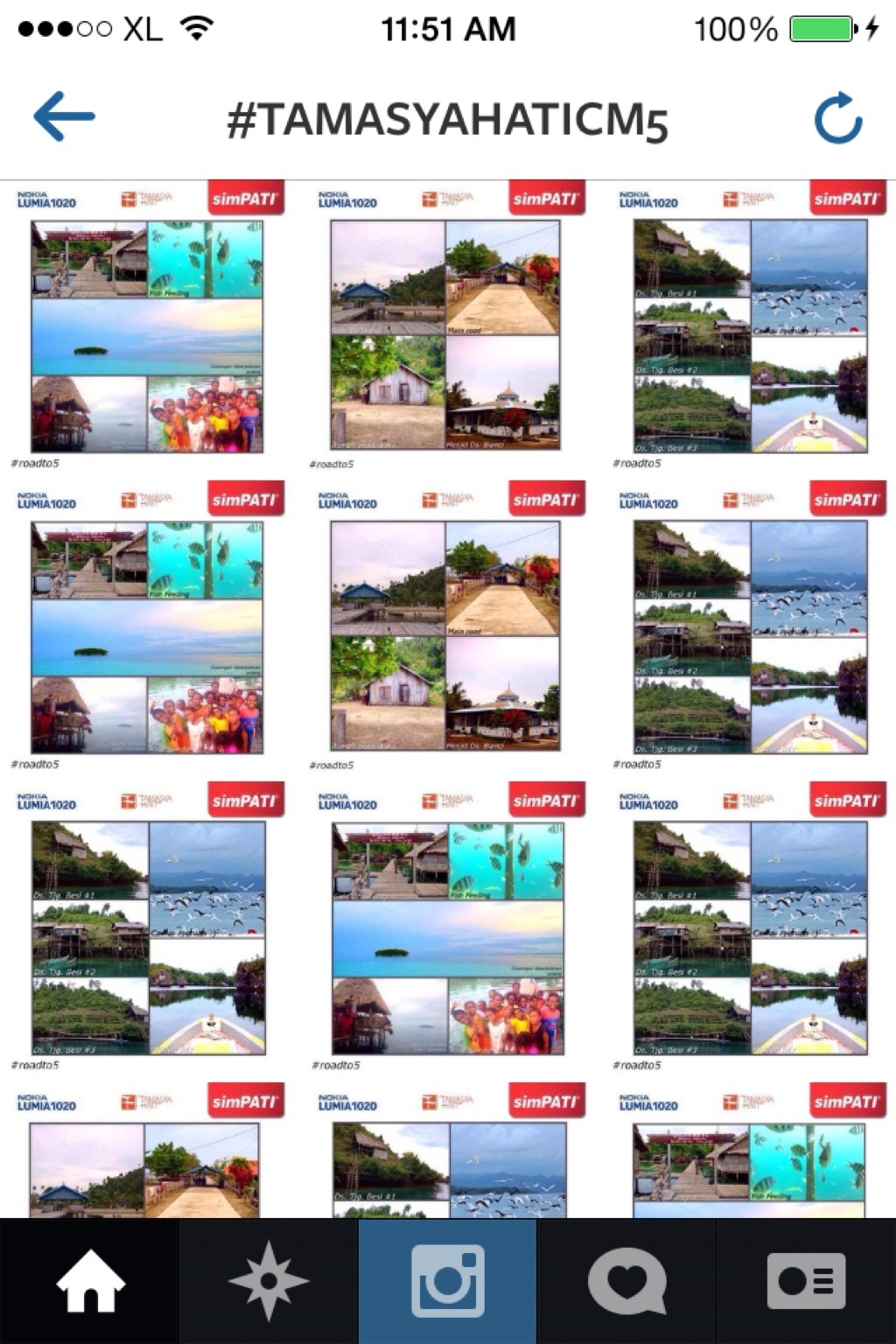
This is how Nokia and Telkomsel promote the 41MP Lumia 1020, by showcasing photos taken with the 1020 in collages limited to the tiny confines of Instagram instead of using something like 500px or Flickr that displays pictures as large as your screen can handle.

They probably are doing something on Facebook which would be a better way for a photography showcase if done correctly but with this collage approach, you can do the same with any cheap mobile phone camera. They won’t be able to see the details and appreciate the quality anyway.

Way to undermine the results of what is supposedly the greatest mobile phone camera ever made. Good job guys. – View on Path.

Got the Lumia updated last night. It was the much talked about and long awaited Portico update. Rather disappointed at how it went. See, when it said Step 1 of 4 I was expecting for there to be steps 2-4 so I planned for a photo collage of the steps and caption it “step by step”. I figured, if step one was data migration, I’d document the process to note what the steps would involve.

Instead, as soon as it hit 100% it got super excited, saying Update complete four times!! I’ve never seen a gadget get so excited about completing an update. But it had lied to me. There were no steps 2-4. It lied. And it was happy. But I was not. – View on Path.

First impressions of the HTC Windows Phone 8X

HTC is launching its Windows Phone phones here well before the others and having used the 8X briefly, it’s very hard to resist. It’s slim, incredibly light, and looks very, very attractive. The rubbery enclosure is a godsend for those who tend to drop their phones since it gives a very good grip. The camera on the 8X works really well on its own, pictures come out great and the macro can be really tight, but Nokia just has better camera support.

Sure, it’s thinner and lighter than the Lumia 920 and arguably has better speakers but it doesn’t offer the cool and fancy camera tools that Nokia has, there’s no Nokia Drive, which means no turn by turn navigation, and no CityLens. 8X definitely wins on style but the substance fails to carry it over the line. 920 on the other hand has far more substance, really nice style, but a tad on the bulky side. Let’s hope the bulkiness is due to having a bigger battery. 

I still need iOS for Path, Tumblr, Tweetbot, FaceTime, Google+, WordPress, Flipboard, Instapaper, YouTube, Skitch, and a host of other daily apps that I use. Android would win over Windows Phone in this regard since it has most of the apps above aside from Instapaper, Tweetbot, and FaceTime, but I can’t stand using Android.

YouTube doesn’t seem to have recognized Windows Phone as a viable mobile device. Not just yet. There’s no proper native YouTube app yet to let people watch videos without having to resort to the browser and this stops people from watching certain videos that require the native app for ad display purposes.

The Galaxy S III put me off large screen phones because it’s just so difficult to operate using only one hand and the iPhone 5 is a tiny bit awkward to use due to the height. However, it turns out that these usability issues are strictly tied to the design of the software. The nature of Windows Phone software seems to eliminate this problem almost entirely. Very rarely do you have to reach up to the top quarter of the display to activate particular functions. Most of the controls on Windows Phone apps can be found at the bottom or near the center of the screen.

HTC has a winning chance here with its Windows Phone options but I’d wait for the Lumia 920 or even 820. The 8X is a great phone that’s only let down by the fact that the Lumia phones have much better camera tools and exclusive apps. – Read on Path.

Thought via Path

When mobile phones first became fashionable in the late 90s, people didn’t really care about what those things can do since they all did the same thing and everyone played Snake. And then came the cameras.

At this point, focus was still on how the phones look. The utilitarian devices had become fashion statements and Nokia was the General Motors of its industry, offering all sorts options for all segments.

Then came the all screen iPhone, followed by apps, which destroyed the hardware oriented mobile industry. Now we’ve got everyone making black slabs of glass and metal or plastic, showing squares of all variations.

We’re back to the utilitarian era of mobile industry. How soon will the fashionable era returns? The Lumias are showing the way and HTC is taking the bait. – Read on Path.

Nokia’s Lumia 800 vs N9

Posting it here since I seem to be referring to this chart quite often. Will update it with the Lumia 900 as soon as more details are available.

Nokia’s Lumia 800 vs N9

<param name="movie" value="http://www.youtube.com/watch?v=QvnDunLJSPE

Nokia’s in depth documentary on Lumia 800

chartier:

Yes, it’s the same kind of polished marketing fluff that Apple and a few other companies produce, but that’s the point. It’s polished, and they talk as passionately as engineers, executives, designers, and other nervous non-actors can about loving their work.

via GigaOM

While this is about the Lumia 800, a lot about the hardware could probably be said about the N9 which I really love, after all, the two phones share an identical design with slight tweaks in a few places.

I do hesitate a little about openly recommending the N9 given the limited availability of the applications as well as the unique approach to its use but I can say that I’m enjoying the different ways to use a mobile device. I love it when somebody comes along and offers a fresh take on common activities and the N9 is as fresh as it gets.

I’m genuinely excited about Nokia’s future having seen and now own the N9. This is a fresh start for the company struggling to maintain its position in the rapidly changing world of mobile phones.

Though I’m apprehensive about the deal with Microsoft, having used Windows Phone 7 for about a month earlier this year, I can say that it’s really not a bad piece of software from the consumer point of view. I like how it delivers a truly fresh approach to the user interface, focusing on text and panels rather than icons and heavy graphics. Microsoft’s approach to Metro takes away many of the fluff and shows just the important elements.

Having gone back to the familiar iOS interface, I miss the spartan look of Windows Phone but what can I say, iOS feels a lot like home. It’s what I’ve been used to since 2008 and it’s clearly much more polished and mature.

Today, I use both the N9 as well as an iPhone 3GS. Having owned an iPhone 4 for three months, I never had the intention to upgrade to the 4S. Despite the highly publicized and clearly impressive Siri, it doesn’t fully work outside of the United States and I’d rather wait until the next iteration. Without Siri, the camera is the remaining major upgrade from the 4 and I’m currently quite happy using the cameras on the 3GS as well as the N9.