Facts aren’t enough: Why journalism needs to find a new way to reach the public

Journalism is in a crisis of accountability. Too many reporters are taking the easy route: regurgitating statements from politicians and officials without pushing back, questioning, or even glancing beneath the surface. It’s like they’ve decided that the press briefing is the new gospel, letting the people in power control the narrative and dodging any real scrutiny. This isn’t just lazy; it’s dangerous. When journalists stop asking the hard questions, they become complicit in misleading the public, and they fail democracy.

But here’s the other side of the crisis. Even when journalists are on their game, digging deep, presenting hard facts, and keeping things objective, a big chunk of the public isn’t even listening. Instead, they’re tuned into their own personal version of reality, patched together from social media rumors, conspiracy theories, and “alternative facts” that suit their biases.

A growing number of the public are increasingly immune to traditional reporting, whether it’s coming from newspapers, digital publications, or the nightly news. We’ve reached a point where the truth itself is somehow up for debate, no matter how well it’s documented because the other side have been presenting their versions more convincingly.

So what’s the answer? For starters, journalists need to get back to actually holding people accountable. Enough with the rehashed sound bites. Journalists must turn up the heat, pull apart the claims made by those in power, and lay bare the inconvenient truths, even if they’re messy or complicated.

But let’s be honest: reporting the facts clearly and objectively isn’t enough if they’re just going to be ignored. The media can’t afford to keep shouting into the void. To get through to people, journalists need to shake up the way they’re telling these stories.

Conventional formats aren’t cutting it anymore, readerships are down across the board and publications have been shutting down all around the world. Maybe it’s time to lean into platforms and techniques that disrupt echo chambers rather than reinforcing them.

This could mean turning to data visualizations that make complex issues impossible to ignore or creating interactive stories that don’t just tell people what’s true but show them, letting them see the process and judge for themselves. We need formats that combine the immediacy of social media with the depth of investigative reporting, something more visceral, less dismissible.

And this is where the press need to admit: current methods of engaging with audiences aren’t working for everyone. If journalists want people to trust the media again, they’re going to have to earn it in new ways. That might mean getting closer to the communities they cover and the audience they serve, being more transparent about the reporting process, or even tackling popular myths and misinformation head-on instead of just waving them off as fringe ideas.

Journalism’s mission isn’t just to report facts, it’s to make those facts matter. They can’t give up on that mission just because some people would rather live in a reality of their own design. It’s time for the media to level up, to be tougher, sharper, and more innovative in how to tell the truth. Because the stakes are too high for the facts to keep getting ignored.
When Reporters Become Collateral in an Unpopular Executive Decision

So here we are: The Washington Post announced it won’t endorse a candidate this US election, and the fallout is immediate. Readers are canceling subscriptions in droves, about 200,000 and counting according to NPR, and reporters are left scrambling on social media, pleading for them to stay. As a former journalist, I feel for the reporters caught in this mess. This isn’t just an editorial call they can shrug off. It’s a hit to their credibility, their income, and their professional mission.

To me what’s important isn’t whether a media makes a political endorsement because we live in a time when these decisions don’t matter like they used to. Media endorsements don’t carry the same weight as in previous decades. What matters to me is when they did it. I said on Threads the other day,

The issue isn’t that they will not endorse but that there’s a decades long tradition to endorse one candidate over another and not just for the presidential candidates, it’s often local candidates too. That the boards of two major US papers already drafted the endorsements only to be spiked by their billionaire owners is what matters because it’s too close to Election Day. They could have announced the stance weeks or months ago but they didn’t and now they’re causing a scene.

The timing is everything here. Only 11 days before the election, the paper killed a planned endorsement of Kamala Harris, the Democratic candidate, saying it’s a return to their “roots” of neutrality, as they did until about 50 years ago. But the newsroom is in uproar. Famed reporters like Bob Woodward and Carl Bernstein have called the move cowardly. Others, like former editor Marty Baron, went further, saying it’s a betrayal of democracy itself. Many readers opined in light of the decision that the Post’s slogan, “Democracy dies in darkness”, wasn’t a slogan but a mission statement as the newspaper has decided to tun the lights off to let democracy stumble in darkness.

Meanwhile, there’s Jeff Bezos, the billionaire owner, defending the decision as “principled.” He argues it’s about restoring trust in journalism. But here’s where things get complicated. The same day the Post cancels its endorsement, Bezos’s space company, Blue Origin, had a meeting with none other than Donald Trump. Even if it’s a coincidence, it’s an unfortunate look, especially considering that endorsements were a standard practice at the Post until… well, about five minutes ago. When Woodward and Bernstein broke the Watergate scandal at the Post in the ‘70s, then owner Katherine Graham stood tall defending their decision to run the story and expose the illegal actions of President Nixon which led to his resignation. Bezos on the other hand, has no such conviction, fearing retribution by Trump in case the 34x convicted felon ended up winning re-election, and jeopardizing his government contracts and other opportunities for his companies.

And it’s not just the Post. Earlier this month, the Los Angeles Times made a similar choice, dropping its own endorsement after its billionaire owner, Patrick Soon-Shiong intervened. His daughter, who supposedly has no influence at the company, defended it as a “family decision” tied to frustration over Harris’s stance on the genocide happening in Palestine. Curiously, a feature series titled, “Case Against Trump” was canceled by the newspaper at his behest. Yet again, we’ve got a big decision, tied to editorial independence, happening at the last minute with little transparency.

USA Today has joined the ranks of papers sitting this one out. However with outlets like The New York Times, Rolling Stone, and the Philadelphia Inquirer still endorsing candidates, it seems the media landscape is splitting down the middle on this issue.

Readers, for their part, feel they’ve been sidelined. Canceling subscriptions is one of the few ways they can register their frustration with decisions made behind closed doors. But the fallout isn’t falling on Bezos, it’s falling on reporters who had no part in the decision. Now, they’re essentially forced into being spokespersons for an editorial shift they didn’t ask for, defending a stance that most of them probably would have argued against.

So, what’s the way out? Instead of reporters bearing the brunt of management’s hasty decision, maybe they could actually join with the readers on this one. Push back internally. Make it clear that if big decisions like this one are going to reshape their relationships with readers, they need to be more than last-minute top-down calls. They could demand a seat at the table, a voice in decisions that impact their integrity and the trust of their audience. Some members of the editorial boards and newsrooms at both the Post and the LA Times have made their strong opinions known even to the point of resigning.

In the end, the future of journalism doesn’t just depend on what’s reported, it depends on how these decisions are made. If the Post, the LA Times, and other major outlets want to regain trust, they need to do more than make calls from the top. Credibility is built on transparency, respect for journalists, and a genuine acknowledgment of the readers who make their work possible.

In the world of ad-supported media, traffic volume is everything. Too often that means sacrificing quality for quantity and prioritising stories that generate clicks. In the subscription world, quantity doesn’t move the needle. Quality does.

Non-Stop star Liam Neeson: ‘I was asked to be James Bond but chose marriage instead’ | Hull Daily Mailbox

Probably an ordinary story and premise for an article but the approach and the storytelling here somehow fascinates me. The article is a profile of Liam Neeson, with him telling how his choice to marry the late Natasha Richardson cost him the chance to be James Bond but it wasn’t that big of a deal after all.

I’m just gonna leave it here for my writing reference.

Non-Stop star Liam Neeson: ‘I was asked to be James Bond but chose marriage instead’ | Hull Daily Mailbox

Thought via Path

There this disturbing trend of companies in Indonesia running writing competitions about their brands or products aimed at journalists and bloggers who attend their events in the hope that they get maximum exposure.

This kind of douchebaggery wouldn’t be accepted in countries with more mature media practitioners and it shouldn’t be accepted here. Journos and bloggers write about things that are worth writing about from their perspective and the perspective of their readers, not because they’ll get prizes.

The argument is it encourages them to write but they’ll be writing under a heavily influenced state of mind. They won’t be critical about the product or the brand and they’re far more likely to write it in the hopes of winning said prize instead of being informative.

I don’t know how many people here would be against such a practice seeing that it’s becoming very common but it would be extremely detrimental to the already poor state of journalism in this country. – Read on Path.

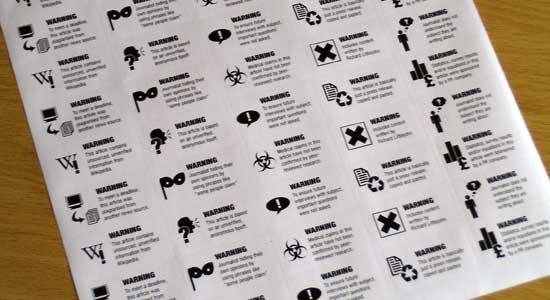
Journalism Warning Labels « Tom Scott

These are hilarious. If only they can be applied to online articles, we need these for the web.

Jim Lehrer, Infotainment, and Luna Maya

Lehrer’s Rules

• Do nothing I cannot defend.
• Cover, write and present every story with the care I would want if the story were about me.
• Assume there is at least one other side or version to every story.
• Assume the viewer is as smart and as caring and as good a person as I am.
• Assume the same about all people on whom I report.
• Assume personal lives are a private matter, until a legitimate turn in the story absolutely mandates otherwise.
• Carefully separate opinion and analysis from straight news stories, and clearly label everything.
• Do not use anonymous sources or blind quotes, except on rare and monumental occasions.
• No one should ever be allowed to attack another anonymously.
• And, finally, I am not in the entertainment business.

Appropriate timing given what’s been going on with regards to journalism and the infotainment industry in this country.
First hand account of the infotainment industry by Dewi Lestari, an author and musician, as well as one by her friend and colleague, Jenny Jusuf. Both in Indonesian. A very well written letter in English by Ve Handojo to the infotainment industry. 

These have been posted in response to the incident involving the model and actress, Luna Maya, which sparked a row between PWI (Indonesian Reporters Association) who felt insulted by her little blast against the infotainment workers and the AJI (Association of Independent Journalists) who supports her right to express her disdain and has distanced itself from those working in the infotainment industry.
Even more comical or perhaps pathetic is that the PWI is using the very law they fought against not too long ago to try and make an example of this woman. On the other hand, I’ve heard some people think this whole drama is concocted between the two parties. Regardless, this non-issue has been a distraction from other more important matters such as the failure of the Copenhagen summit to reach a deal to manage climate change, how efforts to combat corruption is facing opposition from certain higher ups, and why I’ll be working right through Christmas and New Year holidays.

Posted via email from A Geek Dad’s Log | Comment »