On the Vimeo ban in Indonesia

Jakarta Globe asked for my views on the banning of Vimeo in Indonesia which started on Sunday, May 11 2014. Globe reporter Benjamin Soloway wanted to know what the effects might be to tech and innovation in this country, whether it would lead to other actions of the same magnitude, and what is going on with the inconsistency in its implementation. The following is my response.

Hi Benjamin, I actually wrote a piece about this a couple of days ago and some of my thoughts are already in that article, feel free to quote it.

The reasoning behind the decision to ban Vimeo, which isn’t the first time, is a slippery slope that I hope is going to come to a halt once his term as minister expires and a new, more progressive, more technologically sensitive government is installed.

The fact that a small range of nudity and sexually suggestive videos exist on a public service that does not actually promote such themes should not form the basis of a blanket censorship that involves the banning of the entire service.

It’s entirely possible that the very logic and reason that drove this decision will be used to block other services such as Twitter, YouTube, Tumblr, Facebook, Instagram, or even Google. You can easily discover porn and nudity on any of those services if you know the terms. These are content platforms for the public to use and the public will use them in any way they like.

Banning Vimeo entirely is affecting people whose livelihoods depend on having access to the service such as advertising professionals, students, educators, journalists, filmmakers, animators, and so on. We’ve seen agencies complain that their portfolios are now inaccessible. There’s a video going around of an Al Jazeera cameraman complaining that he cannot complete his task because the instructions were posted on Vimeo.

This decision to ban Vimeo entirely is akin to banning DVD players because there’s porn on DVD.

If Tifatul Sembiring or someone like him maintains the position as the highest authority on technology regulations in this country we are facing a brick wall with regards to tech progress and innovation

Back in 2008 when current education minister Mumammad Nuh was the communications minister he moved to ban YouTube because it had insisted on not removing Fitna, a movie that was deemed as offensive to Muslims.

In 2010 Sembiring threatened to shut down access to BlackBerry services because it’s possible to access porn using the device. How much more absurd can you get?

In 2012 he asked what would people do with a 4Mbps internet connection 

He asked a similar question in January of this year 

The tone that he used to ask the questions seemed so mocking and condescending that it was a shock that someone of his position would even pose them to begin with.

Back to the Vimeo situation, the inconsistency within the situation, the fact that APJII wasn’t included in the mailer, that not all ISPs and carriers received the instructions at the same time, that the implementation even within Telkom’s own network is extremely inconsistent speaks volumes of the quality of the organization and personnel.

The fact that a Kominfo director general was contradicted by the ministry’s newly appointed spokesperson within 24 hours says a lot about the coordination within the ministry.

I can only hope that the next government has no such people holding key positions.

Sorry it’s taken a while to form my reply, I’m trying hard to be civil. The very fact that the last two communications ministers have enraged me with their decisions makes it very difficult not to get emotional.

It’s almost like they have no interest in catching up with the best in the world as quickly as they can with regards to technological progress. When South Korea is already rolling out Advanced LTE and developing 5G wireless connection, we only just completed settling the 3G band allocations.
What I think about social media and the upcoming Indonesian elections

The Australian Associated Press emailed me asking my views on the role of social media in this year’s Indonesian elections and the role of digital natives as first times voters.

My long answer below

I don’t think social media can make or break a candidate by itself. Presence on social networks certainly help raise their profiles but it also opens them up to attacks.

While use of social media in Indonesia seems massive, the majority of things I see about this upcoming election and even Indonesian elections in the past, is about making fun of elections and candidates.

The primary driver of political campaigns remains television. The influence of TV is still significantly much larger than the likes of Twitter or Facebook but TV and other “traditional” media also take their news from social media, therefore social media presence and activities can help spearhead the image or intention that the candidates want to project. Television can amplify what is being said or what is happening on social media.

Look at the publicity on Aburizal Bakrie’s trip to the Maldives for example. That trip from four or so years ago first made the rounds on YouTube and Twitter a few days ago and within hours it was picked up by television as well as online news media and became a national talking point by the end of the day.

That being said, conversations on social media are also being driven by what is happening on TV so you have that full circle of coverage and talking points from both media amplifying each other until the masses are tired of the subject and move on to the next topic.

Another example is Farhat Abbas. The one time presidential hopeful and legislative candidate was on Twitter until recently, perhaps to deliver his campaign promises, to create a more popular image of himself, and to address people who talked about him. Ultimately it was a failed experiment because everyone saw right through him. His actions that had been reported across all media were amplified and ridiculed on Twitter so much that he eventually shut down his @farhatabbaslaw account, although as it turns out he reactivated it several days later.

The success of Jokowi and Ahok may have been driven by social media but to my eyes, the real driver was the relentless coverage on TV and newspapers about their campaigns and activities. Perhaps the final kicker was the flashmob at Bundaran HI shortly prior to the gubernatorial election day in 2012.

What’s good about this election is that the rise of software developers taking advantage of Pemilu API, which is the publicly available access to the KPU data about all of the legislative candidates and their parties. Spurred on by Perludem, these mobile applications and websites may not be massively popular but they provide far more useful and easier to access information so that the voters are better informed about their options.

The digital natives, in other words, people who are far more comfortable with the internet, mobile devices, and appications, most of which happen to be first time voters, apparently are increasingly looking for election information from the internet. They will scrounge news and info not just from social media but also from news websites and other sources including applications. It’s up to them to decide how to filter and process all that information.

Google is known to have provided a central repository of election news and information for other countries in the past and it’s just a matter of time before they launch an Indonesian version of it. It’s a bit of a shame that they haven’t so far with the election being so close now, just a matter of days. – Read on Path.

XL Axiata pulled its iPhone 5S/C price page

Last night I was tipped that XL Axiata had published its iPhone 5S/C pricing schemes. Suspecting that it was leaked early, I took screenshots and published both the link and the shot. I was later informed that it was indeed leaked and a few hours later the page was taken down.

//platform.twitter.com/widgets.js

Apparently people at XL hadn’t realized the page was already published so it looked like that they scrambled as quick as they could late Saturday night to remove the page, probably gave it a different URL instead of taking it down completely.

As I said last night, the pricing plans for postpaid are almost identical to the US pricing which is excellent but the prepaid prices were a big step up. Turns out, the they were about 25% higher which I suppose isn’t too bad but is shocking nonetheless because it brings the 5S very close into MacBook Air territory.

The Rupiah’s fall against the greenback is perhaps the biggest contribution to the high prepaid prices (although if you go with the postpaid option, the total cost of ownership after 12 months would be within the same ballpark) and if the exchange rate had remained in the 9500-10500 per dollar, I’m sure the iPhones would be a bit more affordable.

Something in my head tells me that this was a set up though. That I was leaked the page specifically to gauge reaction to the prices. It just so happened that the tip came after I had tweeted asking whether people would buy an iPhone 5S if it were to start at Rp 9 million for prepaid. It ended up being 10.5 million and the 5C started at 8.7 million.

Will XL make changes now that it’s all been leaked?

Update: it’s live, no change

– Read on Path.

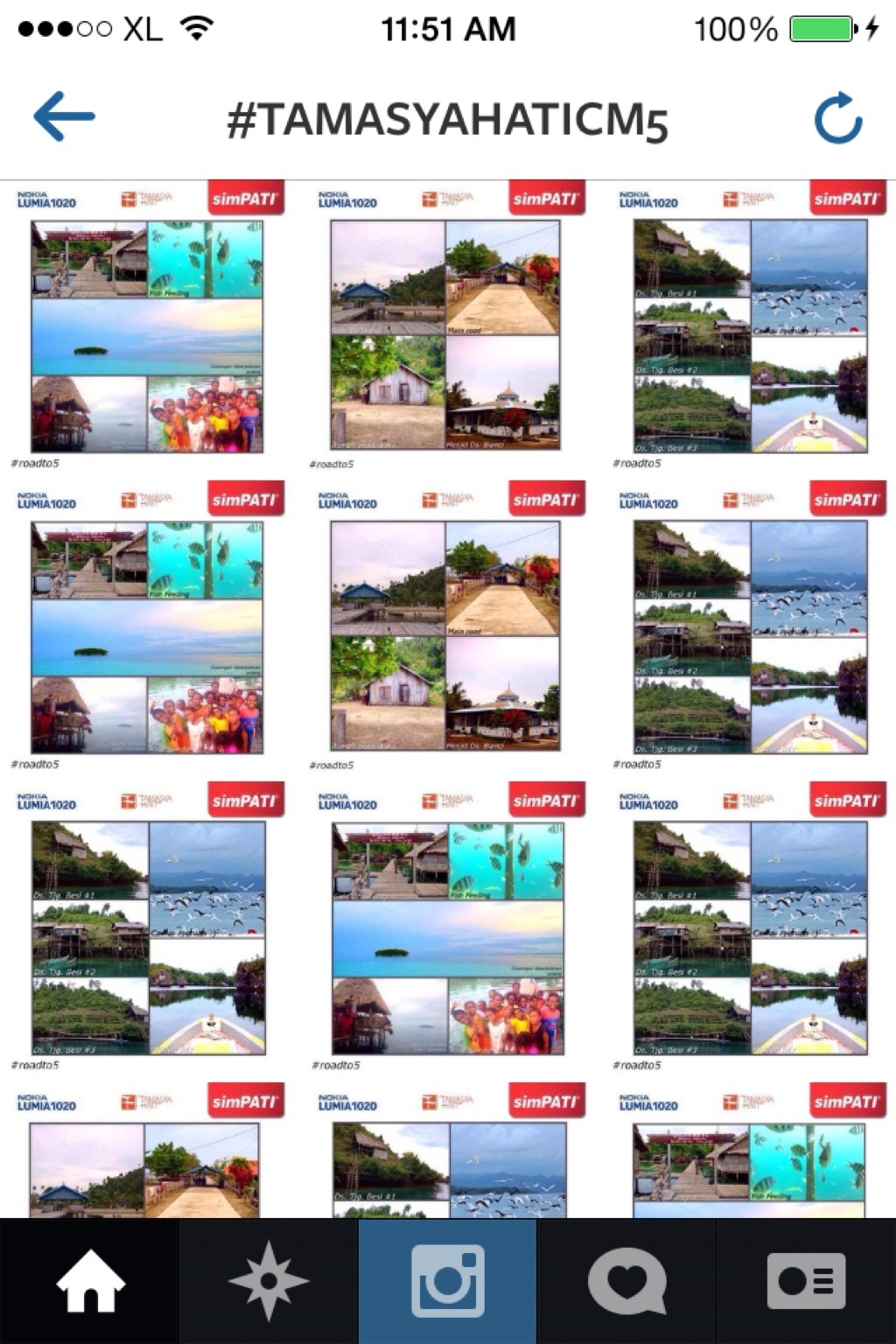
This is how Nokia and Telkomsel promote the 41MP Lumia 1020, by showcasing photos taken with the 1020 in collages limited to the tiny confines of Instagram instead of using something like 500px or Flickr that displays pictures as large as your screen can handle.

They probably are doing something on Facebook which would be a better way for a photography showcase if done correctly but with this collage approach, you can do the same with any cheap mobile phone camera. They won’t be able to see the details and appreciate the quality anyway.

Way to undermine the results of what is supposedly the greatest mobile phone camera ever made. Good job guys. – View on Path.

Über and the private car hire services

You know all those private cars for hire at Soekarno Hatta airport? All those drivers offering “taxi” service? They’re not so bad. Sure they’re a bit more expensive than regular taxis but after a couple of tries, the cost to get me home from the airport isn’t that much more expensive.

Instead of paying 100k plus toll fare, I paid 150k including toll fare and because the fare is agreed upon prior to getting into the car, if we get stuck on a traffic jam, they don’t charge more. It also takes out the frustration of having to wait for ages to get a cab.

Come to think of it, all they need is legitimacy and it’s definitely not difficult. If you think of them as private cars for hire instead of a taxi service, something more like Golden Bird as opposed to Blue Bird, the cost makes more sense.

If you have their phone number, which is direct to the driver instead of the company, you can ask them to pick you up anywhere in the city and go to any place.

In fact, I think these companies are only one step away from becoming something like Uber or Lyft. The only thing lacking is a centralized booking system with accompanying smartphone apps.

There is of course the issue of trust. Because the system is still manual and there’s no immediate or recognizable assurance that they are certified drivers for legitimate transport service companies, there’s no guarantee you won’t get a creepy guy or even a criminal on the driver’s seat. – Read on Path.

Bundaran HI, Central Jakarta, January 17, 2013.

Indonesia to curb sales of personal vehicles

Car sales in Indonesia jumped by 17% from 2010 to 2011, to nearly 900,000 new vehicles, and by 11% year-on-year in the first quarter of 2012, despite global economic gloom.

Indonesia’s market is growing faster than China’s much bigger one: car sales rose by only 2.6% in China between 2010 and 2011. Indonesians now buy more cars than any other south-east Asian nation, having overtaken Thailand last year. They also bought 8m motorcycles in 2011, a number that could rise to 9m this year.

This worries the government. From June 15th Indonesia’s central bank says it will require those who borrow money from a bank to buy a car to make a minimum downpayment of 30%. For motorbikes, the figure will be 25%. Housebuyers will also have to make a minimum deposit of 30%. The new rules are intended to prevent a potential bubble in consumer credit.

Indonesia to curb sales of personal vehicles

It’s Like Tap Tap Tap Buying TUAW*

So this happened.

There was this post the other day by M.G. Siegler citing an example of Disney owning both ESPN and Anaheim Mighty Ducks at the same time for a period and that Boston Red Sox is owned by The New York Times Company. This particular situation however, is not exactly comparable. Like the title said, it’s like Tap Tap Tap buying TUAW. Or the Red Sox buying the NYTimes.

I see it as purely a talent acquisition. The founder of the blog is after all a graphics and interface designer and he’s getting a position in the new parent company which is an app development house while a contributor gets to be chief editor.

In no situation can I expect this deal to make sense. The reason given? Shared vision of growing and reaching out to the Indonesian Mac and iOS communities. That’s bullshit. Come on. Sure it’s a shared vision, sure both parties would like those communities to grow (clearly for very different reasons) but giving that as a reason is purely press talk.

If the acquisition was by an investment or a holding/parent company who happened to have a stake in the other, there’d be no problems with that. It’d be exactly like Disney owning both ESPN and the Mighty Ducks, or like East Ventures owning Apps Foundry and Penn Olson. Oh wait.

Will the blog survive and maintain its course? I don’t see why not. Will it remain an independent blog? I doubt it, after all, it’d be run by an app company instead of by itself. So congratulations on the pile of cash, commiserations on the acquisition.

*Reposted and revised on DailySocial

As per the news from Stephen Hackett at forkbombr, Apple has moved to decommission Apple Online Stores in Indonesia and Vietnam. No reason was given for the decision although at least for Indonesia, the writing has been on the wall for quite some time. Those who bought personalized iPods from the online store will no longer be able to receive personalized replacements should they need to exchange them under service terms.

Apple Online Store for Indonesia first opened for business in November 2008 along with several other Southeast Asian store fronts though without much fanfare. The Southeast Asian stores were established as extensions of the Singapore Apple Online Store with all orders processed and managed from the city state.

Read More