Eric Schmidt: Google is not dominant in search

In answering questions from the Senate Judiciary Antitrust Subcommittee, Google Executive Chairman Eric Schmidt had this to say about its search business:

I am confident that Google competes vigorously with a broad range of companies that go well beyond just Microsoft’s Bing and Yahoo, and that Google has none of the characteristics that I associate with market power.

Creepy guy indeed

Eric Schmidt: Google is not dominant in search

Losing Faith

MG Siegler on Google’s failed launch of Gmail app for iOS earlier today:

That’s maybe my biggest problem with Google. They release something, and I no longer have any faith that it’s going to be any good. It’s hard to get excited about a company like that. It’s the same reason why it’s hard to get excited when Microsoft and Yahoo release new things. The track record just isn’t there any more. The faith is gone.

I share his sentiment for the most part but I still hold hopes for Microsoft and Yahoo since they seem to be getting back on the right track albeit slowly.

Yahoo!’s releases today at Product Runway point generally to the right direction and Microsoft’s deal with Nokia for Windows Phone is beginning to show some promise even though it’s not as quick as I hoped it would be.

Apple claims Android has roots at Apple

Before you go all crazy and accuse me of fanboyism or Apple being ridiculous (or both), go read the piece from Florian Mueller. In one of Apple’s filing against HTC, it says that when Andy Rubin worked at Apple in the 90s, his superiors were the ones who came up with a patent that Rubin later used to create Android, which means he may have been a contributor to the patent that Apple owns. If the ITC judge holds up Apple’s argument, this clearly will not bode well for Android.

Rubin worked at Apple long before the iPhone – even long before the iPod. If Apple had just claimed without particularity that Android started at Apple, most people would dismiss such an allegation as complete nonsense. But Apple now asserts – in a filing with the ITC, which means Apple has a legal obligation to make truthful representations of fact – that Rubin’s superiors at Apple were the inventors of that realtime API patent and he worked for them at the very time they made that invention. He worked as a low-level engineer while the inventors were senior people. It’s possible that he then contributed to the implementation of the claimed invention.

Apple claims Android has roots at Apple

You’ll be missed. Hopefully someone will buy the app off Google or add similar features to their own.

Google shuts down Slide, cuts off Photovine & Disco

Despite having been launched to positive reviews, Photovine is among Slide’s products to be shut down as the independently operated division will be dissolved. Google purchased Slide last year for $200m but never fully integrated the company into itself. The unit allowed to operate on its own accord, sometimes releasing products that are competing with Google’s own internal products.

Slide is also known to favor iOS over Android with Disco and Photovine being two of its most well known apps making appearance on iPhone first. Since Larry Page replaced Eric Schmidt as CEO, he’s been consolidating and restructuring the company. It looks like Slide does not fit within his vision.

Slide founder Max Levchin will leave Google, as will Slide’s head of product, Jared Fliesler, who will join Square.

Photovine is a beautifully designed, very well done app, something that could have come out of Flickr had the Yahoo! people realized what opportunities it has with the photo sharing site. Photovine lets you post photos according to themes and discover other people’s photos who happen to share the same theme. 

Google shuts down Slide, cuts off Photovine & Disco

MP3tunes ruling opens the door for online music lockers

Google and Amazon could well be allowed to run their music locker cloud service without having to seek permission from record labels as the judge in the mp3tunes case puts the responsibility in users’ hands instead of the site’s operators’.

mp3tunes was found to infringe only on songs that it new were pirated but did not remove following a notice.

the DMCA imposes no obligation to investigate potentially infringing activity absent a specific complaint from copyright holders. The only exception is links to sites with URLs containing “red flag” words like “pirate” or “bootleg.

The quoted paragraph above means that without a specific notice from copyright holders, a site’s operator has no obligation to voluntarily check whether files stored in its servers are infringing on copyrights.

MP3tunes ruling opens the door for online music lockers

Google Shows How Not to Complain About the Patent Mess

parislemon:

Great breakdown of Google’s patent post by Harry McCracken. 

It is fairly amazing that one poorly constructed post has managed to turn Google from a sympathetic figure in all of this into a jackass/crybaby hybrid. 

I think the idea behind the post was right, it’s just that Google tried to be specific without being specific enough (and without vetting at least one crucial thing). Perhaps they should have taken the most general, common-sense approach and simply taken a stand against bullshit patents.

Of course, they can’t really do that with a straight face while they’re trying to buy 8,800 new ones at the same time.

Google Shows How Not to Complain About the Patent Mess

badass.

Reshared this from G+, anyone know where it came from originally? I found this but he got it from Skype

Nvidia CEO explains slow Honeycomb tablet sales

“It’s a point of sales problem. It’s an expertise problem. It’s a marketing problem to consumers. It’s a price point problem,“ he reportedly said, adding: "And it’s a software richness of content problem.” – Jen-Hsun Huang

Honeycomb tablets are chock full of problems. In the meantime, iPads continue to dominate tablet sales, mindshare, and discussions despite its lack of availability.

Nvidia CEO explains slow Honeycomb tablet sales

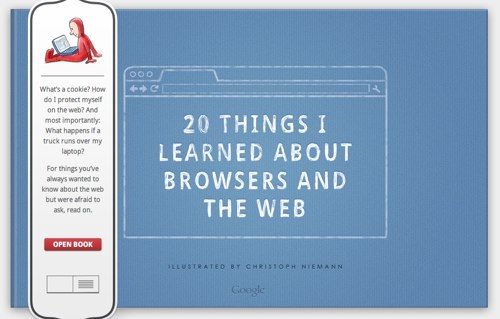
Google explains 20 things about the web in a 61 page book. In HTML5.