Angry Indonesian Internet Users Create Virtual Roadblocks on Google Maps in Response to Mob Murder

Indonesian internet users have flooded Google Maps with virtual roadblocks on nearly every road and street in the Sukolilo district, Pati, Central Java.

This digital protest comes in the wake of a tragic incident where a mob of local residents set fire to a rental car owner and his vehicle, resulting in his death. The victim was reportedly attempting to retrieve the car from suspected car thieves when the mob attacked. Three other men who accompanied the deceased victim were also assaulted and are in a coma in a hospital.

Several rental car business owners have come forward, revealing that they have long blacklisted rentals to individuals carrying Pati-issued identification cards due to concerns about vehicle theft. They claim that the regency is widely known within the industry as a hub for stolen motor vehicles, with many vehicles in the area lacking license plates.

Sukolilo subdistrict head Andrik Sulaksono rejected the allegations, saying the area is not a fencing hub and that it was all said by angry netizens reacting to the news of the murder.

Until recently, law enforcement authorities have reportedly taken little action in response to suspicions and public reports of vehicle theft in the region. This apparent lack of action has prompted some angry Indonesians to resort to vigilante justice.

The incident has sparked outrage among Indonesian internet users, leading to the virtual roadblock campaign on Google Maps as a form of protest and a call for increased attention to the issue of vehicle theft and the need for improved law enforcement in the area.

Police have apprehended ten suspects with evidence belonging to the victims found at their homes, and seized 27 motorcycles and 6 cars with fake registration papers, from one property.

Composite image of one neighborhood in Sukolilo showing virtual roadblocks on Google Maps on nearly every road.

Google Testing Removal of News Tab

With Australia, Canada, and Indonesia passing laws or regulations requiring platforms to pay for news links and the US having introduced the Journalism Competition and Preservation Act last year, removing the News tab looks like Google’s response to avoid having to pay link tax to media companies.

The News tab is only missing for a limited group of users for the moment. It is a test after all and I still see it when I use Google search.

Google Photos’ New AI Tools for Pixel 8 Raise Messy Questions

The Verge raises serious journalistic questions on the legitimacy of images taken using Google’s latest phones because the AI tools in Pixel 8 are much more readily available to manipulate them from the moment they’re taken to having them saved and published.

While the AI-adjusted images may have certain markers embedded, they may not be easily detected without specific tools unless it’s an obvious visual label permanently affixed to the image.

What is a photo? Is it a snapshot of a single millisecond in time? An imprecise memory of a moment? An ideal depiction of an otherwise imperfect brief period? How much is too much manipulation?

Smartphone captures from any brand are almost entirely manipulated after all with software adjustments converging to create the best version of a snapshot, but until now, they are still generally accepted as accurate photographs of a specific moment due to the lack of meaningful deviation from the truth.

When it comes to casual personal collection of photos and videos, these adjustments don’t or won’t amount to anything too serious but for journalistic purposes, these techniques advances pose questions and challenges.

Journalism outlets have guidelines to determine what photo or footage is acceptable to be considered a true capture and the results of a typical smartphone snapshot usually don’t change anything meaningful from the actual scene, but when the definitive capture no longer represents the truth, will the media authorities need to restrict the use of certain devices?

While manipulated images have made their way to major publications undetected until it was too late, they are still relatively rare. 

Of course, photographers have always been able to manipulate situations by changing or adjusting the scene before capturing and sometimes only the presence of a witness or the existence of another image depicting the actual truth can serve as evidence of manipulation.

When the tools people use can significantly alter what was actually taken by the lens before a definitive record is made or saved into the camera’s memory, instead of after, journalism authorities and watchdogs will need to be even more vigilant.

Google’s Whiteboarding App is Joining the Graveyard

Google is discontinuing its collaborative whiteboarding app, Jamboard, and will focus on third-party solutions like FigJam, Lucidspark, and Miro.

Jamboard will become read-only on October 1st, 2024, and all files will be permanently deleted by December 31st, 2024.

The company will help customers migrate to other whiteboard tools.

The Google Graveyard is probably among the largest and most occupied tech graveyards  to ever exist, with so many released products serving essentially as public experiments with no guarantee of long term commitment. Just the other day they announced the end of the Google Podcast app.

The Jamboard was quite useful and popular among education and enterprise customers but instead of committing to it and spending resources to keep iterating, the company chose to end it when customers say competitors’ products serve them better. It’s one thing to hire fast and fire fast but release fast and cancel fast is an irresponsible policy that often affects a large customer base who may have made significant financial commitments.

Why bother releasing new products when you have no long term commitment? Why would you attract customers when all you do is blink at the competition? How can anybody trust a company like this? 

camh:

Welcome to the future.

Turn your hand over, dummy, you have an email.

Why are you looking at your watch while you’re holding your goddamn phone you dipshit. Look at your phone. Not the watch. The phone.

Fine. Be that way. Touch the watch with your only hand without technology. Consider buying another phone for your non-phone hand. Perhaps it’s lonely without a phone to hold.

You recorded this with your Google Glass, didn’t you?

Why am I even asking, of course you did.

Samsung’s Galaxy poses a threat to Android

The fact that Samsung does not mention Google or Android in any of its promotional material for its mobile devices should tell you something. Its Galaxy branding is so powerful, by the time Tizen is ready to roll out carrying tens of thousands of apps on Samsung Apps, people might care less that it doesn’t run Google’s Android because they have a Galaxy device. – Read on Path.

I don’t understand why Google+ has to shout at me all the time.

I think it’s upset that I haven’t been there as often as I used to but this attitude isn’t going to win me back you know.

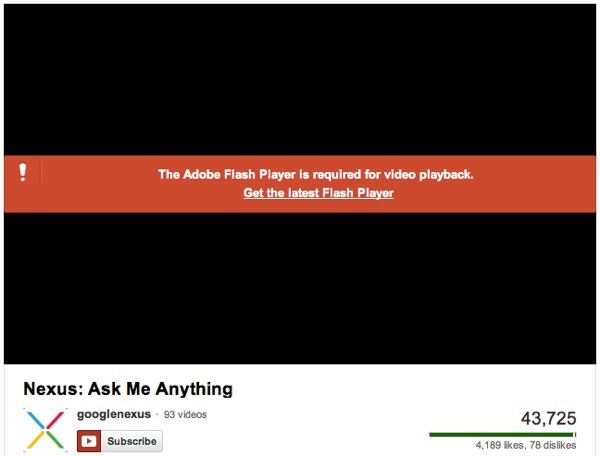
Dear Google, it’s 2012, stop asking people to install Flash. Yes, I’m in the HTML5 trial program.

Google Drive terms and conditions lets Google use your files even if you stop using Google’s services

From the terms and conditions:

The rights that you grant in this licence are for the limited purpose of operating, promoting and improving our Services, and to develop new ones. This licence continues even if you stop using our Services (for example, for a business listing that you have added to Google Maps)

Zack Whittaker on ZDNet takes this paragraph to mean that Google may own your files. I don’t quite agree on that, but of course, terms of service documents can be as clear or vague as the reader makes it out to be. I think the key in the last sentence is the word stop. Does stop simply mean ceasing to login or does it mean after you delete the account? Even further, does it mean Google can use your files even after you delete them from Google Drive?

A statement from Google doesn’t exactly answer my questions.

Google Drive terms and conditions lets Google use your files even if you stop using Google’s services

New Google accounts now integrate Gmail and G+ accounts

Not sure what the big fuss is with Google’s new account creation. 

When you create an Apple ID, you can use that for iTunes, iCloud, Apple Discussion Forums, and product registrations. When you create a Live email account with Microsoft, you get XBox live account, SkyDrive, device registration, etc.

So when you create a Google or a Gmail account, it makes sense to have all Google’s services tied into that one account. Makes it easier to remember login credentials. If you want to have separate logins for separate services, make separate accounts. Not hard and plenty of people do that anyway

New Google accounts now integrate Gmail and G+ accounts