
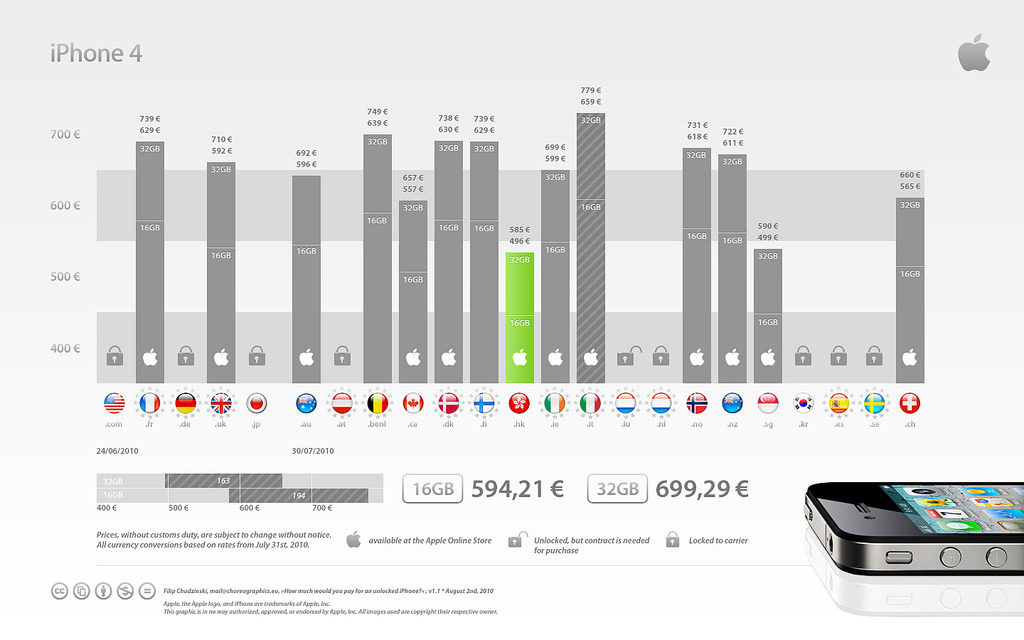
iPhone 4 purchase guide

No matter how hard you expect it to happen, those keys on that MacBook’s keyboard won’t ever flip and reveal additional characters. Oh, and there’s no .?123 key on the MacBook to tap and flip the keyboard. Maybe in the future when Apple introduces context aware touch-enabled keyboard for its Macs as per their patent, but not now, not yet, and definitely not on this MacBook you’re typing on.
This is something I have to remind myself almost daily since May. The time spent typing on the iPad has definitely taken over my muscle memory on using the MacBook and its traditional (I’m trying to avoid describing it as quaint) keyboard.
Speaking of additional characters, I wish Apple would incorporate special characters and symbols into the iOS keyboards. All they have to do is make it an additional keyboard option that can be activated by tapping the globe icon.
More than a year ago I got so used to double tapping the space bar to end a sentence when typing on the iPhone, I started doing it on the MacBook.
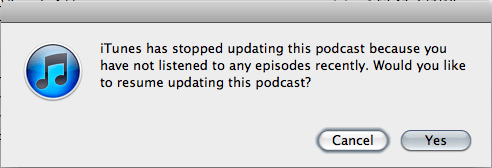
I don’t recall this feature in iTunes 9. iTunes 10 apparently recognizes which subscribed podcasts I haven’t listened to in a certain period of time and automatically stops the subscription. On the side of the podcast title it will mark them with an exclamation mark inside a gray circle just like songs or videos that are missing from the library.
That last point is an issue in itself. Missing items in iTunes have always been marked with that icon. By marking neglected podcasts with the same icon, it can lead people to think their podcasts are missing. Of course, clicking on the icon brings up the dialog box above which explains the situation, but it’s still grounds for confusion.
It’s almost like how Apple uses the same tunes for the default SMS tone in iPhones as when Mac OS X finishes a disc burn or completes an installation.
Apple is not a hardware vendor per se, they are more like an IT consultant. That’s why Apple Store is so successful. In a way, Apple Store is their primary product, like GAP stores are really GAP’s primary product. The user walks in with a problem, and Apple provides a solution made up of a combination of hardware, software, online services, support services, training, accessories, and even culture. Apple users pay for that entire package. If the hardware is commoditized and cheap, that means more profit for Apple, not less, because they are the hardware *buyer* not seller. They buy the hardware on behalf of the user.
From a comment on an Asymco blog post.
nikf:
Business Week interviews Foxconn’s CEO. A fascinating look into the truly-massive operations involved in making an iPhone.
When Apple’s iPhone 4 was nearing production, Foxconn and Apple discovered that the metal frame was so specialized that it could be made only by an expensive, low-volume machine usually reserved for prototypes. Apple’s designers wouldn’t budge on their specs, so Gou ordered more than 1,000 of the $20,000 machines from Tokyo-based Fanuc. Most companies have just one.

Confidential Diagram of the Day: The secret origins of the new iPod Nano and Shuffle revealed!
[reddit.]

iTunes 10 now tells you which step it’s on during the synchronization process. This reduces the guessing game while you wait for the sync to finish. It’s less useful when you’re already familiar with the steps but for those who don’t pay attention that closely, and that includes most people, it certainly helps.
It’s been almost a decade since Apple first introduced the iPod. Back in 2001, $399 got you a 5GB white iPod with monochrome back, a rotating wheel and a battery that lasted 10 hours in the size of a brick. It was badly received but caught attention soon enough. Its ease of use was second to none.
In 2010, $399 gets you a 64GB multi-touch mobile computing device with a 326ppi screen, dual video camera with high definition support and video calling, wireless internet and data sync, weighing 100 grams, works as an exercise monitor and a video editing console with a 40 hour battery.
That’s quite a jump in technology.
iTunes in the mean time went from a music jukebox to… a music jukebox with an online store that sells music, movies, tv series, audiobooks, and apps, a comprehensive podcast directory along with university lectures, and a music oriented social network.
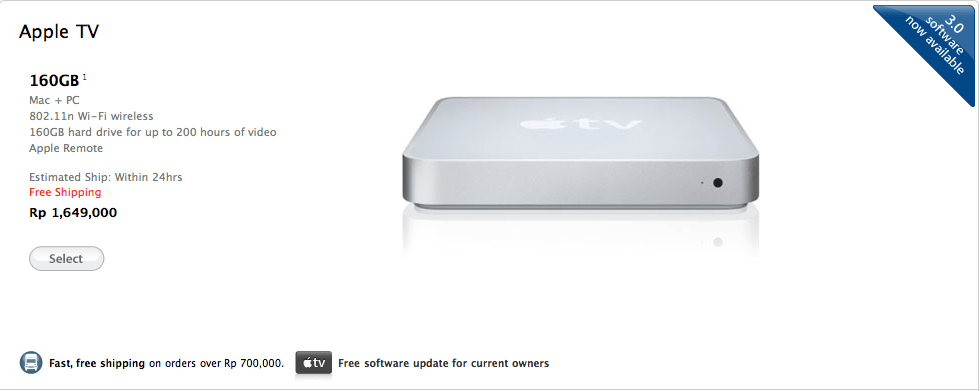
Apple may have announced a brand new Apple TV but as far as its Indonesian online store goes, it’s still the old, silver & white Apple TV with the price slashed to Rp 1.6 million ($177) which presumably will be the price of the new version.
The link that’s supposed to go to the Asian AppleTV page now redirects to the iPod overview page instead with no listing of Apple’s latest black box anywhere on the site. Looks like the old AppleTV is still alive but only at the Indonesian Apple Online Store.
 AuliaSays