Here’s why a 15-inch MacBook Air would be a good addition to the Mac lineup

With all this talk of a 15″ MacBook Air I have one small concern that the screen resolution might stay the same as for the 13.6″ version at 2560×1664 or thereabouts. It doesn’t make a lot of sense but it’s not like they haven’t done it before.

It’s a long time ago and an entirely different executive team, but when Apple introduced the 14″ iBook G4 they kept the screen resolution at 1024×768, the same as the 12″ iBook and the 12″ PowerBook G4. Those who bought the 14″ iBook didn’t get any more work space than those who bought the 12″ version.

The larger iBook had a bigger screen size, bigger hard drive, a SuperDrive that burns DVDs and CDs instead of a Combo Drive that can read DVDs but only burns CDs, and 450 grams heavier, and a higher price.

Apple didn’t want to cannibalize the slightly more expensive 12″ PowerBook G4 which had almost identical specs and they certainly didn’t want the iBook to encroach on the Pro Mac space, so they couldn’t give the 14″ iBook a higher screen resolution.

There’s little chance that someone would pick the 13″ M2 MacBook Pro if Apple makes a 15″ Air available, because frankly, why would you? Even the 13″ M2 MacBook Air is a slightly better machine overall and with a slightly lower price.

Will a 15″ Air pose a threat to the 14″ Pro? Not in the slightest. The 14″ and 16″ Pro machines carry the much more powerful M2 Pro or Max chips and they also have much higher resolution screens with the XDR display. They also have more connectivity or ports. The Air lineup will not have those.

Meta follows Twitter in charging for the coveted blue internet checkmark

Weeks after someone saw code inside the Instagram app referring to paid verification, Meta today formally announced their latest copycat feature, the paid blue checkmark.

Like pretty much every major product that Meta offers, the blue checkmark originally came from somewhere else, in this case, Twitter. Now that Twitter is charging for it, Meta can’t resist doing the same but they added their own twist.

Just like Twitter’s version, you’ll get the all important blue badge, increased visibility and reach, and exclusive features, but you’ll also get personal customer support, something that Twitter can’t offer because Elon fired everyone already.

Meta’s checkmarks are more expensive than Twitter’s. Even more expensive than paying for Netflix, Disney+, or HBO GO. One month of Meta Verification costs the same as Disney+ Hotstar for one entire year. Think about that.

Twitter charges US$11 per month from mobile apps and $8 from the web, while Meta charges $15 from mobile apps and $11 from the web.

Meta’s paid checkmarks are available only in Australia and New Zealand for now, though, so they make you crave for it with the oh so good FOMO and envy brewing up inside of you.

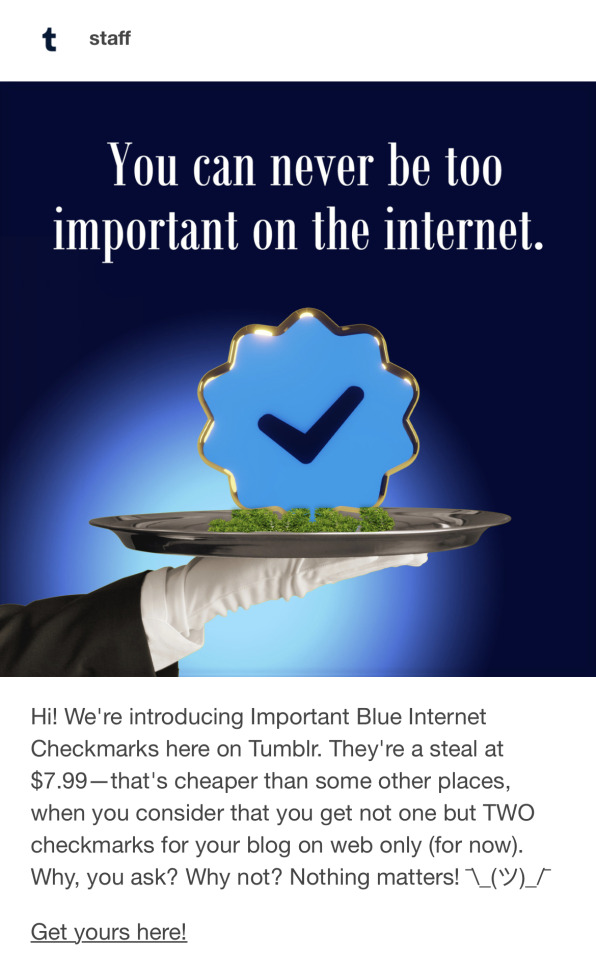
But my favorite one, though, is Tumblr. For a one time payment of $8 you get not one but two badges all at once and if that’s not enough, you can buy and display up to 12 pairs of badges! They now come in all rainbow colors too, not just blue, so it’s so much fancier and cooler because you can pick and choose which colors you want. You pay once and you keep it forever. Or until you delete your account. Love those guys.

Just spent half the day helping my kid format her school paper on Word. I haven’t touched that software probably in more than a decade. Always worked on alternative apps like Pages, Notes, TextEdit, Docs, Bear, iA Writer, etc.

Talk about being overwhelmed. Had to hunt and peck each button and feature and search online for tips on how to do certain things.

Never got my parents to help me with any of those as a kid because they didn’t grow up or worked with computers and to this day they still don’t know how to operate one beyond using browsers and WhatsApp. Had to figure things out myself and it was practically troubleshooting which got me into tech support before journalism kicked in.

As someone who lived through his entire life surrounded by tech products and devices and worked as tech support for a significant period, this was kind of embarrassing but also challenging and humbling. It took much longer to complete than it ought to but got it done eventually.

Getting the brain to reconnect neurons that didn’t need to connect for a long time was quite an exercise. Pretty exciting, actually, but also exhausting.

Blogs vs Microblogs

I’ve shared my thoughts about microblogs vs proper blogs a few times over the years but even after more than 20 years of blogging and more than 15 years of microblogging I still haven’t landed on a definitive position.

It’s evident that the era of Twitter has rendered blogs almost exclusively for more niche segments. The ability of microblogs to deliver almost instant readership and feedback to a piece of writing gives their authors relentless dopamine shots that keeps them around for much longer periods.

Blogs allow for more verbose and nuanced posts but when microblogs allow for that to happen as well, that makes you question the necessity of blogs other than the more obvious ones such as easier indexing, categorization, search, and discovery.

I guess it’s a matter of choosing between delivering more complete thoughts on a faster conversational platform and putting them down on your own space that you can have better control over.

Sometimes I wonder what would happen had something like Pownce had prevailed instead but that would require an alternate world in which the public chose Gowalla over Foursquare. Simplicity seems more likely to win over more complete or elaborate executions in our world after all.

The NY Times changed the headline of Jamelle Bouie’s opinion piece to be much less direct.

I haven’t been a Times subscriber in years and haven’t read anything from there for a while. The more I see this sort of behavior from their editorial team the more I’m convinced the Times is not worth the attention it’s getting. By no means it can be referred to as the paper of record.

The NY Times is a lot like Twitter. It’s an ongoing and escalating dumpster fire but it has so many eyeballs and attention people keep publishing and reading stuff there and triggering more complaints about them.

I get that the second headline is more clickbaity to draw in more curious readers (and page views) because the first headline will definitely be rejected by those who aren’t interested in the issue or will reject anything defending trans rights, but when you read Parker Molloy’s piece, it tells you that the headline change is much deeper than that. It’s more plausible that it’s a deliberate act against the trans community even if they try to argue it’s not the intention.

The NY Times have responded to the claims of being anti trans with a statement published by Nieman Lab. If ever there was a statement that nobody but the writer believes in it, this would be it.

What the heck, Tumblr? 😂😂😂

When Facebook came for your battery, feudal security failed

mostlysignssomeportents:

When George Hayward was working as a Facebook data-scientist, his bosses ordered him to run a “negative test,” updating Facebook Messenger to deliberately drain users’ batteries, in order to determine how power-hungry various parts of the apps were. Hayward refused, and Facebook fired him, and he sued:

https://nypost.com/2023/01/28/facebook-fires-worker-who-refused-to-do-negative-testing-awsuit/

If you’d like an essay-formatted version of this post to read or share, here’s a link to it on pluralistic.net, my surveillance-free, ad-free, tracker-free blog:

https://pluralistic.net/2023/02/05/battery-vampire/#drained

Keep reading

Who Wants to Pay for a Checkmark?

Hey, look who’s taking after one of the most unhinged individuals to ever run a company and dipping their toes into making identity verification a commercial product?

The entire point of account verification is all about confirming that the profile account represents who it claims to be. The part about having to be a notable person or organization was a side effect of the notion that only public figures needed to have their account verified to avoid impersonation.

The fact is anyone or any organization could be impersonated for any reason as notability needs not be on a national, let alone global, level.

If Meta is truly aiming to drive revenue out of account verification then it’s not about notability anymore. They should just make it like Tumblr and charge it for kicks because nobody knows if you’re a dog, who cares as long as you pay? The initial roll out of the revamped Twitter Blue went exactly as everyone outside of the company would expecte.

If account verification is about identity they can do it by enabling rel=“me” by way of a website that the person or entity controls.

The rel=“me” identity verification attribute is used to establish a link between a website and a person’s or organization’s profile on another site. This will assert that the entity owns or runs both the website and the profile on the other site.

Basically it lets other websites or services know that you are who you say you are without having to submit further proof of identity such as your government ID and saves them from the arduous process of manually verifying every profile created on their service and saves you from the repetitive process at each online service.

However, because there’s no central authority that actually verifies this attribution it can create a single point of failure if the reference website gets hijacked, leading to security issues such as identity fraud.

Between the lack of central authority and chaos through impersonation accounts, essentially it comes down to which problem they are more willing to deal with. And if say it costs $5 a month to have a check mark next to your name, that’s potentially hundreds millions maybe billions of dollars of additional annual revenue. Who’s gonna say no to that?

Before you know it every corporate social network will charge for a check mark and you’ll be spending more per month than your streaming subscriptions combined.

Twitter ends all free public API, switches to paid access

“Putting a cap on free API usage could also stop firms working around detecting the spread of misinformation on Twitter.”

That right there is the money shot. Misinformation is much more freely distributed today on the platform than at any time last year without the full trust and safety team and council working to suppress them. Then again the definition of what constitutes misinformation seems to have changed within the company.

The other point is why would any self respecting developer jump right back in after being suddenly shut out without prior or even any official communication on the sudden change of policy?

Anybody who still trusts the company to do anything right must be kidding themselves.

If anything, third party developers might be even more inclined now, if not highly encouraged, to develop for other platforms that offer free or open source API *cough*Mastodon*cough*.

Mastodon isn’t the only open platform in play that takes advantage of the ActivityPub protocol. There are plenty others such as Friendica, Pleroma, CalcKey, etc., that connect through this protocol, which means the playground for software developers and designers is wide open. Even WordPress, Tumblr, and Flickr have ActivityPub on the roadmap for this year.

There’s far more interest now on the federated networks or the open social web than ever before and networks that stay closed are going to miss out.

I wish Tumblr had a much easier and faster way to invoke the action items from the Activity list. I don’t want to have to open each account just to block them when it’s obvious they’re spam or troll accounts. I’d be really happy if they add a long tap or a horizontal swipe to reveal buttons to report as spam, block, or other actions.