20 common grammar mistakes

Linguistic intricacies have always been a pet subject of mine since high school and perhaps formed the foundation of what I now do for a living, and that is being a writer and editor. Reading an article like this one helps people (including myself) discover the proper ways to use particular words and identify context more correctly.

My favorite among the 20:

Impactful

It isn’t a word. “Impact” can be used as a noun (e.g., The impact of the crash was severe) or a transitive verb (e.g., The crash impacted my ability to walk or hold a job). “Impactful” is a made-up buzzword, colligated by the modern marketing industry in their endless attempts to decode the innumerable nuances of human behavior into a string of mindless metrics. Seriously, stop saying this.

20 common grammar mistakes

dailylicious2:

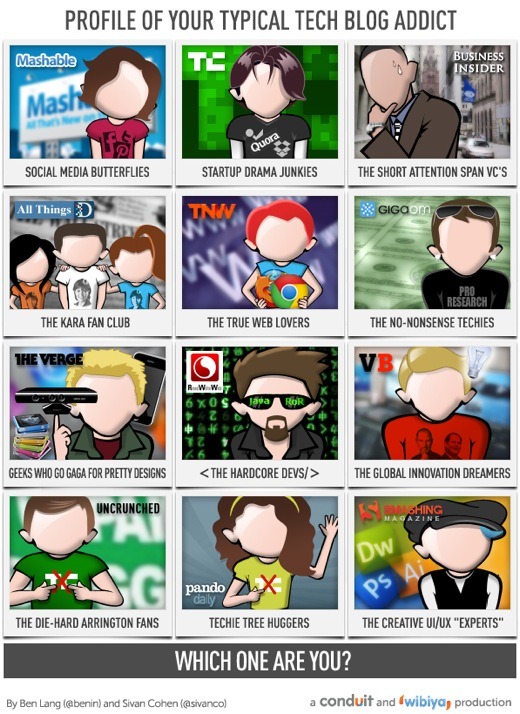
A really funny positioning for tech blog readers. Which one are you?

source : The Next Web

60% of Indonesia’s Consumption is Domestic

From the BBC:

However, analysts said that Indonesia has benefited from the fact that a huge part of its growth is driven by domestic consumption.

“Indonesia is one of the least exposed economies in the region, with a vast domestic market and a relatively small share of exports to gross domestic product, so it is insulated from volatility in the global economy,” said George Worthington of IFR.

Domestic consumption accounts for nearly 60% of Indonesia’s economy.

Businesses should take notice.

60% of Indonesia’s Consumption is Domestic

Monetizing Mobile is Facebook’s Greatest Challenge

Jenna Wortham for the New York Times:

Amid the jaw-dropping financial figures the company revealed last week when it filed for a public offering was an interesting admission. Although more than half of its 845 million members log into Facebook on a mobile device, the company has not yet found a way to make real money from that use.

“We do not currently directly generate any meaningful revenue from the use of Facebook mobile products, and our ability to do so successfully is unproven,” the company said in its review of the risks it faces.

Monetizing Mobile is Facebook’s Greatest Challenge

The Linley Group offers a possible reason why Apple is limiting Siri to iPhone 4S.

To reduce system cost and eliminate the extra package required for the Audience chip, Apple cut a deal to integrate the noise-reduction technology directly into its A5 processor, which appears in the iPhone 4S. This technology is critical for the new phone because not only does it improve call quality, it blocks out background noise when users provide voice commands to Siri, the intelligent assistant built into the iPhone 4S. Without this noise reduction, Siri would be unusable even with a modest amount of background noise.

Recently I had installed Dragon Search and Dragon Dictation on my 3GS. While the underlying software that power these apps and Siri are from Nuance, the above finding by The Linley Group could be a reason why Nuance’s Dragon software titles have difficulties in a crowded room in my phone.

Apple is of course known to refrain from introducing or featuring technologies and abilities that have yet to meet its own threshold of acceptable performance in its products.

Another reason that have come up in the past for the lack of Siri in older products was the possibility that because Siri is still in beta, the company may be testing and collecting data to eventually deliver a more complete experience.

Of course, should Apple offer Siri in older iPhones, the value of iPhone 4S will be diminished greatly, and Apple certainly doesn’t want that to happen given that the company still sells the 3GS and 4 for the lower end of the market.

Internationally though, it makes little difference since Siri doesn’t offer much of an assistance beyond dictation and personal reminders outside of the United States at the moment anyway. Additionally, its linguistic limitations makes Siri practically unusable in many markets.

/via @charlesarthur

The Linley Group offers a possible reason why Apple is limiting Siri to iPhone 4S.

The LA Times brought up the issue that Scottish people have with Siri. Despite being part of the UK, the Scots clearly have such thick accents that Siri has trouble understanding them. The results are obviously unfortunate for the Scots and for Apple but make for some humorous exchanges. At least Apple knows it has a wee bit of problem over the Atlantic.

Avid Studio goes to the iPad

AllThingsD:

“We’ve seen a shift in how creation is happening, and it’s really happening on almost any device,” said Tanguy Leborgne, vice president of consumer and mobile technology strategy at Avid. “We think the tablet is more than just a consumer device; more and more people are creating on it.”

The app will be iPad only for now and costs $4.99 for the first 30 days after which it will be $7.99. 

If there’s anyone out there who still say the iPad is a media consumption device, go suck on this.

Avid Studio goes to the iPad

Thinking about ebooks the way we think about console games and mobile apps

Maybe I haven’t thought this through but amidst all this kerfuffle about proprietary eBook formats, has anyone thought about ebook platforms? Apple has its own format for iBooks, Amazon’s Kindle reads its own format as well, so does Kobo, etc. Yes, there’s the standard ePub format that everyone is supposed to agree on but we know that it may not necessarily serve the commercial interests of each eBook platform provider.

Authors and publishers are pretty much beholden to the whims of platform providers like Apple and Amazon because they rely on these big consumer electronics guys to deliver their work to their readers as far as the digital format is concerned.

Why not think of these as platforms? You know, just like how console game developers have to recreate their games for every console they want to distribute their games on. Just like how mobile application developers have to recode their apps to deliver the best experience on each mobile platform. Just like how software developers have to redo their work for Mac, Windows, and Linux.

The path that delivered us these platforms may have differed from how the ebook formats have come to be but what we have now is pretty much the same situation. Consider the standard ePub format as the web app of ebooks, able to be read anywhere on any platform but has yet to deliver the richer experience that “native” formats are able to.

Just a thought.

Foxconn’s workers in context

The working conditions at Foxconn has been the subject of much discussion and outrage over the last few days following the New York Times exposé. Apple has since bore the majority, if not the full, brunt of the criticisms for allowing what looks to be a sweatshop full of suicides with workers earning very little while making iProducts despite other consumer electronics companies also employing Foxconn to do their manufacturing and assembly.

What everybody has missed on however, is context. Thanks to Tim Worstall at Forbes, we now have that context and even better, there’s a clear infographic to illustrate that if you can’t be bothered reading Worstall’s counter argument. I had to link to Worstall’s entire blog instead of the infographic post since Forbes seems to have messed up the link but I’ll embed it for you.

Foxconn’s workers in context

The four types of BlackBerry users

I’m just gonna let you see the infographic yourself.

The four types of BlackBerry users