WHAT THE HECK I DIDN’T REALISE THEY ACTUALLY DID THIS

This was probably the greatest thing I’ve seen all day!!!
Ladies and gentlemen, my new favorite gif.
A company asked me for advice about innovation, relevance, and the consumer. This is what I told them. The entire advice sounds to me like a whole load of corporate speak and essentially things that they should already know, but hey, they asked.
===
Now, whatever the company does, few things are more important than its products, so if a company wants to be relevant to its market it needs to have compelling products, something that has the values and characteristics desired by the intended consumers.
Most of the time consumers don’t know what they want so it’s important for a company to take calculated initiatives to discover what consumers really want. You can’t just throw everything and the kitchen sink into the product because that would be highly inefficient and not to mention wasteful. It takes research and some difficult decision making to arrive at that product.
Product communications strategies always follow the reasons behind the product’s existence. Why was it developed and created? What sort of issues or pain points are the product meant to address? If a product is badly conceived, it’s never going to have a good story and while it’s not impossible to create a story post conception, it would be difficult. Stories sell products, it’s crucial to have a good story to push products to consumers.
A breakthrough to me isn’t always about something new but about achieving better ways to accomplish an existing task. Example, a bucket with a spout and a handle which makes it a much better bucket to use. In other words, through innovation. A breakthrough is something that changes the behavior of consumers.
Innovations aren’t always breakthroughs but a breakthrough is always born through innovation.
As to how [the company] can be more relevant, do a lot of product and consumer behavior research, find out their pain points as well as their pleasure points and work on a way to address them.
I don’t know how much input does [the local office] have in product development but having a fast follower strategy might help to address the gap with the market leaders but at the same time also develop a strategy to transition if the company manages to catch up with the leaders. Fast follower doesn’t work without anyone to follow.
Jakarta Globe asked for my views on the banning of Vimeo in Indonesia which started on Sunday, May 11 2014. Globe reporter Benjamin Soloway wanted to know what the effects might be to tech and innovation in this country, whether it would lead to other actions of the same magnitude, and what is going on with the inconsistency in its implementation. The following is my response.
Hi Benjamin, I actually wrote a piece about this a couple of days ago and some of my thoughts are already in that article, feel free to quote it.
The reasoning behind the decision to ban Vimeo, which isn’t the first time, is a slippery slope that I hope is going to come to a halt once his term as minister expires and a new, more progressive, more technologically sensitive government is installed.
The fact that a small range of nudity and sexually suggestive videos exist on a public service that does not actually promote such themes should not form the basis of a blanket censorship that involves the banning of the entire service.
It’s entirely possible that the very logic and reason that drove this decision will be used to block other services such as Twitter, YouTube, Tumblr, Facebook, Instagram, or even Google. You can easily discover porn and nudity on any of those services if you know the terms. These are content platforms for the public to use and the public will use them in any way they like.
Banning Vimeo entirely is affecting people whose livelihoods depend on having access to the service such as advertising professionals, students, educators, journalists, filmmakers, animators, and so on. We’ve seen agencies complain that their portfolios are now inaccessible. There’s a video going around of an Al Jazeera cameraman complaining that he cannot complete his task because the instructions were posted on Vimeo.
This decision to ban Vimeo entirely is akin to banning DVD players because there’s porn on DVD.
If Tifatul Sembiring or someone like him maintains the position as the highest authority on technology regulations in this country we are facing a brick wall with regards to tech progress and innovation
Back in 2008 when current education minister Mumammad Nuh was the communications minister he moved to ban YouTube because it had insisted on not removing Fitna, a movie that was deemed as offensive to Muslims.
In 2010 Sembiring threatened to shut down access to BlackBerry services because it’s possible to access porn using the device. How much more absurd can you get?
In 2012 he asked what would people do with a 4Mbps internet connection
He asked a similar question in January of this year
The tone that he used to ask the questions seemed so mocking and condescending that it was a shock that someone of his position would even pose them to begin with.
Back to the Vimeo situation, the inconsistency within the situation, the fact that APJII wasn’t included in the mailer, that not all ISPs and carriers received the instructions at the same time, that the implementation even within Telkom’s own network is extremely inconsistent speaks volumes of the quality of the organization and personnel.
The fact that a Kominfo director general was contradicted by the ministry’s newly appointed spokesperson within 24 hours says a lot about the coordination within the ministry.
I can only hope that the next government has no such people holding key positions.
Sorry it’s taken a while to form my reply, I’m trying hard to be civil. The very fact that the last two communications ministers have enraged me with their decisions makes it very difficult not to get emotional.
It’s almost like they have no interest in catching up with the best in the world as quickly as they can with regards to technological progress. When South Korea is already rolling out Advanced LTE and developing 5G wireless connection, we only just completed settling the 3G band allocations.
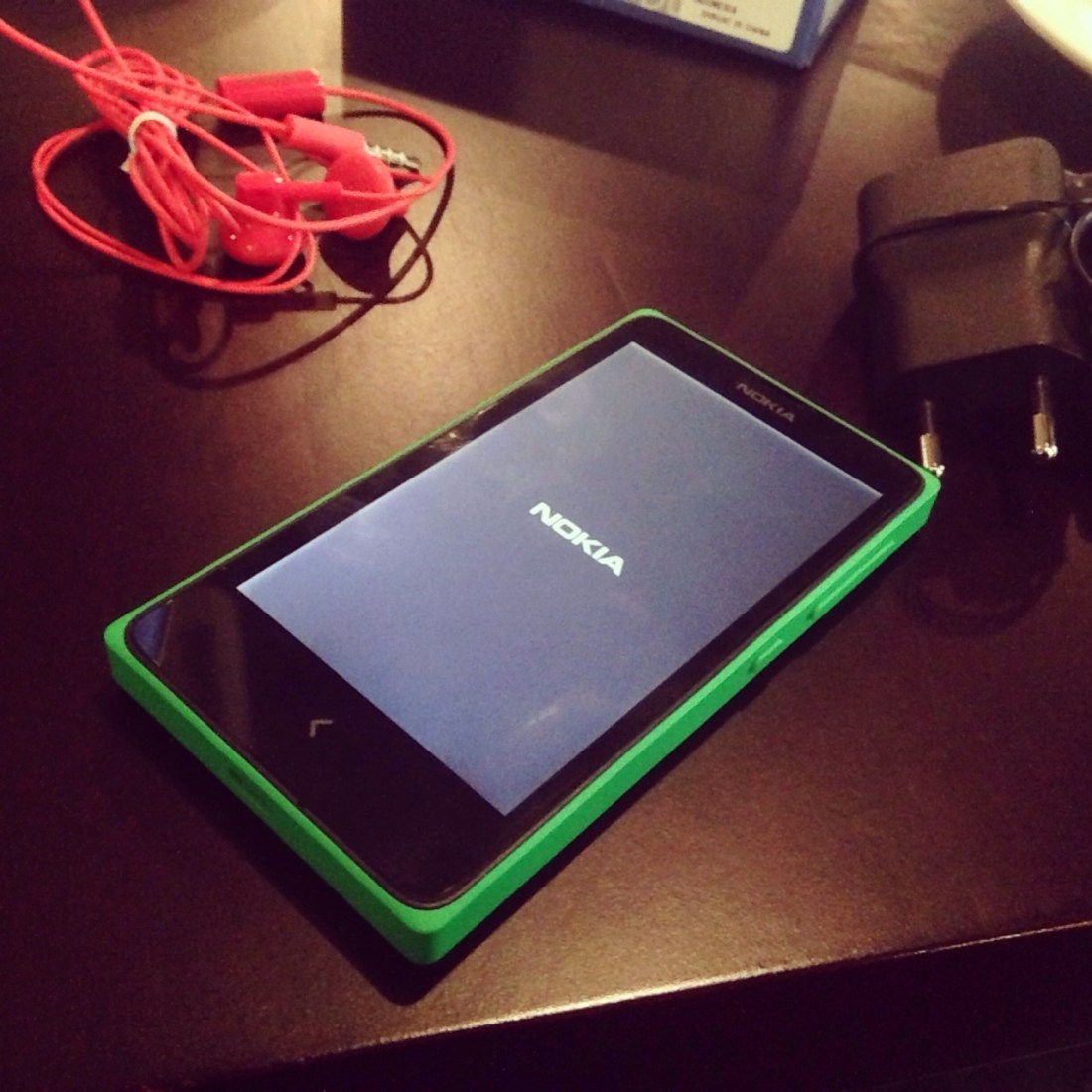
This Nokia X looks like a pretty fun phone to use for those who have specific needs for an entry level smartphone and not too bothered by the lack of Google services.
Battery life that lasts about a couple of days between charges, basic apps like Mail (Outlook) Opera mini, Facebook, Twitter, BBM, Line, a bunch of games, and sporting dual SIM cards, although I think only one slot has 3G access, and a Nokia Store that is decent enough for the most part, should be sufficient for the intended market, not to mention having OneDrive support as well as MixRadio and built in FM Radio.
Sadly despite having 512MB of RAM, the sluggishness in response times, in even the built in apps, makes the phone a less attractive phone to have compared to the similarly spec’d and priced Lumia 520. Nokia needs to really optimize the OS to have it operate apps a lot smoother. The OS itself runs just fine but there are noticeable lags when running apps such as delayed typing response, which can be crucial.
On the other hand, people’s tolerance towards the lag may differ and the intended market for the phone may give it a pass. What may go against the phone’s success would be the alternatives at the same or similar price and people’s willingness to use non Google services. If the Microsoft, Nokia, and Here apps are acceptable to consumers, then it’s one less major hurdle to deal with.
Anyone noticing that American couples started calling each other bae? Why are they doing that, is babe too difficult to pronounce? They both contain only a single syllable. Is hun for hunny/honey too quaint these days? That last b at the end of the word causing difficulties?
Of course, intimate couples haven’t called each other by names for decades. They use words like darling, sweety, honey, cupcakes, and in the 90s and 2000s, they try to scare each other by using the word boo. Remember that song by Usher and Alicia Keys, My Boo? That song comes up, my head gets filled with images of that ghost from Super Mario.
Anyway, they already shorten homeboy to homey or homes, so I guess if they call their significant others bae because babe is “old”, then they’re gonna call their friends ho? – Read on Path.
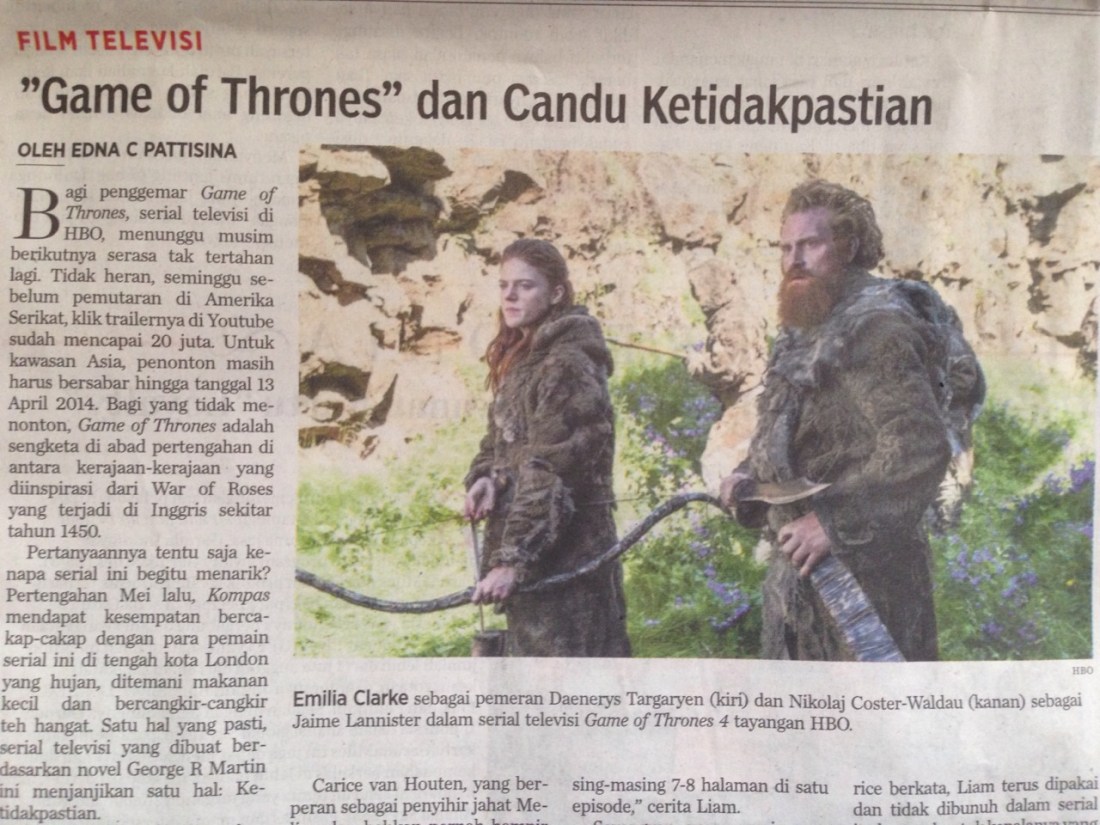
According to Indonesian newspaper Kompas, that’s Daenerys Targaryen and Jaime Lannister.
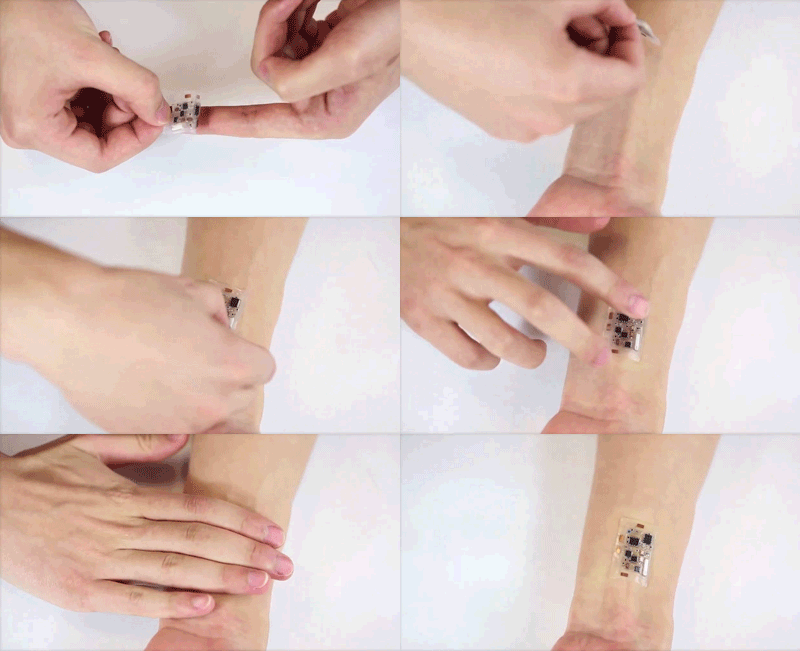
Stick-On Circuit Could Put Your Phone On Your Finger For Pocket Change
Related to my previous post, this would convince me the wearable era is progressing faster than perhaps most people expected.
I haven’t worn a watch since the year 2000 but prior to that, four or five years went by when I didn’t wear a watch. The last time I remember wearing one regularly was back at high school when my gym teacher always shouted in my ear to remind me to take it off during gym class. So after a few weeks, I decided to just dump the watch.
At first it was noticeable, not having a watch on my arm, but it didn’t take long before I got used to it. There were clocks almost everywhere I go and there’s always someone to ask for the time when a clock wasn’t around, so it stopped becoming a big deal.
Not having a watch was made even less significant when I got my first mobile phone upon starting university. The phone lasted several days on a single charge, unlike today’s smartphones, and it was always on. I didn’t have to bring a charger anywhere. A portable battery pack was unheard of, perhaps even laughable at that time.
Fast forward to 2011 when I began to stop wearing glasses and made the switch to contact lenses. The fundamental issue with both the glasses and the watch is that you simply have to take them off and put them back on from time to time depending on your activity. Maybe for some people this isn’t such a big deal, but for me it is. You can put it down to being forgetful but I’m one of those people who probably would accidentally leave his head if it wasn’t attached.
In university I had to tape a sign at the door of my apartment to remind me to carry my wallet, monthly tram/train tickets, keys, and phone. There had been countless times prior to that, and even a few after, that I had managed to leave the house without my ticket, my wallet, or my keys. I don’t recall leaving anywhere without my phone though.
Since 2010 though, I’ve managed to lose two iPhones and left one in the cab while on an overseas trip (thankfully it was returned), although I haven’t lost another one so far.
Which brings me to the growing trend in wearable electronic devices. Anyone remember those slap bands that you put on your wrists? The ones that served absolutely no purpose whatsoever other than being flashy accessories? I hadn’t seen one since the 80s until recently at a toy fair.
Anyway, the whole notion of putting something around the arm feels very unnatural and unnecessary to me regardless of the purpose. Sports bands offer measure your physical activities, track your run, and some other supposedly useful bio analytics. I’m not a runner and I don’t feel a pressing need to have my physical activities tracked and measured, no matter what anyone says.
Mobile phone makers are also trying their hands at making multipurpose armbands that not only tell the time but also serve as an extension of your smartphone. Is pulling a phone from your pocket that much of a nuisance to you? Is it such a terrible exercise to flick your mobile-phone-holding hand to see the screen that you have to put a proxy device on your arm to save you a single movement?
Sure, it may help locate your phone when you can’t find it or give you information when the phone is tucked inside your bag and you’re on a bike run or doing some other activity, but when these things run out of power around the same time as your phone, then what’s the point? Why bother?
I’ve given up wearing glasses in favor of contact lenses to save me from having to locate my glasses each time I take them off. Some of you will scold me for this but I don’t take my contact lenses unless I’m off for a swim. Even then I sometimes forget until I realized my vision was suddenly blurry upon resurfacing from the water. I take them off once in a while to clean them but they go back on soon after.
I’ve gone through about half a dozen glasses over 20 years having broken them accidentally each time. One or two even broke a number of times. Similar to my experience after not wearing watches anymore, after a few months, I’ve simply grown used to not wearing glasses and in the occasions that I had to, they felt really uncomfortable.
Which brings me to the head gear. I’ve had an opportunity to use Google Glass. Having that wrapped around my forehead is even worse than having to wear glasses. Maybe one day this sort of device will be more akin to regular glasses than the additional attachment that we’re familiar with today, and then people won’t feel that these things are too alien or too intrusive anymore. Maybe they will be embedded into future contact lenses.
In any case, these wearable gears at this point don’t really present that much of a value to most people as their creators and proponents would like you to think.
By no means am I a laggard. My entire life has been lived surrounded by electronic gadgets from game consoles to video players, laser discs, home stereo systems, portable music players, to desktop and mobile computers, to feature phones and smart phones, and I’ve even tried Oculus Rift.
Every consumer goods manufacturer will want to try their hands at making wearable devices that would work, and a handful of them will make millions from people who think that they need them. But at this point, I haven’t seen a real value out of those devices. They don’t present that much of a use other than as vanity accessories, unlike the iPhone after Apple introduced the App Store. At that point the smartphone had been around for almost ten years, all terrible devices.
Maybe we’re still at the very beginning of the wearable computer era, a time when everyone is still trying to figure things out. A time when you still would end up looking like a Borg when you wear them.
Let me know when they’ve managed to build holo projectors and the holo suite.