ChatGPT will always give you an answer even if it’s wrong

Between fast and correct ChatGPT will always choose fast because it’s not programmed or trained to say it doesn’t have the answer. ChatGPT is trained to respond confidently and as a result will always provide you with an answer regardless whether the answer is false or factual.

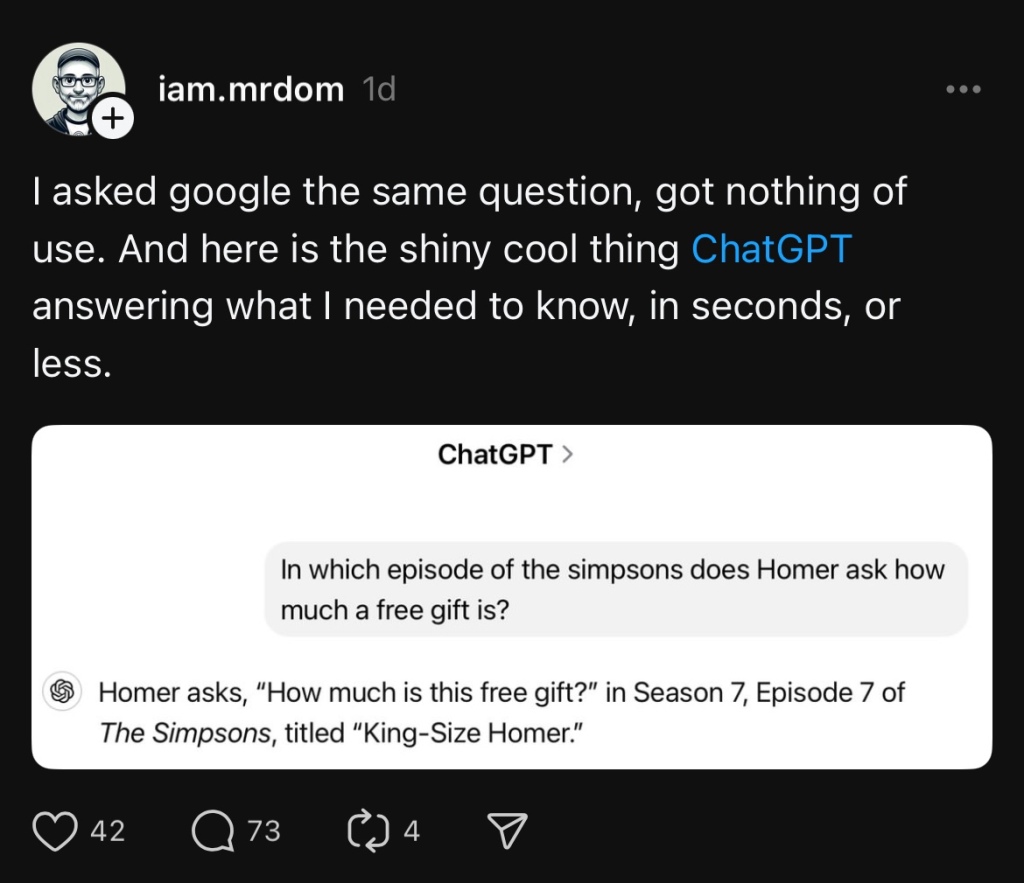
In this example ChatGPT was asked in what episode of The Simpsons did Homer Simpson ask how much is a free gift. ChatGPT confidently answered episode 7 of season 7, King Size Homer.

That episode was indeed titled King Size Homer but it’s not the episode where Homer asked the question. That episode was The Joy of Sect, season 9 episode 13 as confirmed by IMDb.

Given that a chatbot built upon a Large Language Model (LLM) would be beneficial for IMDb to have, maybe it’s just a matter of time before they build one for themselves. After all, search seems to be making way for chatbots or voice queries lately. There is however, a caveat, which I will get to in a second.

If you enter “Homer how much free gift” into YouTube’s search bar, it will give you this video as the first answer. Granted it only says the episode title, number, and season in the video description, which can easily be incorrect or even blank but cross referencing that with IMDb confirmed it’s the correct one.

If you search on Google, it may suggest to you the more accurate quote to search for which should give you the same YouTube video at or near the top of the search results. Google 1, ChatGPT 0.

Google search suggestions for “Homer how much”

ChatGPT may well be the most advanced LLM chatbot today but it’s a language model designed and trained to deliver the most grammatically or syntactically correct response according to the material it has been trained on. It is not trained to provide the correct answer to queries because it’s not meant to be a search engine or database that you submit queries to.

While ChatGPT does not verify or fact check its responses, other models may be trained to find the correct answer and infer the answer from information it comes across online.

If ChatGPT happens to provide the correct answer it’s only because the answer is contained in the training material with the relevant context which it manages to pull out. In other words correct answers are delivered by chance without verification. How many times have you realized it was lying to you and you had to ask why it gave you the wrong answer or to check whether the information it gave you is correct?

Remember last year when everyone was reporting that ChatGPT had passed the bar exam (lawyer’s exam) in the top 10%? It actually didn’t. It was more like in the top 69% to 48% depending on the peers or cohorts. The grading method was flawed.

Again, ChatGPT is not an information database but it does know how to form correct sentences, write in certain styles, translate texts, and help you with your coding. Maybe one day it may become an information database but today, with GPT 3.5, 4.0, and 4o, is not that day.

Use ChatGPT as a writing or coding assistant and you’re probably golden but you still have to play the role of an editor to make sure it gives you the correct output for you needs.

Angry Indonesian Internet Users Create Virtual Roadblocks on Google Maps in Response to Mob Murder

Indonesian internet users have flooded Google Maps with virtual roadblocks on nearly every road and street in the Sukolilo district, Pati, Central Java.

This digital protest comes in the wake of a tragic incident where a mob of local residents set fire to a rental car owner and his vehicle, resulting in his death. The victim was reportedly attempting to retrieve the car from suspected car thieves when the mob attacked. Three other men who accompanied the deceased victim were also assaulted and are in a coma in a hospital.

Several rental car business owners have come forward, revealing that they have long blacklisted rentals to individuals carrying Pati-issued identification cards due to concerns about vehicle theft. They claim that the regency is widely known within the industry as a hub for stolen motor vehicles, with many vehicles in the area lacking license plates.

Sukolilo subdistrict head Andrik Sulaksono rejected the allegations, saying the area is not a fencing hub and that it was all said by angry netizens reacting to the news of the murder.

Until recently, law enforcement authorities have reportedly taken little action in response to suspicions and public reports of vehicle theft in the region. This apparent lack of action has prompted some angry Indonesians to resort to vigilante justice.

The incident has sparked outrage among Indonesian internet users, leading to the virtual roadblock campaign on Google Maps as a form of protest and a call for increased attention to the issue of vehicle theft and the need for improved law enforcement in the area.

Police have apprehended ten suspects with evidence belonging to the victims found at their homes, and seized 27 motorcycles and 6 cars with fake registration papers, from one property.

Composite image of one neighborhood in Sukolilo showing virtual roadblocks on Google Maps on nearly every road.

Adam Mosseri further clarifies position about news on Threads

Instagram and Threads Chief Adam Mosseri posted on Threads to clarify what people perceive to be suppression of news on the platform.

I don’t believe the IG team and especially leadership are sneaky or malicious in any way but it’s difficult to see this statement and take it at face value.

Just to clarify, and this is on me for not being specific enough in my language historically, we’re not trying to avoid being a place for any news. News about sports, music, fashion, culture is something we’re actively pursuing. Political news is the topic where are looking to be more careful. Politics is already very much on threads, and that’s okay, we’re just not looking to amplify it.

He said that the kind of news (and presumably other types of discussions) they want on the platform is around sports, music, fashion, and culture. They prefer those to be driving the conversation instead of hard news or politics which are not actually banned but they want to be “more careful” about those topics, presumably, and it’s my guess, because of how sensitive and delicate they can be, not to mention Meta’s issue and history with the news media in general.

Everything in life is about politics. Sports is a battleground for political ideologies (Colin Kaepernick, anyone?), the fashion scene is a statement of political allegiances (Cate Blanchett, we see you), and music is a hotbed of political discourse (where do I even start?). As for culture, oh boy, if it’s not a political minefield then what is?

These are hot button arenas rife with debates over subjects such as race, social justice, equality, opportunity, and exploitation—topics that Meta appears to prefer to avoid. It seems Meta’s ideal platform is one of superficial harmony and feel-good aesthetics, shunning the gritty realities of societal discourse in favor of saccharine content and elaborate platitudes.

The more fundamental issue

Choosing what topics to focus on isn’t even their main problem. The Threads platform’s algorithmic approach to content curation is fundamentally flawed, prioritizing stale content and undermining the user experience.

The default ‘For You’ feed is plagued by a glaring disconnect between user expectations and delivery, as it frequently surfaces posts that are either already two days old—a virtual eon in the text-based social media space—or irrelevant and unwanted. This not only diminishes the freshness of the feed but also calls into question the platform’s understanding of ‘relevancy,’ which is intrinsically tied to the timeliness of content.

Additionally, the apparently elusive ‘Following’ feed, which offers a chronological timeline, is marred by its clunky activation and its baffling tendency to revert to the ‘For You’ feed at random. This erratic behavior disrupts the user’s control over their own social media experience, forcing them back into a loop of outdated content.

Threads says it wants to be a conversation platform but its default feed still struggles to surface timely and relevant posts. It is certainly a challenge to algorithmically deliver content that matches everyone’s unique sets of interests, and it has to be algorithmically driven if they want to ensure people don’t miss posts that they may be interested.

Clearly it’s not impossible to run a purely chronologically driven feed because Twitter did it before and Mastodon, along with its ActivityPub gang, still do, but unless you’re chronically online, the likelihood of seeing posts that are published while you’re away is small.

Without an algorithm that can be tuned to identify your interests and serve you posts that match them you’ll have to rely on other people surfacing them to you either by replying to those posts or have someone repost them and for some people that works just fine but when you run a platform with the intention of keeping as much of people’s time and attention, an algorithm is necessary.

In essence, Threads still has some ways to go to address the critical issue of recency, leaving users drowning in a sea of irrelevance. The platform’s inability to provide a consistently up-to-date and relevant feed not only frustrates users but also undermines the very purpose of social media—to connect people with what matters to them, here and now.

A text based social platform is inherently different to one that’s based on images or videos. Usage on TikTok and Instagram are driven more by entertainment value while text platforms are about what’s happening. If Meta wants Threads to be a place for conversations, let people follow their interests, not just accounts, and tune the algorithm to lean heavier on recency.

Atari acquires Intellivision

This is a headline you might have expected in the 1980s instead of 2024 but today’s Atari and Intellivison aren’t the same two companies that were bitter rivals in what many consider the first video game or console wars. They’re a few incarnations removed from that, not to mention several generations of consoles ago. In any case, this acquisition might result in some interesting interpretation of those old IPs.

This also means that the first console wars finally ended after four decades. Much longer than the Nintendo vs Sega war which lasted less than 20 years.

Wouldn’t it be fun to have those ancient games released again for today’s consoles and see how Gen Zs and Gen As handle them?

Five years of iPadOS: A Promising Start, but More Work Ahead

When Apple announced the separation of iPadOS from iOS in 2019, it felt like a watershed moment for the iPad. As someone who has been using and writing about the iPad since its inception, I was excited to see Apple acknowledging that the device deserved its own distinct operating system. The iPad had long outgrown its roots as a mere “big iPhone,” and it was time for its software to reflect that.

Key innovations and enhancements
Now, nearly five years later, iPadOS has indeed made significant strides. The Scribble feature enhances the handwriting and note taking ability of the Apple Pencil by letting people write directly on text fields which improves the text input experience. The Files app improvements have elevated the iPad’s file management capabilities, albeit not quite to desktop level. With Universal Control you can work on a Mac and an iPad simultaneously using one set of keyboard and mouse or trackpad.

Similarly, enhancements to multitasking in recent versions of iPadOS have made it easier to work with multiple apps simultaneously. Split View and Slide Over changed the way people use the iPad by allowing them to work with multiple apps much more easily. Stage Manager, though still a work in progress, takes this ability even further and shows the bigger potential of iPadOS.

On the hardware side, the debut of the M1-powered iPad made it truly a desktop computing class device allowing many other features to be unlocked or introduced. While the Smart Keyboard Folio allowed the iPad to serve as a laptop replacement for many, the Magic Keyboard which comes with a trackpad drives this even further even if it adds quite a bit of heft. Each new version gained brighter, sharper, and more precise display to deliver greater color accuracy and enhanced visual experience and specifically on the Pro line, thanks to ProMotion, True Tone, Retina XD, and P3 color gamut.

The introduction of the Pencil transformed the iPad into a robust tool for creative individuals across many fields and the new Pencil Pro only enhances that further with gyroscope support, haptic feedback, squeeze, and barrel roll capabilities. The iPad can also work with popular game controllers, by the way.

macOS on iPad is not the answer
Despite these improvements, iPadOS still has a long way to go before it can truly rival the functionality and flexibility of desktop operating systems like macOS. The file management system, for example, still feels clunky and limited compared to what’s available on a Mac. And while the multitasking features have improved, they can still feel confusing and unwieldy at times.

While there are calls for the iPad to run macOS altogether due to its clearly capable hardware systems, that’s ignoring the fact that it would take a mammoth multi-year effort to turn the macOS into not just a touch-capable platform but one that can actually feel at home with a touch interface. The macOS was never designed to be a touch-interaction system while the iPadOS was, so it would take comparably less effort to deliver enhancements to the iPadOS.

Part of the challenge lies in Apple’s own apparent uncertainty about the iPad’s role in its ecosystem. Is it meant to be a laptop replacement or a complementary device? After all, it is entirely possible to use the iPad without having a conventional computer in many use cases and situations but at the same time it still lacks a number of “desktop” system capabilities to convince people that it’s what they need as opposed to a traditional computer. On the other hand, Apple Vision Pro is looking more like the future of personal computing than the iPad now.

At the D8 All Things D Conference in 2010 the late Apple co-founder and CEO Steve Jobs likened PCs to trucks, suggesting that in the post-PC era, only a minority would need the full range of capabilities offered by conventional computers. However, perception may be the iPad’s biggest hurdle.

Is the Mac holding back the iPad?
There’s also the question of whether the recent resurgence of the Mac, driven by the success of Apple Silicon, has shifted Apple’s priorities away from the iPad. The iPad is 13 years old now but the introduction of the M1 chip brought incredible performance and efficiency to the Mac lineup, potentially leading Apple to refocus more resources on its traditional computing platform. However the company’s latest and most powerful and capable chip, the M4, debuted on the latest iPad Pro with Mac deployment of the chip still further down the line.

Regardless of the reasons behind it, iPadOS still feels like a work in progress. This is a shame because the iPad hardware has never been more powerful or capable. The M4 chip in the latest iPad Pro models is a marvel of engineering, and the Apple Pencil and Magic Keyboard add even more versatility to the device.

Maybe if they let the iPad run macOS there won’t be too many reasons left for people to buy the Macs? Although back in 2010 that was probably where the company was heading, trying to disrupt their own product before someone else does it for them. These days, though, sales of the Mac have been as strong as ever while iPad sales are not as big as they could have been.

iPad’s apps and perception problems
For the iPad to truly live up to its potential, Apple needs to continue pushing iPadOS forward. This means building on recent improvements but also thinking more boldly about what a modern tablet operating system should be capable of because with every release the iPad Pro has been the most cutting edge tablet computer on the market bar none. The hardware is always second to none while the software consistently leaves much room for criticism and improvements. Maybe it’s by design to prevent it from cutting into the Mac sales? A more robust file management system and a more streamlined multitasking interface seem to be what many people are crying for.

Additionally, Apple should strive to attract more developers to create apps optimized for the iPad’s larger screen and unique capabilities. Developers are keen to create best in class apps for the iPhone but on the iPad that enthusiasm doesn’t seem to be as high, perhaps understandably due to the significant difference in device popularity and also in complexity given the different capabilities and interface requirements carried by the iPad, and therefore the effort needed to create them.

There are apps for just about every category on the iPad. After all, the most popular apps on the iPad have been productivity or note taking apps such as Notability, Good Notes, and Microsoft Office, creative apps such as Procreate, Canva, and the Adobe suite, entertainment or streaming apps like Disney+, HBO/Max, Spotify, and Netflix, and education apps like Duolingo and Coursera. Despite this, people are still saying the iPad line doesn’t have the app they want or the apps do less than their desktop versions.

Google’s and Microsoft’s suites are examples of such apps. While their apps are popular on the iPad, people still resort to the desktop versions to be or feel more productive or to work faster and more efficiently thanks to certain missing features or capabilities, or because the workflow is different.

It’ll get there, one day

The good news is that Apple has shown a willingness to iterate and improve iPadOS over time. The past few years have brought meaningful changes to the platform, even if they haven’t always gone as far as some might have hoped. With the iPad’s hardware continuing to evolve rapidly, there’s every reason to believe that iPadOS will eventually catch up.

In the meantime, the iPad remains an incredible device for a wide range of tasks, from drawing and note-taking to video editing and music production. It may not yet be the laptop replacement some are hoping for but it remains an essential part of many people’s computing lives.

The potential is there for iPadOS to become a truly great operating system, one that fully unlocks the power and versatility of the iPad hardware. It may take longer than some of us would like but Apple will get there eventually.

Why Apple debuted the M4 on the iPad Pro instead of the Mac

I’m working on a longer piece about iPads but I just want to put this out first. Fast Company’s Harry McCracken sat down with Apple Senior Vice Presidents Greg Joswiak and John Ternus to talk about the latest iPad models that just came out this week.

I’ve been wondering why Apple decided to launch the M4 with the iPad, breaking “tradition” with previous M series chip releases. Apple did mention previously that this generation of iPad Pro wouldn’t have been possible without the M4 and there’s been plenty of dicsussions about the M4’s capabilities and significance, but for some, the M series had unofficially stood for “Mac”. It’s a high performance class chip designed to do deliver the most power but also incredibly long battery life. While it does make sense for it to eventually make it to the iPad, I didn’t expect a brand new version to debut on the iPad. It had debuted on a Mac and new versions had been showcased first on Macs, until now.

According to Joz, Apple’s engineers were able to incorporate in the M4 the capabilities they need to support the technologies they want to include in the latest iPad Pro, which was why they went with it.

That Apple is in a position to incorporate the technologies it needs into the chips it designs doesn’t just explain how it was able to build the thin, powerful iPad Pro. It’s also why the M4 is showing up first in the iPad Pro rather than a Mac: Rather than being a Mac processor repurposed for an iPad, it was conceived from the start to drive the iPad Pro’s new OLED screen.

“Our chip team was able to build that controller into the road map,” explains Joswiak. “And the place they could put it was the M4.”

This to me is a sign that Apple remains faithful to the iPad line despite years of seeming neglect in terms of the direction of the product. At some point the iPad was going to be the future of Apple’s computing, potentially replacing the Mac, at least for the masses, but with the release of Vision Pro and the resurgence of the Mac thanks to the M series chips, that plan isn’t so clear anymore. Maybe now the plan is to offer different devices for different types of consumers. I’ll get into that and more in the upcoming piece.

People are spreading unfounded rumors of Apple cancelling their investment in Indonesia

Apparently people are spreading misinformation that Apple has backed out of its Rp1.6 trillion ($100 million) investment in Indonesia and canceled plans to build a resource plant after Tim Cook’s visit to Indonesia last month, based on a clickbait headline.

First of all, that plant cancellation story was lifted from news coverage from early 2023 when an official from the Maritime Affairs and Investment Ministry claimed that Apple approached the government in 2016 about building a lead processing plant but the company reportedly said that the government must get rid of illegal mining operations and meet the company’s environmental, social, and governance guidelines. The government’s failure to comply with that request meant that plans to build the plant were shelved, the official said. That is old story, nothing about that is new. There was also no investment amount mentioned because it never came to that point.

Secondly, the $100 million investment has been spent gradually since 2018 on establishing and running three Apple Developer Academy sites with another one expected to open in Bali next year. It’s an ongoing investment as part of regulatory compliance to meet the local component requirement necessary continue selling 4G and 5G smartphones in the country. Back in 2016 Apple reportedly committed $44 million on establishing an Apple Developer Academy in the country within three years, the first of which opened in 2018.

This investment is indeed small compared to the amount of money spent by Indonesian consumers on purchasing iPhones in 2023. Figures from the Ministry of Industries revealed that out of the nearly 2.8 million smartphones imported by Indonesia last year, 85% of them had been iPhones because despite domestic manufacturing of 50 million smartphones a year, Apple’s smartphones are fully imported.

Apple supplier Pegatron was once reported to invest $1 billion to open an Apple manufacturing plant in Batam in 2019 but that report was either inaccurate or that the company drastically changed its plans in short order. While Pegatron’s consumer electronics plant did open in Batam, it has yet to manufacture Apple products to date.

Certain government officials and critics have pointed out that the amount invested by Apple in the country is minuscule in comparison, especially when other Apple products are included. Additionally, with Apple’s newly announced $250 million investment in Singapore to expand its original campus in the country and the company’s increased investment in Vietnam, where the company has spent nearly $16 billion since 2019, Apple’s Indonesian investment numbers and plans are incomparable.

It’s for this very reason that President Joko Widodo has assigned his most senior aide, Coordinating Minister for Maritime Affairs and Investments Luhut B. Panjaitan, to ensure that not only will Apple’s investment plans come to fruition but that the country can play a bigger role in Apple’s manufacturing and development operations.

In short, it’s simply not true that Apple already canceled its recently announced $100 million investment. All the commotion came about due to the conflation of a government official’s statement in early 2023 and the recently cited investment figure for Apple’s Developer Academy.

Super Apps in America might be different from the Asian ones

In this Vergecast episode they keep saying Apple doesn’t allow super apps on iOS so they won’t have to concede the market to something like WeChat which made the hardware mostly irrelevant. They also said the banks are prevented from using the payment feature directly so they have to sign a deal with Apple to use Apple Pay.

I get that it’s an American perspective but don’t publish misinformation. China’s WeChat and Southeast Asian “super” apps like Grab, Gojek, and Air Asia all work on iPhones with no problems whatsoever. We use these apps daily to book a car, a bike, order food, arrange for courier deliveries, pay for stuff, etc.

Highlighting that last part, we use these apps to pay for things. The retail finance world in Southeast Asia is probably a world away from the American one. We don’t just use our bank accounts to make payments, we often send our money to multiple digital wallets and other finance-enabled apps allowing us to pay for utility bills, insurance, car registration, installments, paylaters, and many other payments, and earn ourselves points or cash back just like credit cards.

Our shopping apps are also payment apps. Imagine using your Amazon, Uber, or Temu app to pay for your city ordinance, cable, neighborhood services, and many other bills.

Most banks and digital wallets in Southeast Asia skip Apple, Android, or Samsung Pay altogether because Android is dominant so they all adopt QR payments in their respective markets.

Right now a common QR payment is being rolled out across almost all of Southeast Asia so whichever Southeast Asian bank or wallet you use you’ll be able to use your account to pay for almost anything anywhere in the region that accepts QR payments.

I regularly use my Singaporean UOB account to pay for things like groceries and gasoline in Jakarta by scanning the QR code on the merchant terminal and it’s as seamless as using your card. Sure it’s not as fancy as tapping your phone or watch to pay for stuff but in terms of financial inclusion, it’s so much wider since cheap Android phones are on board.

There’s also no good reason why Uber and Uber Eats have to be different apps! If anything Uber is one of the few American companies that know everything about super apps because they competed with Grab and Gojek in Southeast Asia before retreating and merging their local ops with Grab. They were also in China, the original super app market.

Apple is not preventing super apps from existing or working on your phones. Is anyone even trying it in the US? It’s not Apple who’s actively preventing it, it’s the “western” digital culture, the market, it’s Americans who don’t want them. What you might prefer to have instead in the US are integrated services or features around a specific theme or category.

Like Google Maps gives you direction but also information about venues and locations including place reviews, prices, photos, opening times, transit and traffic information, and so on.

Right now Spotify is trying to be some sort of a super app by offering not just songs and lyrics and information about musicians and bands but also music videos and podcasts, and now they’re trialing online education courses in the UK.

Who knows maybe Netflix will also add education courses or classes or live sports and events aside from streaming movies, series, documentaries, and games because those are things you do on your TV.

Think of what you can do in Fortnite or Roblox already and expand that outside the narrow boundaries. I mean Fortnite and Roblox already hosted concerts, Duolingo added maths and music courses.

See what I’m getting at? The category expansions app developers are trying in the “western” markets are not all encompassing like in Asia but they grow out of a central theme.

FWIW, you can lump Instagram into this category because it’s a photo and video sharing app that has direct and group messaging, audio and video calls, online shops, and gives you information about venues and locations. Who knows what else will Meta be adding to Instagram in the near future?

X suffers from declining usage but you won’t hear that from Indonesians

NBC News has the stats from a few traffic monitoring companies showing the drop in usage and downloads of the former Twitter app.

In February, X had 27 million daily active users of its mobile app in the U.S., down 18% from a year earlier, according to Sensor Tower, a market intelligence firm based in San Francisco. The U.S. user base has been flat or down every month since November 2022, the first full month of Musk’s owning the app, and in total it’s down 23% since then, Sensor Tower said. 

The numbers were nearly as bad worldwide, as daily active users on the mobile app fell to 174 million in February, down 15% from a year earlier, the firm said. The worldwide user base has been flat or down every month during Musk’s tenure began except one, when it grew slightly in October and then resumed falling, according to Sensor Tower. 

Other social media apps experienced modest increases in their worldwide user bases during the same period, according to the research, with Snapchat growing 8.8%, Instagram 5.3%, Facebook 1.5% and TikTok 0.5%. Those apps all experienced declines over that period in the U.S., but none was as steep as the decline on X. 

X had “the most material decline in active users compared to its peers,” Abe Yousef, a senior insights analyst at Sensor Tower, wrote in a research report. 

The company also struggles to retain advertisers with 75% of the top 100 ceasing their spend on X. The kinds of ads you see on the site are now primarily cryptocurrency, AI apps, individuals promoting their own accounts, and other oddities.

While there’s no numbers shared for individual countries or markets, traffic and attention for the Indonesian market seems to remain high or at least visibly active, despite the exodus reported worldwide.

What’s happening in the US and most of the English speaking community doesn’t seem to affect the Indonesian speaking users who continue to post and have conversations on the platform.

Politics, entertainment, and daily life activities dominate the discourse in the market especially with the general election happening in February and the results only just announced on Wednesday. The local scene on X seems to remain healthy more than a year after the acquisition and just under a year after the platform was legally reestablished under X Corporation.

As the English speaking crowd slowly make their way to alternative platforms such as BlueSky, Threads, Mastodon, and other platforms on the social web, the bulk of the Indonesian crowd are mostly sticking to Instagram and TikTok in addition to X itself and major brands such as Bank Mandiri, BCA, Mitsubishi, Grab, Warner Music, and Indosat, are still buying spots on X.

There’s little to no push factor that will drive them away from the platform and no amount of pull will convince them to make a move. Unless there’s an existential threat to their presence on X or to X itself, it’s extremely unlikely for Indonesians on the platform to switch to another. The majority, especially the younger demographics, are already on TikTok and Instagram anyway because they prefer video platforms, which leaves text based alternatives a niche.

Everything is a billboard these days

Car sharing and rental company Free2Move rolled out a new advertising unit in Germany recently where they placed ad screens on the rear side windows of their cars.

On-car advertising is by no means new. For decades cabs around the world have had advertising boards or brackets installed on their trunk or the roof as a way to increase revenue. Brands have also deployed cars or other vehicles to promote their products during campaign periods, and racing cars have always sold advertising or brand placements as part of sponsorship packages.

These days even private car owners can also partner with certain advertising companies to place stickers or wraps on most parts of their cars to earn money as they drive around the city, so there’s nothing surprising or novel about placing ads on cars.

However, Free2Move, which is a Stellantis subsidiary, decided that it’s a good idea to place advertising screens on the rear windows instead of stickers or wraps. According to Reddit users, these displays don’t activate unless the car is parked or stationary, most likely to avoid breaking local laws on car safety.

It’s not difficult to imagine the thought process that went into creating this ad unit. A screen takes away the need to take the car to the shop to place or replace stickers or wraps as necessary. Depending on how the technology works, they may be able to program the ads and deploy them at will or as part of a schedule, or they can update them over the air. Any typos or errors on the ad which may escape QA stage may be fixed much more easily that printed ads.

However, screen-based ads are much more distracting, and therefore less safe. When they’re only deployed when the car is stationary, it’s much less effective than having a wrapped car drive around town because far fewer people would see the ad on the the car when they’re parked versus when they’re on the move. The ad product may be novel or innovative but the effectiveness is certainly up in the air.

Speaking of up in the air, just the other day I posted about Indonesian airlines putting up ads on the overhead compartment panels on their planes. This is not new, they’ve been doing this for so long, maybe a decade or more, and they’re not the only airlines that do this.

These ads are certainly eyesores but they do take advantage of a captive market. What are you gonna do on an airplane, not look around? I’d argue that these ads are much more effective than the window screens on Free2Move, at least when it comes to creating awareness and imprinting the brand and product on people’s minds.

Some people don’t like ads because they can be intrusive and pervasive, not to mention distracting, which they certainly are when they’re on LED panels. However, it’s nigh impossible to avoid or ignore them and in many cases ads can be informative. People love ads that entertain, that are inspirational, and they equally hate intrusive and incessant ones.

These car window ads, in my opinion, because they supposedly don’t run when the car is moving, more likely serves little purpose, even as a tech demo, because ads are all about return on investment and for advertisers, I can’t imagine the return being worth the cost or effort compared to more conventional placements.