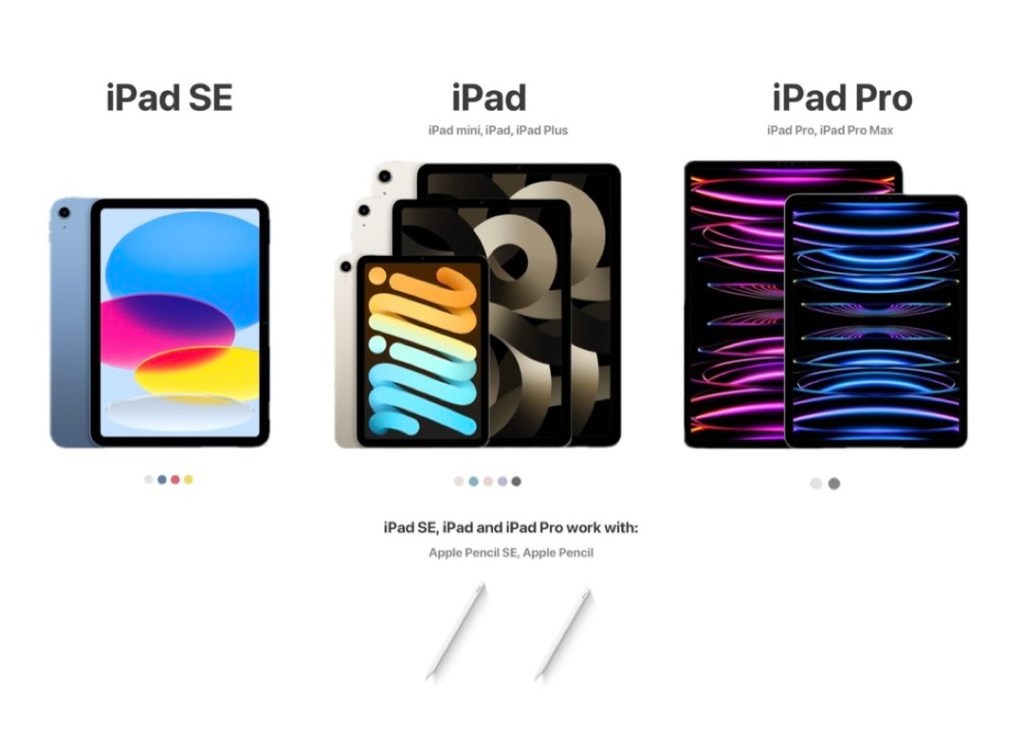
iPad line up proposal

Let’s face it, the iPad line up is a little bloated if not confusing at the moment.

You have the 9th Gen iPad which carries all of the baggage of that generation’s iPad, the 10th generation iPad which overlaps so much with the iPad Air, the iPad Air itself which has lost all meanings thanks to the 10th Gen iPad, the iPad mini which can serve whole other categories of functions due to its diminutive size, and finally the iPad Pro that comes in two sizes.

Sebastiaan de With’s proposal here tries to align the product closer to the less confusing iPhone line up. While it doesn’t change the number of models, it gets rid of the 9th Gen and the original Pencil, introduces a low end iPad and adds a Plus model to the regular range.

I can agree with that and my details would be as follows:

When Apple introduces the 11th Gen regular iPad, the 9th Gen would be gone along with the original Pencil and any other lighting iPad accessory. That clears that table.

Let the low end iPad be the previous generation model with one or two color options, no cellular, and just one storage size because it’s meant to be the most accessible iPad that also serves the education market.

The standard iPad would include the mini and the Plus, all carrying the previous generation chipsets, obviously lower tech specs compared to the Pro, no high speed charging or connector just the widely acceptable one, and a single camera.

As for TouchID vs FaceID on the regular iPads, I lean towards TouchID unless they can lower the cost on that component.

The Pro will obviously be the flagship model with all the bells and whistles.

What about the Air? Right now the Air nomenclature is just that, a nomenclature. Functionally it serves as a confusing spot on the line up because the 10th gen iPad is too close to it but it carries a previous generation Pro chipset and features. They can keep the name for the regular iPad like how they kept the MacBook Air and Pro and got rid of the vanilla MacBook. That way they can have the iPad mini, iPad Air, iPad Plus all under the “regular iPad” class.

The Pencil will have two options, regular or Pro but there will be a hard separation. Only the Pro iPads can use either Pencil models while the non Pro iPad have to stick to the regular Pencil. That takes away the customer confusion. You want Pro features, get the Pro iPad. 

Although maybe the Pro Pencil can work with the regular iPads but it just won’t have the Pro features enabled. It’ll be like a high speed charging or data cable delivering at low speed because the host or target device doesn’t support high speed.

I’m not addressing the nearly Apple Watch level overwhelming range of SKUs here because there’s going to be multiple colors, storage sizes, and cellular vs WiFi models to worry about. 

The important element is is addressing the fundamental differences between the different iPad categories. Streamlining the product range this way will present a much more coherent set of options to the consumers. 

People will have an easier time deciding which model to get especially those figuring out if they should get the 10th gen iPad, the Air, or the smaller Pro model, and retail staff won’t be tearing their hair out helping customers figure it out.

Google Photos’ New AI Tools for Pixel 8 Raise Messy Questions

The Verge raises serious journalistic questions on the legitimacy of images taken using Google’s latest phones because the AI tools in Pixel 8 are much more readily available to manipulate them from the moment they’re taken to having them saved and published.

While the AI-adjusted images may have certain markers embedded, they may not be easily detected without specific tools unless it’s an obvious visual label permanently affixed to the image.

What is a photo? Is it a snapshot of a single millisecond in time? An imprecise memory of a moment? An ideal depiction of an otherwise imperfect brief period? How much is too much manipulation?

Smartphone captures from any brand are almost entirely manipulated after all with software adjustments converging to create the best version of a snapshot, but until now, they are still generally accepted as accurate photographs of a specific moment due to the lack of meaningful deviation from the truth.

When it comes to casual personal collection of photos and videos, these adjustments don’t or won’t amount to anything too serious but for journalistic purposes, these techniques advances pose questions and challenges.

Journalism outlets have guidelines to determine what photo or footage is acceptable to be considered a true capture and the results of a typical smartphone snapshot usually don’t change anything meaningful from the actual scene, but when the definitive capture no longer represents the truth, will the media authorities need to restrict the use of certain devices?

While manipulated images have made their way to major publications undetected until it was too late, they are still relatively rare. 

Of course, photographers have always been able to manipulate situations by changing or adjusting the scene before capturing and sometimes only the presence of a witness or the existence of another image depicting the actual truth can serve as evidence of manipulation.

When the tools people use can significantly alter what was actually taken by the lens before a definitive record is made or saved into the camera’s memory, instead of after, journalism authorities and watchdogs will need to be even more vigilant.

Linda Yaccarino doesn’t have X on her Home Screen

X CEO Linda Yaccarino showing her iPhone screen to the audience at Code Conference

CEO of X doesn’t have X on her Home Screen but casually (maybe inadvertently) shows off Facebook and Instagram while on stage at Code Conference. Maybe she uses the browser, maybe it’s on the second page, maybe she’s a desktop or Tweetdeck user, doesn’t matter, successfully fumbled the optics all on her own, nevermind the interview itself.

This is why companies have PR people who deal with media or appearance briefings. Going to be a study case or example in PR circles.

Kara Swisher then posted her Home Screen in response and hilariously this set off a trend on Threads where people started showing off their home screens and discussed why they have certain apps there.

Google’s Whiteboarding App is Joining the Graveyard

Google is discontinuing its collaborative whiteboarding app, Jamboard, and will focus on third-party solutions like FigJam, Lucidspark, and Miro.

Jamboard will become read-only on October 1st, 2024, and all files will be permanently deleted by December 31st, 2024.

The company will help customers migrate to other whiteboard tools.

The Google Graveyard is probably among the largest and most occupied tech graveyards  to ever exist, with so many released products serving essentially as public experiments with no guarantee of long term commitment. Just the other day they announced the end of the Google Podcast app.

The Jamboard was quite useful and popular among education and enterprise customers but instead of committing to it and spending resources to keep iterating, the company chose to end it when customers say competitors’ products serve them better. It’s one thing to hire fast and fire fast but release fast and cancel fast is an irresponsible policy that often affects a large customer base who may have made significant financial commitments.

Why bother releasing new products when you have no long term commitment? Why would you attract customers when all you do is blink at the competition? How can anybody trust a company like this? 

AI voice detection and recognition are becoming more crucial

This Twitter thread shows how far along artificial voices have come. For those who are familiar with Steve Jobs’ voice, the voice in these recordings is almost indistinguishable from the original. When you listen to them, you can be forgiven to think that it’s actually Steve Jobs saying these words, never mind that he’s been gone for more than a decade.

The only catch is that because the training set must have been taken from the many recordings of his Apple keynote speeches and product announcements, they all sound like he’s reading from a script or making announcements. None of the sentences sound natural the way someone would speak if they were having a regular conversation or answering questions but that’s not too difficult to overcome. The tools to make adjustments to AI generated voices to sound more natural already exists.

Here’s another example. The YouTube channel Star Wars Comics have started to experiment with using generated voices to narrate some storyline’s from the Star Wars comic books to keep their audience up to date with what’s happening in the comics. In one video, they used James Earl Jones’ Darth Vader voice to say the lines in the pages of the comic book. Their latest video voiced a conversation between Emperor Palpatine and Darth Vader from another issue in the recent Darth Vader comic book series, both using the generated voices of their real actors.

As many in the comments noted, while their voices sound indistinguishable from the original, the speech patterns make it obvious that these were generated. That’s because the voices weren’t adjusted to the way a person would speak in a proper conversation given in the situation. Again, these are relatively trivial changes that one could make using their AI voice generators.

While these may be little more than fun projects for the curious minds, the day when someone can create entirely fabricated recordings to manipulate the public is already here. You can already create fake videos of a person saying things that they never actually said, now the voices sound even closer to the original.

When deepfake videos started popping up in 2020, people knew that this was going to be a significant problem. People are already easily fooled by fabricated articles or stories and this is just going to make it far more challenging for people to fact check and verify the validity of recordings.

All I can say for that is, brace for impact.

zerohski:

Ngl this was way funnier in my head

(If you like my work consider reblogging ty <3)

Today I learned of the existence of the word bumbershoot

Been saying for a while that ASEAN is a largely irrelevant organization of geographically adjacent nations that share very little common interest and barely a common goal. 

Anwar is probably the first regional leader to implicitly admit its irrelevance while Indonesia has always been a champion of ASEAN’s appearance of a united front made up of human rights violators and corrupt governments who are careful not to offend each other out of fear that their own dirty laundry become exposed and openly addressed.

As long as this sorry excuse of an organization can’t even resolve a conflict within its own member state decisively, it will never be the substantial economic and political union it has always wished or pretended to be.

It’s always upsetting seeing a StarTrek show ending whether by its own accord or by executive order but when it’s ordered, it doesn’t get to conclude on its own terms no matter how much time they give it. 

Discovery hasn’t been the best among all Treks and even breaks the mold of what a Trek show is especially given how frequently it’s centered and dependent on Michael Burnham saving the day. What it does have though, are some of the boldest story tellings in the franchise and really going to new places and opening up far more possibilities. 

Would have loved to see it go six or seven seasons with Burnham as captain in a rebuild of the Federation in the 32nd century and all the storylines and conflicts that would have gone along with it. Maybe we’ll still get to see it in season 5 but just one season of that, and only ten episodes, it’s going to come in very compact and rushed.

I have two posts on Netflix Indonesia’s price drop, one written by myself, the other by ChatGPT. It was a fun exercise in seeing how different the pieces would turn out. ChatGPT took a very general analysis view on the subject matter while I dug deeper on the reasons and give more business and competitive context to the readers. Let me know what you think of both.